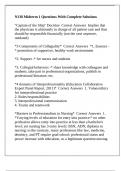
***N138 Midterm Questions With Complete Solutions
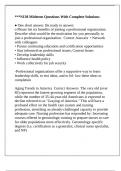
● One short answer. Be ready to answer:
o Please list six benefits of joining a professional organization.
Describe what would be the motivation for you personally to
join a professional organization. Correct Answers • Network
with colleagues
• Pursue continuing education and certification opportunities
• Stay informed on professional issues; Current Issues
• Develop leadership skills
• Influence health policy
• Work collectively for job security
-Professional organizations offer a supportive way to learn
leadership skills, to test ideas, and to fol- low these ideas to
completion
Aging Trends in America Correct Answers The very old (over
85) represent the fastest-growing segment of the population,
while the number of 35-44-year-old Americans is expected to
decline referred to as "Graying of America." This will have a
profound effect on the health care system and nursing
profession, stretching an already-challenged capacity to provide
adequate care. Nursing profession has responded by: Increasing
courses offered in gerontologic nursing to prepare nurses to care
for older populations more effectively. Gerontology-specific
degrees (i.e. certification as a generalist, clinical nurse specialist,
and NP)
,Basic provisions of the Affordable Care Act Correct Answers
○ Health insurers could no longer set lifetime limits on
insurance coverage
○ Young adults could be covered on their parents insurance until
age 26, unless they are offered insurance coverage at work
○ Could not deny coverage to a person younger than 19 because
of a pre-existing condition
○ Coverage of recommended preventive services with no out of
pocket expenses for insurance holders, the right to appeal
coverage decisions and having a choice of primary care
providers
○ Persons with preexisting conditions could not be denied
coverage
○ Have choice of primary care
Benner's five stages of nursing proficiency: Novice, Advanced
Beginner, Competent, Proficient, Expert. Correct Answers o
*Novice (stage 1)-* has little background and limited practical
skills; relies on rules and expectations of others for direction
▪ Nursing students
o *Advanced beginner (stage 2)* - has marginally competent
skills; uses theory and principles much of the time; experiences
difficulty establishing priorities
▪ Thinks they know what they're doing, may be making
assumptions and rushing into things too quickly
, o *Competent practitioner (stage 3)* - Feels competent,
organized; plans and sets goals; thinks abstractly and
analytically; coordinates several tasks simultaneously
▪ Usually have 2-3 years experience in a setting
o *Proficient practitioner (stage 4)* views patients holistically,
recognizes subtle changes; sets priorities with ease; focuses on
long term goals
▪ Typically have been in practice 3-5 years
o *Expert practitioner (stage 5)*- performs fluidly; grasps
patient needs automatically; responses are integrated; expertise
comes naturally
▪ Reached only after extensive practice experience. 5-10 years
down the road
Define ethnocentrism Correct Answers Ethnocentrism -
inclination to view one's own cultural group as the standard by
which to judge the value of other cultural groups
Describe some internal influences on internal behaviors Correct
Answers o Personality characteristics are internal variable that
determine how one manages illness:
▪ *Dependence and independence*
● Dependence: rely on others to take care of them
● Independence: patients in this state need assistance in
recognizing limitations and using available resources to meet
needs
▪ *Coping ability*
● One short answer. Be ready to answer:
o Please list six benefits of joining a professional organization.
Describe what would be the motivation for you personally to
join a professional organization. Correct Answers • Network
with colleagues
• Pursue continuing education and certification opportunities
• Stay informed on professional issues; Current Issues
• Develop leadership skills
• Influence health policy
• Work collectively for job security
-Professional organizations offer a supportive way to learn
leadership skills, to test ideas, and to fol- low these ideas to
completion
Aging Trends in America Correct Answers The very old (over
85) represent the fastest-growing segment of the population,
while the number of 35-44-year-old Americans is expected to
decline referred to as "Graying of America." This will have a
profound effect on the health care system and nursing
profession, stretching an already-challenged capacity to provide
adequate care. Nursing profession has responded by: Increasing
courses offered in gerontologic nursing to prepare nurses to care
for older populations more effectively. Gerontology-specific
degrees (i.e. certification as a generalist, clinical nurse specialist,
and NP)
,Basic provisions of the Affordable Care Act Correct Answers
○ Health insurers could no longer set lifetime limits on
insurance coverage
○ Young adults could be covered on their parents insurance until
age 26, unless they are offered insurance coverage at work
○ Could not deny coverage to a person younger than 19 because
of a pre-existing condition
○ Coverage of recommended preventive services with no out of
pocket expenses for insurance holders, the right to appeal
coverage decisions and having a choice of primary care
providers
○ Persons with preexisting conditions could not be denied
coverage
○ Have choice of primary care
Benner's five stages of nursing proficiency: Novice, Advanced
Beginner, Competent, Proficient, Expert. Correct Answers o
*Novice (stage 1)-* has little background and limited practical
skills; relies on rules and expectations of others for direction
▪ Nursing students
o *Advanced beginner (stage 2)* - has marginally competent
skills; uses theory and principles much of the time; experiences
difficulty establishing priorities
▪ Thinks they know what they're doing, may be making
assumptions and rushing into things too quickly
, o *Competent practitioner (stage 3)* - Feels competent,
organized; plans and sets goals; thinks abstractly and
analytically; coordinates several tasks simultaneously
▪ Usually have 2-3 years experience in a setting
o *Proficient practitioner (stage 4)* views patients holistically,
recognizes subtle changes; sets priorities with ease; focuses on
long term goals
▪ Typically have been in practice 3-5 years
o *Expert practitioner (stage 5)*- performs fluidly; grasps
patient needs automatically; responses are integrated; expertise
comes naturally
▪ Reached only after extensive practice experience. 5-10 years
down the road
Define ethnocentrism Correct Answers Ethnocentrism -
inclination to view one's own cultural group as the standard by
which to judge the value of other cultural groups
Describe some internal influences on internal behaviors Correct
Answers o Personality characteristics are internal variable that
determine how one manages illness:
▪ *Dependence and independence*
● Dependence: rely on others to take care of them
● Independence: patients in this state need assistance in
recognizing limitations and using available resources to meet
needs
▪ *Coping ability*