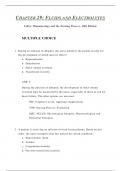
C HAPTER 29: F LUIDS AND E LECTROLYTES
Lilley: Pharmacology and the Nursing Proces s, 10th Edition
MULTIPLE CHOICE
1. During an infusion of albumin, the nurse monitors the patient closel y for
the development of which adverse effect?
a. Hypernatremia
b. Dehydration
c. Fluid volume overload
d. Transfusion reaction
ANS: C
During the infusion of albumin, the development of fluid volume
overload must be monitored by the nurse, especiall y in those at risk for
heart failure. The other options are incorrect.
DIF: Cognitive Level: Appl ying (Application)
TOP: Nursing Process: Evaluation
MSC: NC LEX: Physiological Integrit y: Pharmacological and
Parenteral Therapies
2. A patient is receiving an infusion of fresh frozen plasma. Based on this
order, the nurse interprets that this patient has which condition?
a. Hypovolemic shock
b. Anemia
c. Coagulation disorder
d. Previous transfusion reaction
, ANS: C
Fresh frozen plasma is used as an adjunct to massive blood transfusion
in the treatment of patients with underl ying coagulation disorders. The
other options are not indications for fresh frozen plasma.
DIF: Cognitive Level: Understanding (Comprehension)
TOP: Nursing Process: Assessment
MSC: NC LEX: Physiological Integrit y: Pharmacological and
Parenteral Therapies
3. The nurse is preparing to transfuse a patient with a unit of packed red
blood cells. Which intravenous solution is correct for use with the PRBC
transfusion?
a. 5% dextrose in water (D5W)
b. 0.9% sodium chloride (NS)
c. 5% dextrose in 0.45% sodium chloride (D5NS)
d. 5% dextrose in lactated Ringer ’s solution (D5LR)
ANS: B
Blood products should be given onl y with norma l saline 0.9% because
D5W will also cause hemol ysis of the blood product.
DIF: Cognitive Level: Appl ying (Application)
TOP: Nursing Process: Implementation
MSC: NC LEX: Safe and Effective Care Environment:
Management of Care
4. The nurse is preparing to trans fuse a patient with a unit of packed red
blood cells. Which patient would be best treated with this transfusion?
a. A patient with a coagulation disorder
b. A patient with severe anemia
Lilley: Pharmacology and the Nursing Proces s, 10th Edition
MULTIPLE CHOICE
1. During an infusion of albumin, the nurse monitors the patient closel y for
the development of which adverse effect?
a. Hypernatremia
b. Dehydration
c. Fluid volume overload
d. Transfusion reaction
ANS: C
During the infusion of albumin, the development of fluid volume
overload must be monitored by the nurse, especiall y in those at risk for
heart failure. The other options are incorrect.
DIF: Cognitive Level: Appl ying (Application)
TOP: Nursing Process: Evaluation
MSC: NC LEX: Physiological Integrit y: Pharmacological and
Parenteral Therapies
2. A patient is receiving an infusion of fresh frozen plasma. Based on this
order, the nurse interprets that this patient has which condition?
a. Hypovolemic shock
b. Anemia
c. Coagulation disorder
d. Previous transfusion reaction
, ANS: C
Fresh frozen plasma is used as an adjunct to massive blood transfusion
in the treatment of patients with underl ying coagulation disorders. The
other options are not indications for fresh frozen plasma.
DIF: Cognitive Level: Understanding (Comprehension)
TOP: Nursing Process: Assessment
MSC: NC LEX: Physiological Integrit y: Pharmacological and
Parenteral Therapies
3. The nurse is preparing to transfuse a patient with a unit of packed red
blood cells. Which intravenous solution is correct for use with the PRBC
transfusion?
a. 5% dextrose in water (D5W)
b. 0.9% sodium chloride (NS)
c. 5% dextrose in 0.45% sodium chloride (D5NS)
d. 5% dextrose in lactated Ringer ’s solution (D5LR)
ANS: B
Blood products should be given onl y with norma l saline 0.9% because
D5W will also cause hemol ysis of the blood product.
DIF: Cognitive Level: Appl ying (Application)
TOP: Nursing Process: Implementation
MSC: NC LEX: Safe and Effective Care Environment:
Management of Care
4. The nurse is preparing to trans fuse a patient with a unit of packed red
blood cells. Which patient would be best treated with this transfusion?
a. A patient with a coagulation disorder
b. A patient with severe anemia