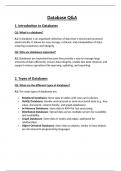
Database Q&A
1. Introduction to Databases
Q1: What is a database?
A1: A database is an organized collection of data that is stored and accessed
electronically. It allows for easy storage, retrieval, and manipulation of data,
ensuring consistency and integrity.
Q2: Why are databases important?
A2: Databases are important because they provide a way to manage large
amounts of data efficiently, ensure data integrity, enable fast data retrieval, and
support various operations like querying, updating, and reporting.
2. Types of Databases
Q3: What are the different types of databases?
A3: The main types of databases are:
Relational Databases: Store data in tables with rows and columns.
NoSQL Databases: Handle unstructured or semi-structured data (e.g., key-
value, document, column-family, and graph databases).
In-Memory Databases: Store data in RAM for fast processing.
Distributed Databases: Spread data across multiple servers for scalability
and availability.
Graph Databases: Store data in nodes and edges, optimized for
relationships.
Object-Oriented Databases: Store data as objects, similar to how objects
are structured in programming languages.
, Q4: What is the difference between SQL and NoSQL databases?
A4: SQL databases are structured and use tables with predefined schemas and
relationships. They support complex queries and transactions (e.g., MySQL,
PostgreSQL). NoSQL databases are designed for unstructured or semi-structured
data and support flexible data models, offering better scalability (e.g., MongoDB,
Cassandra).
3. DBMS (Database Management System)
Q5: What is a DBMS?
A5: A Database Management System (DBMS) is software that manages and
controls access to databases. It facilitates data storage, retrieval, manipulation,
and ensures data integrity, security, and concurrency control.
Q6: What are the different types of DBMS?
A6: The main types of DBMS are:
Hierarchical DBMS: Organizes data in a tree structure (e.g., IBM IMS).
Network DBMS: Organizes data using a graph structure (e.g., Integrated
Data Store).
Relational DBMS: Organizes data in tables and uses SQL (e.g., MySQL,
Oracle).
Object-Oriented DBMS: Stores data as objects (e.g., db4o).
NoSQL DBMS: Designed for unstructured data (e.g., MongoDB, Cassandra).
4. Database Operations
Q7: What are CRUD operations?
A7: CRUD stands for:
Create: Add new data to the database.
1. Introduction to Databases
Q1: What is a database?
A1: A database is an organized collection of data that is stored and accessed
electronically. It allows for easy storage, retrieval, and manipulation of data,
ensuring consistency and integrity.
Q2: Why are databases important?
A2: Databases are important because they provide a way to manage large
amounts of data efficiently, ensure data integrity, enable fast data retrieval, and
support various operations like querying, updating, and reporting.
2. Types of Databases
Q3: What are the different types of databases?
A3: The main types of databases are:
Relational Databases: Store data in tables with rows and columns.
NoSQL Databases: Handle unstructured or semi-structured data (e.g., key-
value, document, column-family, and graph databases).
In-Memory Databases: Store data in RAM for fast processing.
Distributed Databases: Spread data across multiple servers for scalability
and availability.
Graph Databases: Store data in nodes and edges, optimized for
relationships.
Object-Oriented Databases: Store data as objects, similar to how objects
are structured in programming languages.
, Q4: What is the difference between SQL and NoSQL databases?
A4: SQL databases are structured and use tables with predefined schemas and
relationships. They support complex queries and transactions (e.g., MySQL,
PostgreSQL). NoSQL databases are designed for unstructured or semi-structured
data and support flexible data models, offering better scalability (e.g., MongoDB,
Cassandra).
3. DBMS (Database Management System)
Q5: What is a DBMS?
A5: A Database Management System (DBMS) is software that manages and
controls access to databases. It facilitates data storage, retrieval, manipulation,
and ensures data integrity, security, and concurrency control.
Q6: What are the different types of DBMS?
A6: The main types of DBMS are:
Hierarchical DBMS: Organizes data in a tree structure (e.g., IBM IMS).
Network DBMS: Organizes data using a graph structure (e.g., Integrated
Data Store).
Relational DBMS: Organizes data in tables and uses SQL (e.g., MySQL,
Oracle).
Object-Oriented DBMS: Stores data as objects (e.g., db4o).
NoSQL DBMS: Designed for unstructured data (e.g., MongoDB, Cassandra).
4. Database Operations
Q7: What are CRUD operations?
A7: CRUD stands for:
Create: Add new data to the database.