N138: Test #1 Study Guide Questions With Complete
Solutions
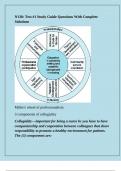
Miller's wheel of professionalism
3 components of collegiality
Collegiality—important for being a nurse bc you have to have
companionship and cooperation between colleagues that share
responsibility to promote a healthy environment for patients.
The (3) components are:
,Essence: Promotion of a supportive and healthy work
environment (cooperation and recognition of interdependence
among member of the nursing profession)
Support: Nurses and students (Sharing with supporting,
assisting and counseling other nurses and nursing students)
Collegial Behaviors
5 barriers to professionalism
Gender Issues: somebody might be thinking of things like to
stereotype someone.
Historical Influences:
External Conflicts: if there are many disagreements on the way
we do things and varying education. We work with ppl who are
coming from different backgrounds and different educational
attainment
Internal Conflicts: where maybe we have our own perception of
things based on the way we were taught or the way we were
trained
Varying Levels of Education for Entry into Practice
Utley-Smith Article
Returning to school syndrome model (3 stages)
, Honeymoon:
Can last from few hours to many months
Positive, sense of satisfaction, optimistic outlook
Conflict
Turbulent negative emotions begin to surface. Feelings of
inadequacy due to not trusting previous experiences and
knowledge in determining appropriate responses in nursing.
May be associated with student depression, bursts of anger,
helplessness, academic difficulties, insecurity, sadness, and
lethargy.
Reintegration
Multiphasic
Begins with strong rejection of new culture, but leads to positive
resolution through biculturalism.
Unfortunate alternatives: false acceptance
Schumacher and Meleis: Transitions
Types of transitions (3):
· Developmental
o Ex: transition to parenthood
· Situational
o Ex: educational and professional roles, immigration,
homelessness, near-death experiences
· Health-illness
o Ex: from tube feeding to oral nutrition as a transition in the
process of rehabilitation
Organizational Transitions
Solutions
Miller's wheel of professionalism
3 components of collegiality
Collegiality—important for being a nurse bc you have to have
companionship and cooperation between colleagues that share
responsibility to promote a healthy environment for patients.
The (3) components are:
,Essence: Promotion of a supportive and healthy work
environment (cooperation and recognition of interdependence
among member of the nursing profession)
Support: Nurses and students (Sharing with supporting,
assisting and counseling other nurses and nursing students)
Collegial Behaviors
5 barriers to professionalism
Gender Issues: somebody might be thinking of things like to
stereotype someone.
Historical Influences:
External Conflicts: if there are many disagreements on the way
we do things and varying education. We work with ppl who are
coming from different backgrounds and different educational
attainment
Internal Conflicts: where maybe we have our own perception of
things based on the way we were taught or the way we were
trained
Varying Levels of Education for Entry into Practice
Utley-Smith Article
Returning to school syndrome model (3 stages)
, Honeymoon:
Can last from few hours to many months
Positive, sense of satisfaction, optimistic outlook
Conflict
Turbulent negative emotions begin to surface. Feelings of
inadequacy due to not trusting previous experiences and
knowledge in determining appropriate responses in nursing.
May be associated with student depression, bursts of anger,
helplessness, academic difficulties, insecurity, sadness, and
lethargy.
Reintegration
Multiphasic
Begins with strong rejection of new culture, but leads to positive
resolution through biculturalism.
Unfortunate alternatives: false acceptance
Schumacher and Meleis: Transitions
Types of transitions (3):
· Developmental
o Ex: transition to parenthood
· Situational
o Ex: educational and professional roles, immigration,
homelessness, near-death experiences
· Health-illness
o Ex: from tube feeding to oral nutrition as a transition in the
process of rehabilitation
Organizational Transitions