Applications of Linked Lists
Linked lists are widely used in various computer science and programming
scenarios due to their efficient memory management and flexibility in dynamic
data storage. Below are some of the most common applications of linked lists.
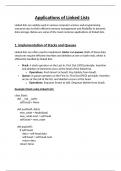
1. Implementation of Stacks and Queues
Linked lists are often used to implement stacks and queues. Both of these data
structures require efficient insertion and deletion at one or both ends, which is
efficiently handled by linked lists.
Stack: A stack operates on the Last In, First Out (LIFO) principle. Insertion
and deletion of elements occur at the head of the linked list.
o Operations: Push (insert at head), Pop (delete from head).
Queue: A queue operates on the First In, First Out (FIFO) principle. Insertion
occurs at the tail of the list, and deletion occurs at the head.
o Operations: Enqueue (insert at tail), Dequeue (delete from head).
Example (Stack using Linked List):
class Stack:
def __init__(self):
self.head = None
def push(self, data):
new_node = Node(data)
new_node.next = self.head
self.head = new_node
def pop(self):
if self.head:
data = self.head.data
self.head = self.head.next
return data
return None
, Example (Queue using Linked List):
class Queue:
def __init__(self):
self.head = None
self.tail = None
def enqueue(self, data):
new_node = Node(data)
if not self.tail:
self.head = self.tail = new_node
else:
self.tail.next = new_node
self.tail = new_node
def dequeue(self):
if not self.head:
return None
data = self.head.data
self.head = self.head.next
if not self.head:
self.tail = None
return data
2. Graph Representation (Adjacency List)
In graph theory, a graph can be represented using adjacency lists, which is
essentially a collection of linked lists. Each node in the graph corresponds to a
linked list where the neighbors of that node are stored.
Directed and Undirected Graphs: Each node points to other nodes through
edges.
Space Efficiency: An adjacency list is more space-efficient than an
adjacency matrix, especially for sparse graphs.
Linked lists are widely used in various computer science and programming
scenarios due to their efficient memory management and flexibility in dynamic
data storage. Below are some of the most common applications of linked lists.
1. Implementation of Stacks and Queues
Linked lists are often used to implement stacks and queues. Both of these data
structures require efficient insertion and deletion at one or both ends, which is
efficiently handled by linked lists.
Stack: A stack operates on the Last In, First Out (LIFO) principle. Insertion
and deletion of elements occur at the head of the linked list.
o Operations: Push (insert at head), Pop (delete from head).
Queue: A queue operates on the First In, First Out (FIFO) principle. Insertion
occurs at the tail of the list, and deletion occurs at the head.
o Operations: Enqueue (insert at tail), Dequeue (delete from head).
Example (Stack using Linked List):
class Stack:
def __init__(self):
self.head = None
def push(self, data):
new_node = Node(data)
new_node.next = self.head
self.head = new_node
def pop(self):
if self.head:
data = self.head.data
self.head = self.head.next
return data
return None
, Example (Queue using Linked List):
class Queue:
def __init__(self):
self.head = None
self.tail = None
def enqueue(self, data):
new_node = Node(data)
if not self.tail:
self.head = self.tail = new_node
else:
self.tail.next = new_node
self.tail = new_node
def dequeue(self):
if not self.head:
return None
data = self.head.data
self.head = self.head.next
if not self.head:
self.tail = None
return data
2. Graph Representation (Adjacency List)
In graph theory, a graph can be represented using adjacency lists, which is
essentially a collection of linked lists. Each node in the graph corresponds to a
linked list where the neighbors of that node are stored.
Directed and Undirected Graphs: Each node points to other nodes through
edges.
Space Efficiency: An adjacency list is more space-efficient than an
adjacency matrix, especially for sparse graphs.