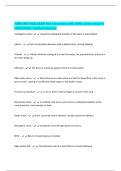
HCAD 5301 Questions and Right Answers
Rate A+
Healthcare organization (HCO) - ✅✅ A corporation providing the services of
multiple patient care teams, such as a hospital or clinic, supporting care providers
with clinical, logistic, and strategic services.
Mission - ✅✅ The central purpose of an organization; its reason for existence.
Population health - ✅✅ The health of a defined group of individuals, such as a
state or civil division, or insured group, measured by the incidence and prevalence
of disease or infirmity.
Benchmark - ✅✅ The best performance on a specific measure of which the
organization is aware. A realistic comparison—a value that a similar
Organization has achieved
Incidence - ✅✅ Incidence is the number of newly diagnosed cases of a disease.
An incidence rate is the number of new cases of a disease divided by the number of
persons at risk for the disease. If, over the course of one year, five women are
diagnosed with breast cancer out of a total female study population of 200 who do
not have breast cancer at the beginning of the study period, then we would say the
incidence of breast cancer in this population was 0.025 (or 2,500 per 100,000
women-years of study)
Prevalence - ✅✅ Prevalence is "the total number of cases of disease existing in a
population. A prevalence rate is the total number of cases of a disease existing in a
population divided by the total population. So, if a measurement of cancer is taken
in a population of 40,000 people and the result is that 1,200 were recently
diagnosed with cancer and 3,500 are living with cancer, then the prevalence of
cancer" is
(1,200 + 3,500) ÷ 40,000 = 0.118 (or 11,750 per 100,000 persons).
Best practices - ✅✅ Work processes that have been proven to achieve
benchmark.
, Licensed independent practitioner (LIP) - ✅✅ "Any practitioner permitted by
law and by the [HCO] to provide care and services, without direction or
supervision."
Credentials - ✅✅ Documented evidence of licensure, education, training,
experience, or other qualifications; used to assign specific care privileges to an
LIP, consistent with the scope of their license and assigned clinical responsibilities
Stakeholders - ✅✅ Individuals or groups who have a direct interest in the
organization's success.
Opportunities for improvement (ofis) - ✅✅ Any situation where current
performance is inferior to benchmark. Excellent hcos seek and resolve ofis,
creating an environment where improvement is a central part of the culture.
Patient-centered care - ✅✅ Care that is respectful and responsive to individual
patient preferences, needs, and values
Associates - ✅✅ People (employees, trustees and other volunteers, medical staff
members, and agents of contract suppliers) who give their time and energy to the
HCO and its activities.
Value-based insurance design - ✅✅ Linking financial incentives to the quality
and efficiency of care provided.
Certificate of need - ✅✅ Approval for new services and construction, expansion,
or renovation of hospitals or related facilities; issued in many states
Health Insurance Portability and Accountability Act - ✅✅ Federal law that
addresses issues of health insurance but also requires hcos and their workers to
protect patient information and confidentiality diligently.
Emergency Treatment and Labor Act - ✅✅ Federal act requiring all hcos that
provide emergency care to accept all patients, regardless of ability to pay, until the
patients are stabilized and can be safely moved.
Community benefit - ✅✅ Services provided gratis by hcos to their surrounding
communities. Current law requires hospitals to satisfy a community benefit
standard to qualify as tax-exempt charities under section 501(c)(3) of the Internal
Rate A+
Healthcare organization (HCO) - ✅✅ A corporation providing the services of
multiple patient care teams, such as a hospital or clinic, supporting care providers
with clinical, logistic, and strategic services.
Mission - ✅✅ The central purpose of an organization; its reason for existence.
Population health - ✅✅ The health of a defined group of individuals, such as a
state or civil division, or insured group, measured by the incidence and prevalence
of disease or infirmity.
Benchmark - ✅✅ The best performance on a specific measure of which the
organization is aware. A realistic comparison—a value that a similar
Organization has achieved
Incidence - ✅✅ Incidence is the number of newly diagnosed cases of a disease.
An incidence rate is the number of new cases of a disease divided by the number of
persons at risk for the disease. If, over the course of one year, five women are
diagnosed with breast cancer out of a total female study population of 200 who do
not have breast cancer at the beginning of the study period, then we would say the
incidence of breast cancer in this population was 0.025 (or 2,500 per 100,000
women-years of study)
Prevalence - ✅✅ Prevalence is "the total number of cases of disease existing in a
population. A prevalence rate is the total number of cases of a disease existing in a
population divided by the total population. So, if a measurement of cancer is taken
in a population of 40,000 people and the result is that 1,200 were recently
diagnosed with cancer and 3,500 are living with cancer, then the prevalence of
cancer" is
(1,200 + 3,500) ÷ 40,000 = 0.118 (or 11,750 per 100,000 persons).
Best practices - ✅✅ Work processes that have been proven to achieve
benchmark.
, Licensed independent practitioner (LIP) - ✅✅ "Any practitioner permitted by
law and by the [HCO] to provide care and services, without direction or
supervision."
Credentials - ✅✅ Documented evidence of licensure, education, training,
experience, or other qualifications; used to assign specific care privileges to an
LIP, consistent with the scope of their license and assigned clinical responsibilities
Stakeholders - ✅✅ Individuals or groups who have a direct interest in the
organization's success.
Opportunities for improvement (ofis) - ✅✅ Any situation where current
performance is inferior to benchmark. Excellent hcos seek and resolve ofis,
creating an environment where improvement is a central part of the culture.
Patient-centered care - ✅✅ Care that is respectful and responsive to individual
patient preferences, needs, and values
Associates - ✅✅ People (employees, trustees and other volunteers, medical staff
members, and agents of contract suppliers) who give their time and energy to the
HCO and its activities.
Value-based insurance design - ✅✅ Linking financial incentives to the quality
and efficiency of care provided.
Certificate of need - ✅✅ Approval for new services and construction, expansion,
or renovation of hospitals or related facilities; issued in many states
Health Insurance Portability and Accountability Act - ✅✅ Federal law that
addresses issues of health insurance but also requires hcos and their workers to
protect patient information and confidentiality diligently.
Emergency Treatment and Labor Act - ✅✅ Federal act requiring all hcos that
provide emergency care to accept all patients, regardless of ability to pay, until the
patients are stabilized and can be safely moved.
Community benefit - ✅✅ Services provided gratis by hcos to their surrounding
communities. Current law requires hospitals to satisfy a community benefit
standard to qualify as tax-exempt charities under section 501(c)(3) of the Internal