1. Fundamental Equations and Conversion Factors
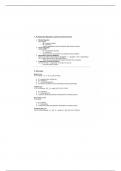
● Dilution Equation
M1V1=M2V2
○ M = molarity (moles/L)
○ V = volume (L)
○ Used to calculate the final concentration after diluting a solution.
● Titration Equation
CAVA=CBVB
○ C = concentration (moles/L)
○ V = volume (L)
○ Used to find the concentration of a substance during a titration.
● Atmospheric Pressure Relations
Patm=1 atm=760 mmHg=760 torrP_{\text{atm}} = 1 \, \text{atm} = 760 \, \text{mmHg} =
760 \, \text{torr}Patm=1atm=760mmHg=760torr
○ These are exact equivalences between different units of pressure.
● Temperature Conversion (Kelvin)
K=T°C+273.15K = T_{\text{°C}} + 273.15K=T°C+273.15
○ Converts Celsius to Kelvin.
2. Gas Laws
Boyle’s Law
P1V1=P2V2P_1 V_1 = P_2 V_2P1V1=P2V2
● P = pressure (atm, mmHg, etc.)
● V = volume (L)
● T = constant temperature
● As pressure increases, volume decreases (inversely proportional).
Charles’ Law
V1T1=V2T2\frac{V_1}{T_1} = \frac{V_2}{T_2}T1V1=T2V2
● V = volume (L)
● T = temperature (K)
● Volume is directly proportional to temperature at constant pressure.
Gay-Lussac’s Law
P1T1=P2T2
● P = pressure
● T = temperature
● Pressure is directly proportional to temperature at constant volume.
Combined Gas Law
P1V1T1=P2V2T2\frac{P_1 V_1}{T_1} = \frac{P_2 V_2}{T_2}T1P1V1=T2P2V2
● Dilution Equation
M1V1=M2V2
○ M = molarity (moles/L)
○ V = volume (L)
○ Used to calculate the final concentration after diluting a solution.
● Titration Equation
CAVA=CBVB
○ C = concentration (moles/L)
○ V = volume (L)
○ Used to find the concentration of a substance during a titration.
● Atmospheric Pressure Relations
Patm=1 atm=760 mmHg=760 torrP_{\text{atm}} = 1 \, \text{atm} = 760 \, \text{mmHg} =
760 \, \text{torr}Patm=1atm=760mmHg=760torr
○ These are exact equivalences between different units of pressure.
● Temperature Conversion (Kelvin)
K=T°C+273.15K = T_{\text{°C}} + 273.15K=T°C+273.15
○ Converts Celsius to Kelvin.
2. Gas Laws
Boyle’s Law
P1V1=P2V2P_1 V_1 = P_2 V_2P1V1=P2V2
● P = pressure (atm, mmHg, etc.)
● V = volume (L)
● T = constant temperature
● As pressure increases, volume decreases (inversely proportional).
Charles’ Law
V1T1=V2T2\frac{V_1}{T_1} = \frac{V_2}{T_2}T1V1=T2V2
● V = volume (L)
● T = temperature (K)
● Volume is directly proportional to temperature at constant pressure.
Gay-Lussac’s Law
P1T1=P2T2
● P = pressure
● T = temperature
● Pressure is directly proportional to temperature at constant volume.
Combined Gas Law
P1V1T1=P2V2T2\frac{P_1 V_1}{T_1} = \frac{P_2 V_2}{T_2}T1P1V1=T2P2V2