FINAL STUDY GUIDE EXAM: NR569
DIFFERENTIAL DIAGNOSIS IN
ACUTE CARE, 2025/2026 WITH
CORRECT/ACCURATE ANSWERS
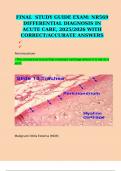
Perichondrium
- The connective tissue that envelops cartilage where it is not at a
joint.
Malignant Otitis Externa (MOE)
,- Necrotizing external otitis. Symptoms include severe otalgia and
otorrhea with unresponsiveness to treatment. Pain is worse at
night and with chewing,
- Risk factors: Age, Diabetes Mellitus, and being
immunocompromised.
Treatment for Acute Otitis Externa (AOE)
- Topical antibiotics are the treatment of choice for AOE, with or
without steroids.
- Topical antibiotics are the preferred therapy because a higher
concentration of the antimicrobial can be delivered to the infected
tissue that systemic antibiotics.
- An ear wick may be inserted in the ear to facilitate installation of
antibiotic drops in a tight canal.
- Systemic antibiotics are NOT indicated unless the patient also
has a co-existing AOM infection.
Acute Otitis Media
,- An acute, suppurative infectious process marked by the
presence of infected middle ear fluid and inflammation of the
mucosa lining the middle ear space. The infection is most
frequently precipitated by impaired function of the Eustachian
tube, resulting in the retention and suppuration of retained of
retained secretions. AOM may be associated with purulent
otorrhea if there is a ruptured tympanic membrane. AOM usually
responds promptly to antimicrobial therapy.
- Adults with AOM should be treated with antibiotics; first line
agent is amoxicillin/clavulanate.
- Recurrent cases that do not resolve despite treatment may need
referral to ENT.
Otitis Media with Effusion (OME)
- Fluid in the middle ear WITHOUT the presence of infection.
Causes: Upper respiratory infection (URI), barotrauma, allergies,
or a recent AOM infection. Mild pain and conductive hearing loss
may be present. Air bubbles are seen behind the tympanic
membrane.
, Barotrauma
Discomfort in middle ear due to barometric changes (airplane,
scuba). Worsened by URI. Vacuum in middle ear pulls tympanic
membrane inward. Tympanic membrane can rupture resulting in
hearing loss, bleeding and fluid leakage. Pain, pressure,
decreased hearing, and dizziness can occur.
- Tympanic membrane heals spontaneously but can take a few
weeks.
- Surgery may be indicated if the TM does not heal within 2
months, or with presence infections.
- Antibiotics are indicated only if there is evidence of infection.
DIFFERENTIAL DIAGNOSIS IN
ACUTE CARE, 2025/2026 WITH
CORRECT/ACCURATE ANSWERS
Perichondrium
- The connective tissue that envelops cartilage where it is not at a
joint.
Malignant Otitis Externa (MOE)
,- Necrotizing external otitis. Symptoms include severe otalgia and
otorrhea with unresponsiveness to treatment. Pain is worse at
night and with chewing,
- Risk factors: Age, Diabetes Mellitus, and being
immunocompromised.
Treatment for Acute Otitis Externa (AOE)
- Topical antibiotics are the treatment of choice for AOE, with or
without steroids.
- Topical antibiotics are the preferred therapy because a higher
concentration of the antimicrobial can be delivered to the infected
tissue that systemic antibiotics.
- An ear wick may be inserted in the ear to facilitate installation of
antibiotic drops in a tight canal.
- Systemic antibiotics are NOT indicated unless the patient also
has a co-existing AOM infection.
Acute Otitis Media
,- An acute, suppurative infectious process marked by the
presence of infected middle ear fluid and inflammation of the
mucosa lining the middle ear space. The infection is most
frequently precipitated by impaired function of the Eustachian
tube, resulting in the retention and suppuration of retained of
retained secretions. AOM may be associated with purulent
otorrhea if there is a ruptured tympanic membrane. AOM usually
responds promptly to antimicrobial therapy.
- Adults with AOM should be treated with antibiotics; first line
agent is amoxicillin/clavulanate.
- Recurrent cases that do not resolve despite treatment may need
referral to ENT.
Otitis Media with Effusion (OME)
- Fluid in the middle ear WITHOUT the presence of infection.
Causes: Upper respiratory infection (URI), barotrauma, allergies,
or a recent AOM infection. Mild pain and conductive hearing loss
may be present. Air bubbles are seen behind the tympanic
membrane.
, Barotrauma
Discomfort in middle ear due to barometric changes (airplane,
scuba). Worsened by URI. Vacuum in middle ear pulls tympanic
membrane inward. Tympanic membrane can rupture resulting in
hearing loss, bleeding and fluid leakage. Pain, pressure,
decreased hearing, and dizziness can occur.
- Tympanic membrane heals spontaneously but can take a few
weeks.
- Surgery may be indicated if the TM does not heal within 2
months, or with presence infections.
- Antibiotics are indicated only if there is evidence of infection.