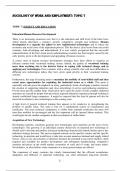
SOCIOLOGY OF WORK AND EMPLOYMENT: TOPIC 7
TOPIC 7: SOCIETY AND EDUCATION
Education/Human Resource Development
There is an increasing awareness now that it is the education and skill level of the labor force
which largely determine a country's growth, competitive strength and resilience. Human
development is a capacity the adjust to new sophisticated technologies and to reduce the
economic and social costs of the adjustment process. This has been a clear lesson from successful
countries, both developing and industrialized. It is now widely recognized that the successful
industrialization of the East Asian newly industrializing countries has been largely caused by the
early priority given to the development and upgrading of human resources.
A corner stone in human resource development strategies have been efforts to organize an
efficient country-wide vocational training system. Indeed, the quality of vocational training
more than anything else is the decisive factor in coping with technical change and in
applying new technologies. Even countries with a strong scientific elite will meet difficulties in
diffusing new technologies unless they have given equal priority to their vocational training
systems.
Furthermore, this type of training tends to maximize the mobility of semi-skilled staff and thus
create more opportunities for exploding the industrial sector as a whole. This point is
especially relevant given the emphasis in many, particularly Asian, developing countries towards
the creation of supporting industries and close networking of service and producing enterprises.
For the most part the smaller firms which grow up to meet the needs of more complex industrial
structures are created by people who previously acquired industrial experience through working in
already established larger enterprises. It might be expected that this kind of pattern will also be
observed in relation to new technologies in the coming years.
A high level of general technical training thus appears to be conducive to strengthening the
position of smaller firms. The same is true for a standardized system of examinations and
certificates. The more technical competence is visible from standard certificates the more will
inter-firm mobility be encouraged and the less important will be internal labour markets. This
would again favour smaller companies in their recruitment of skilled labor.
Acquisition of New Technology
Developing countries, sometimes generate new technologies and sometimes are the users of new
technologies. The question; if an individual country should rely on imported new technology or
should seek to develop and produce advanced technology domestically indeed touches upon a key
industrial strategy decision. The answer depends entirely on the specific country and the specific
technology in question and would have to take into account numerous demand and supply related
factors, such as size and structure of domestic demand; the potential to tap export markets; skills
required and available for product development and subsequent manufacturing; competitive
situation and prices in the world market; economies of scale and of scope; and many others.
Nevertheless, in what follows some comments of a more general nature are offered.
The experience of many countries has clearly demonstrated that the efficient assimilation,
adaptation and diffusion of imported technology can yield substantial long-term benefits.
1
TOPIC 7: SOCIETY AND EDUCATION
Education/Human Resource Development
There is an increasing awareness now that it is the education and skill level of the labor force
which largely determine a country's growth, competitive strength and resilience. Human
development is a capacity the adjust to new sophisticated technologies and to reduce the
economic and social costs of the adjustment process. This has been a clear lesson from successful
countries, both developing and industrialized. It is now widely recognized that the successful
industrialization of the East Asian newly industrializing countries has been largely caused by the
early priority given to the development and upgrading of human resources.
A corner stone in human resource development strategies have been efforts to organize an
efficient country-wide vocational training system. Indeed, the quality of vocational training
more than anything else is the decisive factor in coping with technical change and in
applying new technologies. Even countries with a strong scientific elite will meet difficulties in
diffusing new technologies unless they have given equal priority to their vocational training
systems.
Furthermore, this type of training tends to maximize the mobility of semi-skilled staff and thus
create more opportunities for exploding the industrial sector as a whole. This point is
especially relevant given the emphasis in many, particularly Asian, developing countries towards
the creation of supporting industries and close networking of service and producing enterprises.
For the most part the smaller firms which grow up to meet the needs of more complex industrial
structures are created by people who previously acquired industrial experience through working in
already established larger enterprises. It might be expected that this kind of pattern will also be
observed in relation to new technologies in the coming years.
A high level of general technical training thus appears to be conducive to strengthening the
position of smaller firms. The same is true for a standardized system of examinations and
certificates. The more technical competence is visible from standard certificates the more will
inter-firm mobility be encouraged and the less important will be internal labour markets. This
would again favour smaller companies in their recruitment of skilled labor.
Acquisition of New Technology
Developing countries, sometimes generate new technologies and sometimes are the users of new
technologies. The question; if an individual country should rely on imported new technology or
should seek to develop and produce advanced technology domestically indeed touches upon a key
industrial strategy decision. The answer depends entirely on the specific country and the specific
technology in question and would have to take into account numerous demand and supply related
factors, such as size and structure of domestic demand; the potential to tap export markets; skills
required and available for product development and subsequent manufacturing; competitive
situation and prices in the world market; economies of scale and of scope; and many others.
Nevertheless, in what follows some comments of a more general nature are offered.
The experience of many countries has clearly demonstrated that the efficient assimilation,
adaptation and diffusion of imported technology can yield substantial long-term benefits.
1