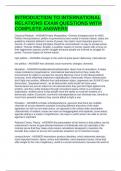
INTRODUCTION TO INTERNATIONAL
RELATIONS EXAM QUESTIONS WITH
COMPLETE ANSWERS
Classical Realism - ANSWER-Hans Morgenthau--German immigrant prior to WW2,
Politics Among Nations; politics is governed by laws rooted in human nature; states are
guided by interests defined in terms of power; the state's most important goal is to
survive; no nation's moral principles should be universalized; no way to escape power
politics; Thomas Hobbes--English, Leviathan; based on human nature with a focus on
their aggressive aspects; power struggle because people are inclined to struggle for
power. Focuses largely on human nature.
high politics - ANSWER-changes in the world of great power diplomacy; international
low politics - ANSWER-less dramatic socio-economic changes; domestic
liberalism - ANSWER-Neoliberalism/institutionalist: direct rival of neorealism, if states
create institutions (organizations, international law/rules/norms) they create the
environment for states to escape the security dilemma, focus on the liberal political
economy, most influential response to globalization; Democratic Peace: democracies
don't fight one another, different from authoritarian states, opponents are ALWAYS non-
democratic, "perpetual peace", an all democratic world would not have wars.
Democracies are just as violent as non-democracies they just don't fight against one
another, and they settle disputes through nonviolent means which is a normative
explanation, another piece is that people have the ability to recall the leaders of a
democratic nation; Economic: economic interdependence can eliminate war, benefit so
much from peaceful relations they cannot afford to fight a war.
Pluralism - ANSWER-complex interdependence; assumes that there are multiple
channels of access between societies including different branches of the state
apparatus as well as non-state actors, as opposed to the unitary state assumption
characteristic of realism; issues are seen as disaggregated and separate; issue-areas;
agenda-setting is a matter of significance, the ways in which actors are able to set the
agenda is important
Rational Choice Theory - ANSWER-the presumption of this theory is that politics can be
understood in terms of goal-directed behavior of individuals who act rationally in the
minimal sense that they make ends-means calculations designed to maximize the
benefits they expect to accrue from particular situations (or to minimize losses)
constructivism - ANSWER-interactions produce identities, which determine interests;
most important factors: ideas, norms and identities; most important issues: those that
offer insight to the role of legitimacy; world is a social construction; because the world is
, something we make up and put together ourselves, and not something that is given to
us, the search for laws (patterns of behavior) is inappropriate; ideas shape behavior,
norms shape behavior, identities determine interests which emerge from interaction.
"Anarchy is what states make of it"
multinational corporation - ANSWER-international businesses (profit-making entities)
states - ANSWER-international actors; sovereign territorial units; no higher authoritative
structure; about 200 states
Intergovernmental organizations - ANSWER-Associations of states; UN; hundreds
nongovernmental organization - ANSWER-associations of individuals; non-profit; private
entities; thousands
levels of analysis - ANSWER-scheme for classifying causes; 1st: individual level--tied to
properties of individuals, human nature; 2nd: state--economic, political and ideological
structures; 3rd: system--anarchy, lack of a ruler/government and distribution of power
(multipolarity, bipolarity and unipolarity)
emergent property - ANSWER-a property that something has at a high level that is not
existent at a lower level; table analogy
dominant strategy - ANSWER-best option no matter what the other side does; part of
the chicken dilemma and the security dilemma
security dilemma - ANSWER-intentions versus capabilities; focuses on an enhancement
of self-defense capabilities, which can be seen as a potentially hostile act; more
important is building up the offensive capabilities than the defensive intentions.
positivism - ANSWER-a theory of science that states you should study the social world
the way natural scientists study the natural world; predictions, theories and ways of
testing theories.
deterrence - ANSWER-the power to influence some international actor into inaction
through threat of force
compellance - ANSWER-the power to influence some international actor into a desired
action through force or threat of force.
diplomacy - ANSWER-the theory of "conversational implicature"; people follow the
following rules of conversation: quality (people say only what is true); quantity (give the
right amount of information); relevance (say only what is relevant to the topic);
affirmativeness (be as polite and upbeat as possible)
RELATIONS EXAM QUESTIONS WITH
COMPLETE ANSWERS
Classical Realism - ANSWER-Hans Morgenthau--German immigrant prior to WW2,
Politics Among Nations; politics is governed by laws rooted in human nature; states are
guided by interests defined in terms of power; the state's most important goal is to
survive; no nation's moral principles should be universalized; no way to escape power
politics; Thomas Hobbes--English, Leviathan; based on human nature with a focus on
their aggressive aspects; power struggle because people are inclined to struggle for
power. Focuses largely on human nature.
high politics - ANSWER-changes in the world of great power diplomacy; international
low politics - ANSWER-less dramatic socio-economic changes; domestic
liberalism - ANSWER-Neoliberalism/institutionalist: direct rival of neorealism, if states
create institutions (organizations, international law/rules/norms) they create the
environment for states to escape the security dilemma, focus on the liberal political
economy, most influential response to globalization; Democratic Peace: democracies
don't fight one another, different from authoritarian states, opponents are ALWAYS non-
democratic, "perpetual peace", an all democratic world would not have wars.
Democracies are just as violent as non-democracies they just don't fight against one
another, and they settle disputes through nonviolent means which is a normative
explanation, another piece is that people have the ability to recall the leaders of a
democratic nation; Economic: economic interdependence can eliminate war, benefit so
much from peaceful relations they cannot afford to fight a war.
Pluralism - ANSWER-complex interdependence; assumes that there are multiple
channels of access between societies including different branches of the state
apparatus as well as non-state actors, as opposed to the unitary state assumption
characteristic of realism; issues are seen as disaggregated and separate; issue-areas;
agenda-setting is a matter of significance, the ways in which actors are able to set the
agenda is important
Rational Choice Theory - ANSWER-the presumption of this theory is that politics can be
understood in terms of goal-directed behavior of individuals who act rationally in the
minimal sense that they make ends-means calculations designed to maximize the
benefits they expect to accrue from particular situations (or to minimize losses)
constructivism - ANSWER-interactions produce identities, which determine interests;
most important factors: ideas, norms and identities; most important issues: those that
offer insight to the role of legitimacy; world is a social construction; because the world is
, something we make up and put together ourselves, and not something that is given to
us, the search for laws (patterns of behavior) is inappropriate; ideas shape behavior,
norms shape behavior, identities determine interests which emerge from interaction.
"Anarchy is what states make of it"
multinational corporation - ANSWER-international businesses (profit-making entities)
states - ANSWER-international actors; sovereign territorial units; no higher authoritative
structure; about 200 states
Intergovernmental organizations - ANSWER-Associations of states; UN; hundreds
nongovernmental organization - ANSWER-associations of individuals; non-profit; private
entities; thousands
levels of analysis - ANSWER-scheme for classifying causes; 1st: individual level--tied to
properties of individuals, human nature; 2nd: state--economic, political and ideological
structures; 3rd: system--anarchy, lack of a ruler/government and distribution of power
(multipolarity, bipolarity and unipolarity)
emergent property - ANSWER-a property that something has at a high level that is not
existent at a lower level; table analogy
dominant strategy - ANSWER-best option no matter what the other side does; part of
the chicken dilemma and the security dilemma
security dilemma - ANSWER-intentions versus capabilities; focuses on an enhancement
of self-defense capabilities, which can be seen as a potentially hostile act; more
important is building up the offensive capabilities than the defensive intentions.
positivism - ANSWER-a theory of science that states you should study the social world
the way natural scientists study the natural world; predictions, theories and ways of
testing theories.
deterrence - ANSWER-the power to influence some international actor into inaction
through threat of force
compellance - ANSWER-the power to influence some international actor into a desired
action through force or threat of force.
diplomacy - ANSWER-the theory of "conversational implicature"; people follow the
following rules of conversation: quality (people say only what is true); quantity (give the
right amount of information); relevance (say only what is relevant to the topic);
affirmativeness (be as polite and upbeat as possible)