Introduction to Python
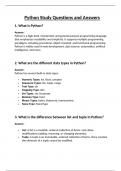
1. What is Python?
Definition: Python is a high-level, interpreted, general-purpose
programming language. It's known for its simplicity and readability, making
it an excellent choice for beginners and professionals alike.
History: Python was created by Guido van Rossum in the late 1980s and
released in 1991. It was designed to be easy to understand and use, with a
syntax that emphasizes readability.
Applications:
o Web Development: Frameworks like Django and Flask.
o Data Science: Libraries like pandas, NumPy, and Matplotlib.
o Machine Learning: Libraries like TensorFlow, scikit-learn, and
PyTorch.
o Automation: Writing scripts to automate tasks.
2. Key Features of Python
Readable Syntax: Python uses indentation to structure code, which makes
it visually clean and easy to follow.
Interpreted Language: Python code is executed line by line, which makes it
easier to debug.
Cross-Platform: Python can run on Windows, macOS, Linux, and others.
Large Standard Library: Python comes with an extensive standard library
that simplifies tasks like file handling, web scraping, and regular
expressions.
Dynamic Typing: You don’t have to declare the type of a variable when
defining it; Python will figure it out.
3. Why Choose Python?
Ease of Learning: Python has simple syntax and a large community, making
it an easy language to learn for beginners.
, Versatility: Python can be used in various fields, from web development to
artificial intelligence.
Community and Support: Python has one of the largest programming
communities, offering lots of tutorials, forums, and open-source libraries.
Example Code for Introduction to Python:
# This is a simple Python program
print("Welcome to Python Programming!")
4. Python IDEs and Setup
Installing Python:
o Download the latest version from python.org.
o Follow the installation instructions for your operating system.
IDE Choices:
o VS Code: Lightweight, customizable, and supports Python extensions.
o PyCharm: Full-fledged IDE for professional Python development.
o Jupyter Notebooks: Great for data science and analysis tasks.
5. What Makes Python Stand Out from Other Languages?
1. Simplicity and Readability
Simple Syntax: Python’s syntax is straightforward, using plain English
keywords (like if, else, while, for), which makes the code easy to read and
write.
Indentation: Unlike other languages, Python uses indentation (whitespace)
to define code blocks, rather than curly braces or semicolons. This
enhances readability and reduces the chances of errors.
1. What is Python?
Definition: Python is a high-level, interpreted, general-purpose
programming language. It's known for its simplicity and readability, making
it an excellent choice for beginners and professionals alike.
History: Python was created by Guido van Rossum in the late 1980s and
released in 1991. It was designed to be easy to understand and use, with a
syntax that emphasizes readability.
Applications:
o Web Development: Frameworks like Django and Flask.
o Data Science: Libraries like pandas, NumPy, and Matplotlib.
o Machine Learning: Libraries like TensorFlow, scikit-learn, and
PyTorch.
o Automation: Writing scripts to automate tasks.
2. Key Features of Python
Readable Syntax: Python uses indentation to structure code, which makes
it visually clean and easy to follow.
Interpreted Language: Python code is executed line by line, which makes it
easier to debug.
Cross-Platform: Python can run on Windows, macOS, Linux, and others.
Large Standard Library: Python comes with an extensive standard library
that simplifies tasks like file handling, web scraping, and regular
expressions.
Dynamic Typing: You don’t have to declare the type of a variable when
defining it; Python will figure it out.
3. Why Choose Python?
Ease of Learning: Python has simple syntax and a large community, making
it an easy language to learn for beginners.
, Versatility: Python can be used in various fields, from web development to
artificial intelligence.
Community and Support: Python has one of the largest programming
communities, offering lots of tutorials, forums, and open-source libraries.
Example Code for Introduction to Python:
# This is a simple Python program
print("Welcome to Python Programming!")
4. Python IDEs and Setup
Installing Python:
o Download the latest version from python.org.
o Follow the installation instructions for your operating system.
IDE Choices:
o VS Code: Lightweight, customizable, and supports Python extensions.
o PyCharm: Full-fledged IDE for professional Python development.
o Jupyter Notebooks: Great for data science and analysis tasks.
5. What Makes Python Stand Out from Other Languages?
1. Simplicity and Readability
Simple Syntax: Python’s syntax is straightforward, using plain English
keywords (like if, else, while, for), which makes the code easy to read and
write.
Indentation: Unlike other languages, Python uses indentation (whitespace)
to define code blocks, rather than curly braces or semicolons. This
enhances readability and reduces the chances of errors.