Dispute Resolution
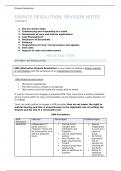
DISPUTE RESOLUTION: REVISION NOTES
CONTENTS
1. Key pre-action steps
2. Commencing and responding to a claim
3. Statements of case and interim applications
4. Case Management
5. Disclosure of Documents
6. Evidence
7. Preparations for trial, trial procedure and appeals
8. trial costs
9. Aspects of costs and enforcement
PRE-ACTION STEPS
OPTIONS FOR RESOLUTION
ADR (Alternative Dispute Resolution) any means of settling a dispute outside
of civil litigation with the assistance of an independent third party.
ADR should be used unless:
Obviously inappropriate
The other party is unlikely to co-operate
Other party cannot be trusted to comply with an award.
If a party chooses not to engage in proposed ADR, they must serve a witness statement
giving reasons within 21 days. Cost penalties can be imposed where a party decides not
to engage
Court can order parties to engage in ADR provided they do not impair the right to
judicial hearing and this is proportionate to the legitimate aim of settling the
dispute quickly and at a reasonable cost
ADR Procedures
ADR Features Advantages Disadvantages
Procedure
Mediation Independent 3rd Can be much May be
party acts as a cheaper than inappropriat
mediator. There will arbitration and e, such as in
be a discussion on a litigation cases of
without prejudice Can be significantly fraud.
basis. quicker No formal
Very flexible – no procedure -
legal requirements risk of
Private parties not
Preserves business knowing all
relationship the facts.
Able to withdraw at Ability to
anytime withdraw –
could be an
,Dispute Resolution
issue
Cannot be enforced
like a court
judgement but
usually binding
contract.
Arbitration Once a party could apply to the Dispute will
agrees to High Court under not receive
arbitration they s66 for permission depth of
cannot enter into to enforce investigation
litigation and is arbitration as if it Remedies
often agreed to in a were a court such as
contract. judgement. injunctions
Likely to be quicker not available
The arbitrator ia a May be cheaper Unlikely to
professional and the Less formal be cheap as
decision reached procedurally arbitration
will be legally Impartial third expert and
binding party with lawyers
expertise needed
Retains
confidentiality
Practical solutions
Decision is binding
LITIGATION
The main advantage is that the courts will break a deadlock between parties.
Order of Civil Claims Proceedings:
1. Pre commencement of proceedings – objectives are established, costs will be
addressed and serious consideration given to ADR (Pre-Action Protocols).
2. Commencement of the Claim – claim form served on defendant together with
the full details of the claim.
3. Interim matters – court manages case to ensure that it progresses towards trail
date.
4. Trial – evidence heard at trial and judge will make a decision as to the outcome.
Post-trial – A party who is unhappy with the judgement may decide to appeal all or part
of the trial judge’s decision
CIVIL CLAIMS
Limitations
Types of claim Limitation
Basic rule 6 years from
Contract 6 the cause
years fromofthe
action
breach accruing
Tort 6 years from when the tort was committed
Tort – personal injury 3 years from the date of cause of action/ knowledge of who
committed the tort.
Latent negligence Minors starts at 18
Ultimate limit of 15 years
3 years from the date of knowledge of the damage
Types of claim and analysis
, Dispute Resolution
Specified claims claim for specified fixed amount of money.
Unspecified claim the court will conduct an investigation to determine the
amount of money payable
The defendant must be traceable and worth suing, i.e. not bankrupt. A lawyer will
not be acting in the best interests of their client if they encourage them to pursue
a case that is hopeless from the outset or with only limited prospects of success.
Remoteness – if the loss is too remote the defendant may not be held liable for it.
Mitigation of loss – the obligation of the claimant to minimise their losses after the
harmful event occurred.
PRE-ACTION PROCEDURE
Principles:
Litigation should be a last resort
Parties should exchange sufficient information
Only reasonable and proportionate steps should be taken by the parties
Practice direction on pre-action conduct and protocols
Ste Action
p
1 Claimant sends letter before claiming, stating:
Details of the claim
Summary of the facts
What the C wants from the D
Key documents
2 Defendant sends a letter of response:
In a reasonable time
Confirming if accepted or indicating a counterclaim
3 Claimant replies and consider ADR
4 Stocktake: the parties should review their positions
5 Sanctions for non-compliance
Party at default pays opponents costs
Claimant is deprived of some or all interest on damages
D is required to pay a higher rate of interest on damages.
Pre-action protocol for professional negligence
Step Action
1 Claimant gives preliminary notice
2 Claimant sends Letter of Claim
3 Defendant acknowledges
4 Defendant investigates claim
5 Defendant sends letter of response
6 1. Claim is denied an no settlement offered so proceedings commence
OR
2. Claim is admitted in whole or part and/or settlement offered
Debt Claims:
DISPUTE RESOLUTION: REVISION NOTES
CONTENTS
1. Key pre-action steps
2. Commencing and responding to a claim
3. Statements of case and interim applications
4. Case Management
5. Disclosure of Documents
6. Evidence
7. Preparations for trial, trial procedure and appeals
8. trial costs
9. Aspects of costs and enforcement
PRE-ACTION STEPS
OPTIONS FOR RESOLUTION
ADR (Alternative Dispute Resolution) any means of settling a dispute outside
of civil litigation with the assistance of an independent third party.
ADR should be used unless:
Obviously inappropriate
The other party is unlikely to co-operate
Other party cannot be trusted to comply with an award.
If a party chooses not to engage in proposed ADR, they must serve a witness statement
giving reasons within 21 days. Cost penalties can be imposed where a party decides not
to engage
Court can order parties to engage in ADR provided they do not impair the right to
judicial hearing and this is proportionate to the legitimate aim of settling the
dispute quickly and at a reasonable cost
ADR Procedures
ADR Features Advantages Disadvantages
Procedure
Mediation Independent 3rd Can be much May be
party acts as a cheaper than inappropriat
mediator. There will arbitration and e, such as in
be a discussion on a litigation cases of
without prejudice Can be significantly fraud.
basis. quicker No formal
Very flexible – no procedure -
legal requirements risk of
Private parties not
Preserves business knowing all
relationship the facts.
Able to withdraw at Ability to
anytime withdraw –
could be an
,Dispute Resolution
issue
Cannot be enforced
like a court
judgement but
usually binding
contract.
Arbitration Once a party could apply to the Dispute will
agrees to High Court under not receive
arbitration they s66 for permission depth of
cannot enter into to enforce investigation
litigation and is arbitration as if it Remedies
often agreed to in a were a court such as
contract. judgement. injunctions
Likely to be quicker not available
The arbitrator ia a May be cheaper Unlikely to
professional and the Less formal be cheap as
decision reached procedurally arbitration
will be legally Impartial third expert and
binding party with lawyers
expertise needed
Retains
confidentiality
Practical solutions
Decision is binding
LITIGATION
The main advantage is that the courts will break a deadlock between parties.
Order of Civil Claims Proceedings:
1. Pre commencement of proceedings – objectives are established, costs will be
addressed and serious consideration given to ADR (Pre-Action Protocols).
2. Commencement of the Claim – claim form served on defendant together with
the full details of the claim.
3. Interim matters – court manages case to ensure that it progresses towards trail
date.
4. Trial – evidence heard at trial and judge will make a decision as to the outcome.
Post-trial – A party who is unhappy with the judgement may decide to appeal all or part
of the trial judge’s decision
CIVIL CLAIMS
Limitations
Types of claim Limitation
Basic rule 6 years from
Contract 6 the cause
years fromofthe
action
breach accruing
Tort 6 years from when the tort was committed
Tort – personal injury 3 years from the date of cause of action/ knowledge of who
committed the tort.
Latent negligence Minors starts at 18
Ultimate limit of 15 years
3 years from the date of knowledge of the damage
Types of claim and analysis
, Dispute Resolution
Specified claims claim for specified fixed amount of money.
Unspecified claim the court will conduct an investigation to determine the
amount of money payable
The defendant must be traceable and worth suing, i.e. not bankrupt. A lawyer will
not be acting in the best interests of their client if they encourage them to pursue
a case that is hopeless from the outset or with only limited prospects of success.
Remoteness – if the loss is too remote the defendant may not be held liable for it.
Mitigation of loss – the obligation of the claimant to minimise their losses after the
harmful event occurred.
PRE-ACTION PROCEDURE
Principles:
Litigation should be a last resort
Parties should exchange sufficient information
Only reasonable and proportionate steps should be taken by the parties
Practice direction on pre-action conduct and protocols
Ste Action
p
1 Claimant sends letter before claiming, stating:
Details of the claim
Summary of the facts
What the C wants from the D
Key documents
2 Defendant sends a letter of response:
In a reasonable time
Confirming if accepted or indicating a counterclaim
3 Claimant replies and consider ADR
4 Stocktake: the parties should review their positions
5 Sanctions for non-compliance
Party at default pays opponents costs
Claimant is deprived of some or all interest on damages
D is required to pay a higher rate of interest on damages.
Pre-action protocol for professional negligence
Step Action
1 Claimant gives preliminary notice
2 Claimant sends Letter of Claim
3 Defendant acknowledges
4 Defendant investigates claim
5 Defendant sends letter of response
6 1. Claim is denied an no settlement offered so proceedings commence
OR
2. Claim is admitted in whole or part and/or settlement offered
Debt Claims: