AACN Essentials of Critical Care Nursing
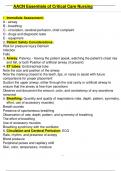
1. Immediate Assessment:
A - airway
B - breathing
C - circulation, cerebral perfusion, chief complaint
D - drugs and diagnostic tests
E - equipment
2. Patient Safety Considerations:
Risk for pressure injury Delirium
Infection
Falls
3. Airway: Patency - Having the patient speak, watching the patient's chest rise
and fall, or both Position of artificial airway (if present)
4. ET tubes: Endotracheal tube
Note the size and position of the airway
Note the marking closest to the teeth, lips, or nares to assist with future
comparisons for proper placement
Suction the upper airway, either through the oral cavity or artificial airway to
ensure that the airway is free from secretions
Observe and document the amount, color, and consistency of any secretions
removed
5. Breathing: Quantity and quality of respirations (rate, depth, pattern, symmetry,
effort, use of accessory muscles)
Breath sounds
Presence of spontaneous breathing
Observation of rate, depth, pattern, and symmetry of breathing
The effort of breathing
Use of accessory muscles
Breathing synchrony with the ventilator
6. Circulation and Cerebral Perfusion: ECG
Rate, rhythm, and presence of ectopy
Blood pressure
Peripheral pulses and capillary refill
Skin, color, temperature, moisture
1/4
1. Immediate Assessment:
A - airway
B - breathing
C - circulation, cerebral perfusion, chief complaint
D - drugs and diagnostic tests
E - equipment
2. Patient Safety Considerations:
Risk for pressure injury Delirium
Infection
Falls
3. Airway: Patency - Having the patient speak, watching the patient's chest rise
and fall, or both Position of artificial airway (if present)
4. ET tubes: Endotracheal tube
Note the size and position of the airway
Note the marking closest to the teeth, lips, or nares to assist with future
comparisons for proper placement
Suction the upper airway, either through the oral cavity or artificial airway to
ensure that the airway is free from secretions
Observe and document the amount, color, and consistency of any secretions
removed
5. Breathing: Quantity and quality of respirations (rate, depth, pattern, symmetry,
effort, use of accessory muscles)
Breath sounds
Presence of spontaneous breathing
Observation of rate, depth, pattern, and symmetry of breathing
The effort of breathing
Use of accessory muscles
Breathing synchrony with the ventilator
6. Circulation and Cerebral Perfusion: ECG
Rate, rhythm, and presence of ectopy
Blood pressure
Peripheral pulses and capillary refill
Skin, color, temperature, moisture
1/4