Timeline of Criminological Theories
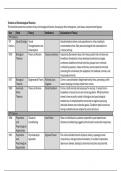
This timeline traces the evolution of key criminological theories, focusing on their emergence, core ideas, and prominent figures:
Year Field Theory Attributors Explanation of Theory
19 Century
th
19th Social Ecology Social Industrialization drives rural populations to cities, leading to
Century Disorganization and concentrated crime. Early social ecologists link urbanization to
Urbanization criminal activity.
1876 Biological Theory of Atavism Cesare Lombroso Inspired by Darwanian ideas, this theory posits that criminals are
Theories hereditary throwbacks to less developed evolutionary stages.
Lombroso classified criminals into four groups: born criminals,
criminals by passion, insane criminals, and occasional criminals
(including the criminaloid, the epileptoid, the habitual criminal, and
the pseudocriminal).
1877 Biological Degenerative Theory Richard Louis Crime is concentrated in illegitimate family lines, prompting a shift
Theories Dugdale toward studying criminals rather than crimes.
1893 Anomie & Theory of Anomie Emile Durkheim Crime is both normal and necessary for society. It arises from a
Strain breakdown of social norms and moral regulation. While Durkheim
Theories viewed crime as partly rooted in biological and psychological
tendencies, he emphasized its connection to egoism (pursuing
individual desires over collective goals). Durkheim sees humans as
having insatiable desires shaped by social structure.
20th Century
1906 Psychiatric Classical Ivan Pavlov Sees an individual as a passive responder to past experiences.
and Conditioning Classical conditioning suggests stimuli lead to automatic responses.
Psychological
Approaches
1915 Psychiatric Psychoanalytic Sigmund Freud The mind is divided into the id (basic drives), superego (moral
and Approach conscience), and ego (rational mediator). In a state of repression
Psychological desires are denied, leading to abnormal reactions and potential
Approaches
, criminal behavior. Freud argued that unresolved guilt can manifest in
crime.
1920 Social Ecology W.I. Thomas & Defining social organization as the decline in the influence of social
Florian Znaniecki rules on individuals within a group. In socially disorganized
neighborhoods, conflicting moral values weaken parental control,
create ethnic group tensions over resources, and normalize
delinquency, fostering gang formation.
1920 Social Ecology Chicago School Robert Park Cities grow through social processes like invasion, dominance, and
accommodation, best studied through careful, scientific study of city
life.
1925 Social Ecology Concentric Zone Ernest Burgess This model divides Chicago into five zones based on urban expansion:
Theory Zone One (the city center), Zone Two (a transitional zone of declining
residences), Zone Three (workers’ homes), Zone Four (a suburban
residential area wit more expensive homes), Zone Five (the outermost
zone, featuring the priciest residences).
1927 Social Ecology Frederic Trasher Gangs form in marginal urban areas due to industrialization,
immigration, and social disorganization. Trasher saw gangs as
spontaneous peer groups providing structure and identity in
fragmented communities. They substitute for fragmented
communities, developing their own values of loyalty and support.
These neighborhoods enable the cultural transmission of criminal
behaviors while failing to instill conventional social norms.
1931 Psychiatric Inferiority Complex Alfred Adler Individuals who lack a sense of superiority may compensate with
and abnormal behaviors.
Psychological
Approaches
1938 Cultural Culture Conflict Thorsten Sellin Conflict arises when the norms of dominant and subordinate cultures
Theories Theory di^er. Primary culture conflict occurs where subordinate cultural
norms are criminalized by the dominant culture. Secondary culture
This timeline traces the evolution of key criminological theories, focusing on their emergence, core ideas, and prominent figures:
Year Field Theory Attributors Explanation of Theory
19 Century
th
19th Social Ecology Social Industrialization drives rural populations to cities, leading to
Century Disorganization and concentrated crime. Early social ecologists link urbanization to
Urbanization criminal activity.
1876 Biological Theory of Atavism Cesare Lombroso Inspired by Darwanian ideas, this theory posits that criminals are
Theories hereditary throwbacks to less developed evolutionary stages.
Lombroso classified criminals into four groups: born criminals,
criminals by passion, insane criminals, and occasional criminals
(including the criminaloid, the epileptoid, the habitual criminal, and
the pseudocriminal).
1877 Biological Degenerative Theory Richard Louis Crime is concentrated in illegitimate family lines, prompting a shift
Theories Dugdale toward studying criminals rather than crimes.
1893 Anomie & Theory of Anomie Emile Durkheim Crime is both normal and necessary for society. It arises from a
Strain breakdown of social norms and moral regulation. While Durkheim
Theories viewed crime as partly rooted in biological and psychological
tendencies, he emphasized its connection to egoism (pursuing
individual desires over collective goals). Durkheim sees humans as
having insatiable desires shaped by social structure.
20th Century
1906 Psychiatric Classical Ivan Pavlov Sees an individual as a passive responder to past experiences.
and Conditioning Classical conditioning suggests stimuli lead to automatic responses.
Psychological
Approaches
1915 Psychiatric Psychoanalytic Sigmund Freud The mind is divided into the id (basic drives), superego (moral
and Approach conscience), and ego (rational mediator). In a state of repression
Psychological desires are denied, leading to abnormal reactions and potential
Approaches
, criminal behavior. Freud argued that unresolved guilt can manifest in
crime.
1920 Social Ecology W.I. Thomas & Defining social organization as the decline in the influence of social
Florian Znaniecki rules on individuals within a group. In socially disorganized
neighborhoods, conflicting moral values weaken parental control,
create ethnic group tensions over resources, and normalize
delinquency, fostering gang formation.
1920 Social Ecology Chicago School Robert Park Cities grow through social processes like invasion, dominance, and
accommodation, best studied through careful, scientific study of city
life.
1925 Social Ecology Concentric Zone Ernest Burgess This model divides Chicago into five zones based on urban expansion:
Theory Zone One (the city center), Zone Two (a transitional zone of declining
residences), Zone Three (workers’ homes), Zone Four (a suburban
residential area wit more expensive homes), Zone Five (the outermost
zone, featuring the priciest residences).
1927 Social Ecology Frederic Trasher Gangs form in marginal urban areas due to industrialization,
immigration, and social disorganization. Trasher saw gangs as
spontaneous peer groups providing structure and identity in
fragmented communities. They substitute for fragmented
communities, developing their own values of loyalty and support.
These neighborhoods enable the cultural transmission of criminal
behaviors while failing to instill conventional social norms.
1931 Psychiatric Inferiority Complex Alfred Adler Individuals who lack a sense of superiority may compensate with
and abnormal behaviors.
Psychological
Approaches
1938 Cultural Culture Conflict Thorsten Sellin Conflict arises when the norms of dominant and subordinate cultures
Theories Theory di^er. Primary culture conflict occurs where subordinate cultural
norms are criminalized by the dominant culture. Secondary culture