

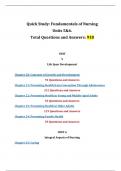
Quick Study: Fundamentals of Nursing
Units 5&6.
Total Questions and Answers: 918
UNIT
5
Life Span Development
Chapter 20: Concepts of Growth and Development
91 Questions and Answers
Chapter 21: Promoting Health from Conception Through Adolescence
212 Questions and Answers
Chapter 22: Promoting Health in Young and Middle-Aged Adults
55 Questions and Answers
Chapter 23: Promoting Health in Older Adults
119 Questions and Answers
Chapter 24: Promoting Family Health
59 Questions and Answers
UNIT 6
Integral Aspects of Nursing
Chapter 25: Caring
, 68 Questions and Answers
Chapter 26: Communicating
134 Questions and Answers
Chapter 27: Teaching
114 Questions and Answers
Chapter 28: Leading, Managing, and Delegating
66 Questions and Answers
, Copyright © 2024 Elizabeth M. All rights reserved. No part of this publication may be reproduced,
distributed, or transmitted in any form or by any means, including photocopying, recording, or
other electronic or mechanical methods, without the prior written permission of the publisher,
except in the case of brief quotations embodied in critical reviews and certain other noncommercial
uses permitted by copyright law.
, Chapter 20
Concepts of Growth and Development
1. You are a nurse working in pediatrics, and a 3-year-old child is brought in for a check-
up. The child is noticeably smaller than other children of the same age and appears to be
struggling with motor skills, like walking and playing. What factors might be influencing
this child's growth and development, and how can you address these concerns during the
assessment?
Answer: Several factors may be influencing the child's growth and development, such as
genetics, nutrition, family support, and health conditions. It's important to consider the
child's overall health, including any chronic illnesses or developmental disorders, as well as
the family’s socio-economic status and home environment. You should conduct a thorough
assessment, paying particular attention to the child's nutrition and family dynamics. Early
intervention may be necessary if growth delays are observed.
2. A mother expresses concern about her child’s slow motor development, particularly
the child’s inability to sit up independently at 10 months old. How would you explain the
typical growth and development milestones at this stage and provide reassurance to the
mother?
Answer: At 10 months, many children may still be developing the muscle strength and
coordination necessary to sit up independently. Growth occurs in a cephalocaudal
direction, meaning children often develop control over their head and upper body before
their lower body. However, variations in development exist, and some children may reach
milestones slightly later than others. You can reassure the mother that her child may be
progressing at their own pace and suggest monitoring the development of other milestones
such as crawling and standing.
3. A nurse is evaluating the growth of a 5-year-old child who has been diagnosed with a
chronic illness. The child has fallen behind in reaching typical milestones. How might this
illness be affecting the child’s growth and development, and what interventions can be put
in place?
Answer: Chronic illness can significantly impact a child’s growth and development by
interfering with physical health, energy levels, and the child’s ability to engage in activities
that promote motor skills. For instance, chronic illnesses may affect appetite, leading to
nutritional deficiencies, or limit physical activities that help strengthen muscles and bones.
Interventions may include working with a multidisciplinary team to manage the child’s
Units 5&6.
Total Questions and Answers: 918
UNIT
5
Life Span Development
Chapter 20: Concepts of Growth and Development
91 Questions and Answers
Chapter 21: Promoting Health from Conception Through Adolescence
212 Questions and Answers
Chapter 22: Promoting Health in Young and Middle-Aged Adults
55 Questions and Answers
Chapter 23: Promoting Health in Older Adults
119 Questions and Answers
Chapter 24: Promoting Family Health
59 Questions and Answers
UNIT 6
Integral Aspects of Nursing
Chapter 25: Caring
, 68 Questions and Answers
Chapter 26: Communicating
134 Questions and Answers
Chapter 27: Teaching
114 Questions and Answers
Chapter 28: Leading, Managing, and Delegating
66 Questions and Answers
, Copyright © 2024 Elizabeth M. All rights reserved. No part of this publication may be reproduced,
distributed, or transmitted in any form or by any means, including photocopying, recording, or
other electronic or mechanical methods, without the prior written permission of the publisher,
except in the case of brief quotations embodied in critical reviews and certain other noncommercial
uses permitted by copyright law.
, Chapter 20
Concepts of Growth and Development
1. You are a nurse working in pediatrics, and a 3-year-old child is brought in for a check-
up. The child is noticeably smaller than other children of the same age and appears to be
struggling with motor skills, like walking and playing. What factors might be influencing
this child's growth and development, and how can you address these concerns during the
assessment?
Answer: Several factors may be influencing the child's growth and development, such as
genetics, nutrition, family support, and health conditions. It's important to consider the
child's overall health, including any chronic illnesses or developmental disorders, as well as
the family’s socio-economic status and home environment. You should conduct a thorough
assessment, paying particular attention to the child's nutrition and family dynamics. Early
intervention may be necessary if growth delays are observed.
2. A mother expresses concern about her child’s slow motor development, particularly
the child’s inability to sit up independently at 10 months old. How would you explain the
typical growth and development milestones at this stage and provide reassurance to the
mother?
Answer: At 10 months, many children may still be developing the muscle strength and
coordination necessary to sit up independently. Growth occurs in a cephalocaudal
direction, meaning children often develop control over their head and upper body before
their lower body. However, variations in development exist, and some children may reach
milestones slightly later than others. You can reassure the mother that her child may be
progressing at their own pace and suggest monitoring the development of other milestones
such as crawling and standing.
3. A nurse is evaluating the growth of a 5-year-old child who has been diagnosed with a
chronic illness. The child has fallen behind in reaching typical milestones. How might this
illness be affecting the child’s growth and development, and what interventions can be put
in place?
Answer: Chronic illness can significantly impact a child’s growth and development by
interfering with physical health, energy levels, and the child’s ability to engage in activities
that promote motor skills. For instance, chronic illnesses may affect appetite, leading to
nutritional deficiencies, or limit physical activities that help strengthen muscles and bones.
Interventions may include working with a multidisciplinary team to manage the child’s

