CHAPTER 3
Income Statement and Related Information
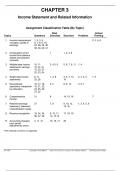
Assignment Classification Table (By Topic)
Brief Critical
Topics Questions Exercises Exercises Problems Thinking
1. Income measurement 1, 2, 3, 5, 2, 3, 4, 6
concepts, quality of 6, 7, 8, 9, 10,
earnings. 22, 28, 29, 30,
38, 39, 40, 41
2. Computation of net 1 1, 2, 3, 8
income from balance
sheets and selected
accounts.
3. Multiple-step income 10, 11, 3, 4 5, 6 5, 6, 7, 9, 11 1, 4
statements; earrings 12,13, 14,
per share. 15, 20, 21,
22, 23, 24
4. Single-step income 8, 11, 1, 2, 8 4, 5, 7, 13, 2, 3, 4, 5 1, 5
statements. 25, 26 16
5. Discontinued 16, 17, 18, 4, 5 8, 9, 13, 3, 5, 7
operations; Intraperiod 19, 21, 22,
tax allocation. 23, 25, 26,
27, 32
6. Comprehensive 31 8 14, 15, 16 7
income.
7. Retained earnings 27 7, 8 9, 10, 12, 1, 2, 4, 5, 6
statement; statement 15, 16
of stockholders‘ equity
8. Revenue recognition 33, 34, 35, 9, 10, 11, 17, 18, 19
36, 37, 38 12, 13,14
*9. Accounting changes; 4, 11, 41 15, 16, 17 20
prior period
adjustments; errors.
*This material covered in an appendix.
5-1-126 Copyright © 2022 WILEY Kieso, Intermediate Accounting, 18/e, Solutions Manual (For Instructor Use Only)
, Assignment Classification Table (By Learning Objective)
Questions Brief Critical
Learning Objectives Exercises Exercises Problems Thinking
1. Identify the uses, 1, 2, 3, 5, 1, 2, 3, 4, 1, 2, 3, 4, 5, 1, 2, 3, 4, 1, 4, 5, 6
limitations, and basic 6, 7, 8, 9, 5, 6 6, 7, 8, 9, 5, 6, 7
content of an income 10, 11, 12, 10, 11, 13,
statement. 13, 14, 15, 16
17, 19, 20,
27, 28, 29
2. Discuss the accounting 12, 16, 17, 4, , 8 2, 8, 13, 14, 1, 3, 1, 4, 5, 6, 7
for unusual income 18, 21, 22, 16 6, 7
items. 23, 25, ,
27, 30, 31,
3. Explain the reporting of 3, 10,11, 7, 9, 12, 15, 16 1, 2, , 4, 6
stockholders‘ equity. 24, 26, 28, 5, 6, 7
4. Explain the revenue 32,33, 34, 9, 10, 11 17, 18, 19
recognition principle. 35, 36, 37, 12, 13, 14
5. Describe the concept of 38,39, 40 2,
earnings quality.
*6. Explain the reporting of 4, 10,11, 15, 16, 17 20 3 6
accounting changes, 41
estimates, and errors.
*This material covered in an appendix.
Copyright © 2022 WILEY Kieso, Intermediate Accounting, 18/e, Solutions Manual (For Instructor Use Only) 5-1-127
, Assignment Characteristics Table
Level of Time
Item Description Difficulty (minutes)
E3.1 Computation of net income. Simple 18–20
E3.2 Compute income measures. Simple 10–15
E3.3 Income statement items. Simple 25–35
E3.4 Single-step income statement. Moderate 20–25
E3.5 Multiple-step and single-step statements Simple 30–35
E3.6 Multiple-step statement Moderate 30–35
E3.7 Multiple-step and single-step statements Moderate 30–40
E3.8 Income statement, EPS. Simple 15–20
E3.9 Multiple-step statement with retained earnings statement Simple 30–35
E3.10 Earnings per share. Simple 20–25
E3.11 Condensed income statement—periodic inventory Moderate 20–25
method.
E3.12 Retained earnings statement. Simple 20–25
E3.13 Earnings per share. Moderate 15–20
E3.14 Comprehensive income. Simple 15–20
E3.15 Comprehensive income. Moderate 15–20
E3.16 Various reporting formats. Moderate 30–35
E3.17 Fundamentals of revenue recognition Simple 10–15
E3.18 Determine transaction price Simple 10–15
E3.19 Allocate transaction price Moderate 15–20
E3.20 Change in accounting principle. Moderate 15–20
P3.1 Multiple-step statement, retained earnings statement Moderate 30–35
P3.2 Single-step statement, retained earnings statement, Simple 25–30
periodic inventory.
P3.3 Various income-related items. Moderate 30–40
P3.4 Multiple- and single-step statements, retained earnings Moderate 45–55
statement.
P3.5 Unusual or infrequent items. Moderate 20–25
P3.6 Retained earnings statement, prior period adjustment. Moderate 25–35
P3.7 Income statement, irregular items. Moderate 25–35
CT3.1 Identification of income statement deficiencies. Simple 20–25
CT3.2 Earnings management. Moderate 20–25
CT3.3 Earnings management. Simple 15–20
CT3.4 Income reporting items. Moderate 30–35
CT3.5 Identification of income statement weaknesses. Moderate 30–40
CT3.6 Classification of income statement items. Moderate 20–25
CT3.7 Comprehensive income. Simple 10–15
5-1-128 Copyright © 2022 WILEY Kieso, Intermediate Accounting, 18/e, Solutions Manual (For Instructor Use Only)
, Answers to Questions
1. The income statement is important because it provides investors and creditors with information
that helps them predict the amount, timing, and uncertainty of future cash flows. It helps investors
and creditors predict future cash flows in a number of different ways. First, investors and creditors can
use the information on the income statement to evaluate the past performance of the company.
Second, the income statement helps users of the financial statements to determine the risk (level of
uncertainty) of income—revenues, expenses, gains, and losses—and highlights the relationship
among these various components.
It should be emphasized that the income statement is used by parties other than investors and
creditors. For example, customers can use the income statement to determine a company‘s ability
to provide needed goods or services, unions examine earnings closely as a basis for salary dis-
cussions, and the government uses the income statements of companies as a basis for formulating
tax and economic policy.
LO: 1, Bloom: K, Difficulty: Simple, Time: 5-7, AACSB: knowledge, Communication, AICPA BB: None, AICPA AC: Reporting, AICPA PC: Communication
2. Information on past transactions can be used to identify important trends that, if continued, provide
information about future performance. If a reasonable correlation exists between past and future
performance, predictions about future earnings and cash flows can be made. For example, a loan
analyst can develop a prediction of future performance by estimating the rate of growth of past
income over the past several periods and project this into the next period. Additional information
about current economic and industry factors can be used to adjust the trend rate based on
historical information.
LO: 1, Bloom: K, Difficulty: Simple, Time: 3-5, AACSB: Knowledge, Communication, AICPA BB: None, AICPA AC: Reporting, AICPA PC: Communication
3. Some situations in which changes in value are not recorded in income are:
(a) Unrealized gains or losses on available-for-sale debt investments,
(b) Changes in the fair values of long-term liabilities, such as bonds payable,
(c) Changes (increases) in value of property, plant and equipment, such as land, natural resources,
or equipment,
(d) Changes (increases) in the values of intangible assets such as customer goodwill, brand value,
or intellectual capital.
Note that some of these omissions arise because the items (e.g., brand value) are not recognized
in financial statements, while others (value of land) are recorded in financial statements but meas-
urement is at historical cost.
LO: 1, 3 Bloom: K, Difficulty: Moderate, Time: 3-5, AACSB: Knowledge, Communication, AICPA BB: None, AICPA AC: Measurement Analysis and Interpretation,
Reporting, AICPA PC: Communication
4. Some situations in which application of different accounting methods or estimates lead to comparison
problems include:
(a) Inventory methods—LIFO vs. FIFO,
(b) Depreciation Methods—straight-line vs. accelerated,
(c) Accounting for long-term contracts—percentage-of-completion vs. completed-contract,
(d) Estimates of useful lives or salvage values for depreciable assets,
(e) Estimates of bad debts,
(f) Estimates of warranty costs.
LO: 6, Bloom: C, Difficulty: Moderate, Time: 3-5, AACSB: Knowledge, Communication, AICPA BB: None, AICPA AC: Measurement Analysis and Interpretation,
Reporting, AICPA PC: Communication
Copyright © 2022 WILEY Kieso, Intermediate Accounting, 18/e, Solutions Manual (For Instructor Use Only) 5-1-129
Income Statement and Related Information
Assignment Classification Table (By Topic)
Brief Critical
Topics Questions Exercises Exercises Problems Thinking
1. Income measurement 1, 2, 3, 5, 2, 3, 4, 6
concepts, quality of 6, 7, 8, 9, 10,
earnings. 22, 28, 29, 30,
38, 39, 40, 41
2. Computation of net 1 1, 2, 3, 8
income from balance
sheets and selected
accounts.
3. Multiple-step income 10, 11, 3, 4 5, 6 5, 6, 7, 9, 11 1, 4
statements; earrings 12,13, 14,
per share. 15, 20, 21,
22, 23, 24
4. Single-step income 8, 11, 1, 2, 8 4, 5, 7, 13, 2, 3, 4, 5 1, 5
statements. 25, 26 16
5. Discontinued 16, 17, 18, 4, 5 8, 9, 13, 3, 5, 7
operations; Intraperiod 19, 21, 22,
tax allocation. 23, 25, 26,
27, 32
6. Comprehensive 31 8 14, 15, 16 7
income.
7. Retained earnings 27 7, 8 9, 10, 12, 1, 2, 4, 5, 6
statement; statement 15, 16
of stockholders‘ equity
8. Revenue recognition 33, 34, 35, 9, 10, 11, 17, 18, 19
36, 37, 38 12, 13,14
*9. Accounting changes; 4, 11, 41 15, 16, 17 20
prior period
adjustments; errors.
*This material covered in an appendix.
5-1-126 Copyright © 2022 WILEY Kieso, Intermediate Accounting, 18/e, Solutions Manual (For Instructor Use Only)
, Assignment Classification Table (By Learning Objective)
Questions Brief Critical
Learning Objectives Exercises Exercises Problems Thinking
1. Identify the uses, 1, 2, 3, 5, 1, 2, 3, 4, 1, 2, 3, 4, 5, 1, 2, 3, 4, 1, 4, 5, 6
limitations, and basic 6, 7, 8, 9, 5, 6 6, 7, 8, 9, 5, 6, 7
content of an income 10, 11, 12, 10, 11, 13,
statement. 13, 14, 15, 16
17, 19, 20,
27, 28, 29
2. Discuss the accounting 12, 16, 17, 4, , 8 2, 8, 13, 14, 1, 3, 1, 4, 5, 6, 7
for unusual income 18, 21, 22, 16 6, 7
items. 23, 25, ,
27, 30, 31,
3. Explain the reporting of 3, 10,11, 7, 9, 12, 15, 16 1, 2, , 4, 6
stockholders‘ equity. 24, 26, 28, 5, 6, 7
4. Explain the revenue 32,33, 34, 9, 10, 11 17, 18, 19
recognition principle. 35, 36, 37, 12, 13, 14
5. Describe the concept of 38,39, 40 2,
earnings quality.
*6. Explain the reporting of 4, 10,11, 15, 16, 17 20 3 6
accounting changes, 41
estimates, and errors.
*This material covered in an appendix.
Copyright © 2022 WILEY Kieso, Intermediate Accounting, 18/e, Solutions Manual (For Instructor Use Only) 5-1-127
, Assignment Characteristics Table
Level of Time
Item Description Difficulty (minutes)
E3.1 Computation of net income. Simple 18–20
E3.2 Compute income measures. Simple 10–15
E3.3 Income statement items. Simple 25–35
E3.4 Single-step income statement. Moderate 20–25
E3.5 Multiple-step and single-step statements Simple 30–35
E3.6 Multiple-step statement Moderate 30–35
E3.7 Multiple-step and single-step statements Moderate 30–40
E3.8 Income statement, EPS. Simple 15–20
E3.9 Multiple-step statement with retained earnings statement Simple 30–35
E3.10 Earnings per share. Simple 20–25
E3.11 Condensed income statement—periodic inventory Moderate 20–25
method.
E3.12 Retained earnings statement. Simple 20–25
E3.13 Earnings per share. Moderate 15–20
E3.14 Comprehensive income. Simple 15–20
E3.15 Comprehensive income. Moderate 15–20
E3.16 Various reporting formats. Moderate 30–35
E3.17 Fundamentals of revenue recognition Simple 10–15
E3.18 Determine transaction price Simple 10–15
E3.19 Allocate transaction price Moderate 15–20
E3.20 Change in accounting principle. Moderate 15–20
P3.1 Multiple-step statement, retained earnings statement Moderate 30–35
P3.2 Single-step statement, retained earnings statement, Simple 25–30
periodic inventory.
P3.3 Various income-related items. Moderate 30–40
P3.4 Multiple- and single-step statements, retained earnings Moderate 45–55
statement.
P3.5 Unusual or infrequent items. Moderate 20–25
P3.6 Retained earnings statement, prior period adjustment. Moderate 25–35
P3.7 Income statement, irregular items. Moderate 25–35
CT3.1 Identification of income statement deficiencies. Simple 20–25
CT3.2 Earnings management. Moderate 20–25
CT3.3 Earnings management. Simple 15–20
CT3.4 Income reporting items. Moderate 30–35
CT3.5 Identification of income statement weaknesses. Moderate 30–40
CT3.6 Classification of income statement items. Moderate 20–25
CT3.7 Comprehensive income. Simple 10–15
5-1-128 Copyright © 2022 WILEY Kieso, Intermediate Accounting, 18/e, Solutions Manual (For Instructor Use Only)
, Answers to Questions
1. The income statement is important because it provides investors and creditors with information
that helps them predict the amount, timing, and uncertainty of future cash flows. It helps investors
and creditors predict future cash flows in a number of different ways. First, investors and creditors can
use the information on the income statement to evaluate the past performance of the company.
Second, the income statement helps users of the financial statements to determine the risk (level of
uncertainty) of income—revenues, expenses, gains, and losses—and highlights the relationship
among these various components.
It should be emphasized that the income statement is used by parties other than investors and
creditors. For example, customers can use the income statement to determine a company‘s ability
to provide needed goods or services, unions examine earnings closely as a basis for salary dis-
cussions, and the government uses the income statements of companies as a basis for formulating
tax and economic policy.
LO: 1, Bloom: K, Difficulty: Simple, Time: 5-7, AACSB: knowledge, Communication, AICPA BB: None, AICPA AC: Reporting, AICPA PC: Communication
2. Information on past transactions can be used to identify important trends that, if continued, provide
information about future performance. If a reasonable correlation exists between past and future
performance, predictions about future earnings and cash flows can be made. For example, a loan
analyst can develop a prediction of future performance by estimating the rate of growth of past
income over the past several periods and project this into the next period. Additional information
about current economic and industry factors can be used to adjust the trend rate based on
historical information.
LO: 1, Bloom: K, Difficulty: Simple, Time: 3-5, AACSB: Knowledge, Communication, AICPA BB: None, AICPA AC: Reporting, AICPA PC: Communication
3. Some situations in which changes in value are not recorded in income are:
(a) Unrealized gains or losses on available-for-sale debt investments,
(b) Changes in the fair values of long-term liabilities, such as bonds payable,
(c) Changes (increases) in value of property, plant and equipment, such as land, natural resources,
or equipment,
(d) Changes (increases) in the values of intangible assets such as customer goodwill, brand value,
or intellectual capital.
Note that some of these omissions arise because the items (e.g., brand value) are not recognized
in financial statements, while others (value of land) are recorded in financial statements but meas-
urement is at historical cost.
LO: 1, 3 Bloom: K, Difficulty: Moderate, Time: 3-5, AACSB: Knowledge, Communication, AICPA BB: None, AICPA AC: Measurement Analysis and Interpretation,
Reporting, AICPA PC: Communication
4. Some situations in which application of different accounting methods or estimates lead to comparison
problems include:
(a) Inventory methods—LIFO vs. FIFO,
(b) Depreciation Methods—straight-line vs. accelerated,
(c) Accounting for long-term contracts—percentage-of-completion vs. completed-contract,
(d) Estimates of useful lives or salvage values for depreciable assets,
(e) Estimates of bad debts,
(f) Estimates of warranty costs.
LO: 6, Bloom: C, Difficulty: Moderate, Time: 3-5, AACSB: Knowledge, Communication, AICPA BB: None, AICPA AC: Measurement Analysis and Interpretation,
Reporting, AICPA PC: Communication
Copyright © 2022 WILEY Kieso, Intermediate Accounting, 18/e, Solutions Manual (For Instructor Use Only) 5-1-129