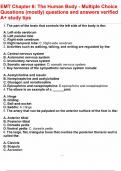
EMT Module 3 Exam (JBL) Ch. 13-18 exam set questions and answers correct and verified A+ Tips NEW!!!!
EMT Module 3 Exam (JBL) Ch. 13-18 exam set questions and answers correct and verified A+ Tips NEW!!!!1. A condition in which the internal body temperature falls below 95 degrees F (35 degrees celsius) 2. A state in which not enough oxygen is delivered to the tissues of the body, caused by low output of blood from the heart. It can be a severe complication of a large acute myocardial infarction, as well as other conditions 3. An extreme, life-threatening, systemic allergic reac- tion that may include shock and respiratory failure. 4. The part of the nervous system that controls the in- hypothermia cardiogenic shock anaphylaxis autonomic ner- voluntary activities of the body such as the heart rate, vous system blood pressure, and digestion of food. 5. The difference between the systolic and diastolic pressures 6. Shock that occurs when there is a block to blood flow in the heart or great vessels, causing an insufficient blood supply to the body's tissues. 7. The late stage of shock when blood pressure is falling. 8. The precontraction pressure in the heart as the vol- ume of blood builds up. 9. Circulatory failure caused by paralysis of the nerves that control the size of the blood vessels, leading to widespread dilation; seen in patients with spinal cord injuries 10. Developing a sensitivity to a substance that initially caused no allergic reaction. pulse pressure obstructive shock decompensated shock preload neurogenic shock sensitization 11. Loss of water from the tissues of the body. dehydration 12. The flow of blood through body tissues and vessels perfusion 13. The presence of abnormally large amounts of fluid between cells in body tissues, causing swelling of the affected area. 14. The force or resistance against which the heart pumps. 15. A blood clot that breaks off from a large vein and travels to the blood vessels of the lung, causing ob- struction of blood flow 16. Shock caused by a sudden, temporary reduction in blood supply to the brain that causes fainting (syn- cope). 17. Shock caused by severe infection, usually a bacterial infection. 18. A swelling or enlargement of the wall of a blood ves- sel that results from weakening of the vessel wall 19. A condition in which low blood volume, due to mas- sive internal or external bleeding or extensive loss of body water, results in inadequate perfusion 20. A condition in which the circulatory system fails to provide sufficient circulation to maintain normal cel- lular functions; also called hypoperfusion 21. The early stage of shock, in which the body can still compensate for blood loss. edema afterload pulmonary em- bolism psychogenic shock septic shock pulse pressure hypovolemic shock shock compensated shock 22. The ability of the heart muscle to contract. myocardial con- tractility 23. Severe shock caused by an allergic reaction anaphylactic shock 24. sphincters Muscles that encircle and, by contracting, constrict a duct, tube, or opening. Examples are found within the rectum, bladder, and blood vessels 25. A swelling or enlargement of the wall of a blood ves- sel that results from weakening of the vessel wall. 26. Compression of the heart as the result of buildup of blood or other fluid in the pericardial sac, leading to decreased cardiac output. aneurysm cardiac tampon- ade 27. A fainting spell or transient loss of consciousness syncope 28. A blue skin discoloration that is caused by a reduced level of oxygen in the blood. Although paleness, or a decrease in blood flow, can be difficult to detect in dark-skinned people, it may be observed by ex- amining mucous membranes inside the inner lower eyelid and capillary refill. On general observation, the patient may appear ashen or gray cyanosis 29. A balance of all systems of the body. homeostasis
Escuela, estudio y materia
- Institución
- EMT
- Grado
- EMT
Información del documento
- Subido en
- 17 de enero de 2025
- Número de páginas
- 13
- Escrito en
- 2024/2025
- Tipo
- Examen
- Contiene
- Preguntas y respuestas
Temas
-
emt module 3 exam jbl ch 13 18 exam set questio

Documento también disponible en un lote