lOMoAR cPSD| 48011787
Downloaded by Vincent kyalo
()
, lOMoAR cPSD| 48011787
COS1501/103/0/2022
STUDY UNIT 1
ACTIVITY 1-11:
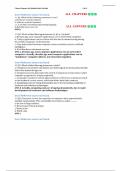
1. Factorising: If we need to factorise an expression of the form x2 + ax + b or (x2 – ax – b or
x2 + ax – b or x2 – ax + b) we need to find some c and some d such that a = c + d and b = (c)(d) and (x
+ c)(x + d) = x2 + ax + b.
(a) x2 + 6x + 9 = x x + (3x + 3x) + (3)(3)
= (x + 3)(x + 3)
(b) x2 – x – 2 = x x + (x – 2x) + (1)(-2)
= (x + 1)(x – 2)
(c) x2 – 5x + 6 = x x – 2x –3x + (-2)(-3)
= (x – 2)(x – 3)
(d) x2 + 4x – 12 = x x – 2x + 6x + (-2)(6)
= (x – 2)(x + 6)
2. Solve x2 − 4x + 4 = 0 by factorising.
Well, at school we learned that: the ‘+’ in front of the last term means that our factorised version x2 −
4x + 4 will be either of the form (x + ?)(x + ?) or of the form (x − ?)(x −? ), and that the ‘−’ in front of
the middle term tells us that our factorised version must be of the form (x − ?)(x − ?).
Experimenting with numbers that, when multiplied give us 4, we soon find that our factorised version has to be (x −
2)(x − 2), or (x − 2)2 if you prefer.
Our equation x2 − 4x + 4 = 0 may therefore be rewritten as (x − 2)2 = 0.
By Property 9, at least one of the factors on the left-hand side must be zero, and both factors are
(x - 2), so we get that x − 2 = 0 ie
that x = 2.
3. Complete the square to solve x2 – 4x = 12.
If x2 − 4x = 12
then x2 − 4x + 4 − 4 = 12 (by Property 8, since 4 − 4 = 0)
ie x2 − 4x + 4 = 12 + 4 (by Property 6 with k = 4)
ie (x − 2)2 = 16 (factorise)
ie x − 2 = 4 or x − 2 = −4 (taking square roots)
ie x = 6 or x = −2 (using Property 6 again, with k = 2).
4. Is 21 a prime number?
No. Refer to the definition of prime numbers on p 16. The
numbers 3 and 7 are factors of 21 (3 × 7 = 21).
5. What is the value of 5! (5 factorial)?
5! = 5 × 4 × 3 × 2 × 1 = 120.
2
Downloaded by Vincent kyalo ()
, lOMoAR cPSD| 48011787
COS1501/103/0/2022
STUDY UNIT 2
ACTIVITY 2-8
1. Define the words “even” and “odd” for positive integers.
Definitions:
- An integer n is even if n is a multiple of 2.
(We can say a positive integer n is even if n = 2k for some positive integer k. You can think of even positive
integers as numbers n of the form n = 2k, where k is some positive integer.) - An integer n is odd if n is not
even.
(Using the general form of an even positive integer, we can now say that n is odd if n = 2k + 1 for some positive
integer k. You can think of odd positive integers as numbers n of the form n = 2k + 1, where k is some positive
integer.)
2. Is it the case that m + (n k) = (m + n)(m + k) for all positive integers m, n and k?
Substitute a few values and see whether the idea is plausible.
Take m = 1, n = 2, and k = 3, then the left-hand side is m +
(n k) = 1 + (2 3) = 7 while the right-hand side becomes
(m + n)(m + k) = (1 + 2) (1 +3 ) = 3 4 = 12.
This is a counterexample to show that it is not the case that m + (n k) = (m + n) (m + k) for all positive integers m,
n and k.
3. Are there any even prime numbers besides 2?
No. Any even prime number other than 2 would have three factors: 1, because 1 is a factor of every number; 2,
because the number we are talking about is supposedly even; and the number itself, because a number is always a
factor of itself. But primes cannot have so many factors, which means that 2 is the only even prime number.
4. If m and n are even positive integers, is m + n even?
If m and n are even positive integers, then each is a multiple of 2, in other words
m = 2k for some k Z+. and n = 2j for some j Z+.
So m+n = 2k + 2j
= 2(k + j)
which means m + n is also even.
5. If m and n are odd positive integers, is m n odd?
If m and n are odd positive integers, then both m and n can be written in the following general form:
m = 2k + 1 for some k in Z+.
and n = 2j + 1 for some j in Z+.
So m n = (2k + 1)(2j + 1)
= 4kj + 2k + 2j + 1
= 2(2kj + k + j) + 1
which means that m n is odd .
An additional exercise:
If m and n are prime, is m + n and m − n prime?
3
Downloaded by Vincent kyalo
()
, lOMoAR cPSD| 48011787
COS1501/103/0/2022
No, not usually.
It can occasionally happen that m + n is also prime: take m = 3 and n = 2 then m + n = 5.
But for other values m + n may not be prime: take m = 3 and n = 7, for instance. 3 + 7 = 10 which is not a prime
number.
What about the difference between two prime numbers? The difference m − n will sometimes be prime and
sometimes not. E.g. 5 – 3 = 2, which is a prime number, but 23 – 3 = 20, which is not prime.
STUDY UNIT 3
ACTIVITY 3-3
1. In each of the following cases, describe the set more concisely, firstly using list notation and then using
set-builder notation.
(a) list notation: {0, 2, 4, 6, 8}. set-builder notation: {x Z≥ | x is an even non-negative integer and x <
10} (property description)
(b) The roster method: {−11, −9, −7, −5, −3, −1}.
There is more than one way (we give only two) to describe this set using set-builder notation:
{x Z | x is an odd negative integer and x > −13} (property description) or,
if you prefer:
{y Z | y is odd and −13 < y < 0} (property description)
(c) The roster method: { } = 0/
(because there does not exist an integer that is, at the same time, positive and less than 1).
In set-builder notation:
One possibility is {x < 1 | x Z+}.
(d) Because of the nature of real numbers, ie between any two real numbers a and b one can always find
another real number, namely (a + b)/2, it is not really possible to represent this set using the roster method.
In set-builder notation: {x R | x > 2}.
2. In each of the following cases, give an unambiguous description in English.
(a) {−1, 0, 1}:
One possibility is to speak of the set having −1, 0 and 1 as its only elements. Another is
to speak of the set of all integers greater than −2 and less than 2.
(b) {x R | 0 < x < 1 }: The set of all real numbers greater than 0 and less than 1.
(c) {0}:
Again we can give many descriptions of this set in English:
- The set having 0 as its only element.
- The set of all non-negative integers less than 1.
- The set of all integers greater than -1 and less than 1.
4
Downloaded by Vincent kyalo ()
Downloaded by Vincent kyalo
()
, lOMoAR cPSD| 48011787
COS1501/103/0/2022
STUDY UNIT 1
ACTIVITY 1-11:
1. Factorising: If we need to factorise an expression of the form x2 + ax + b or (x2 – ax – b or
x2 + ax – b or x2 – ax + b) we need to find some c and some d such that a = c + d and b = (c)(d) and (x
+ c)(x + d) = x2 + ax + b.
(a) x2 + 6x + 9 = x x + (3x + 3x) + (3)(3)
= (x + 3)(x + 3)
(b) x2 – x – 2 = x x + (x – 2x) + (1)(-2)
= (x + 1)(x – 2)
(c) x2 – 5x + 6 = x x – 2x –3x + (-2)(-3)
= (x – 2)(x – 3)
(d) x2 + 4x – 12 = x x – 2x + 6x + (-2)(6)
= (x – 2)(x + 6)
2. Solve x2 − 4x + 4 = 0 by factorising.
Well, at school we learned that: the ‘+’ in front of the last term means that our factorised version x2 −
4x + 4 will be either of the form (x + ?)(x + ?) or of the form (x − ?)(x −? ), and that the ‘−’ in front of
the middle term tells us that our factorised version must be of the form (x − ?)(x − ?).
Experimenting with numbers that, when multiplied give us 4, we soon find that our factorised version has to be (x −
2)(x − 2), or (x − 2)2 if you prefer.
Our equation x2 − 4x + 4 = 0 may therefore be rewritten as (x − 2)2 = 0.
By Property 9, at least one of the factors on the left-hand side must be zero, and both factors are
(x - 2), so we get that x − 2 = 0 ie
that x = 2.
3. Complete the square to solve x2 – 4x = 12.
If x2 − 4x = 12
then x2 − 4x + 4 − 4 = 12 (by Property 8, since 4 − 4 = 0)
ie x2 − 4x + 4 = 12 + 4 (by Property 6 with k = 4)
ie (x − 2)2 = 16 (factorise)
ie x − 2 = 4 or x − 2 = −4 (taking square roots)
ie x = 6 or x = −2 (using Property 6 again, with k = 2).
4. Is 21 a prime number?
No. Refer to the definition of prime numbers on p 16. The
numbers 3 and 7 are factors of 21 (3 × 7 = 21).
5. What is the value of 5! (5 factorial)?
5! = 5 × 4 × 3 × 2 × 1 = 120.
2
Downloaded by Vincent kyalo ()
, lOMoAR cPSD| 48011787
COS1501/103/0/2022
STUDY UNIT 2
ACTIVITY 2-8
1. Define the words “even” and “odd” for positive integers.
Definitions:
- An integer n is even if n is a multiple of 2.
(We can say a positive integer n is even if n = 2k for some positive integer k. You can think of even positive
integers as numbers n of the form n = 2k, where k is some positive integer.) - An integer n is odd if n is not
even.
(Using the general form of an even positive integer, we can now say that n is odd if n = 2k + 1 for some positive
integer k. You can think of odd positive integers as numbers n of the form n = 2k + 1, where k is some positive
integer.)
2. Is it the case that m + (n k) = (m + n)(m + k) for all positive integers m, n and k?
Substitute a few values and see whether the idea is plausible.
Take m = 1, n = 2, and k = 3, then the left-hand side is m +
(n k) = 1 + (2 3) = 7 while the right-hand side becomes
(m + n)(m + k) = (1 + 2) (1 +3 ) = 3 4 = 12.
This is a counterexample to show that it is not the case that m + (n k) = (m + n) (m + k) for all positive integers m,
n and k.
3. Are there any even prime numbers besides 2?
No. Any even prime number other than 2 would have three factors: 1, because 1 is a factor of every number; 2,
because the number we are talking about is supposedly even; and the number itself, because a number is always a
factor of itself. But primes cannot have so many factors, which means that 2 is the only even prime number.
4. If m and n are even positive integers, is m + n even?
If m and n are even positive integers, then each is a multiple of 2, in other words
m = 2k for some k Z+. and n = 2j for some j Z+.
So m+n = 2k + 2j
= 2(k + j)
which means m + n is also even.
5. If m and n are odd positive integers, is m n odd?
If m and n are odd positive integers, then both m and n can be written in the following general form:
m = 2k + 1 for some k in Z+.
and n = 2j + 1 for some j in Z+.
So m n = (2k + 1)(2j + 1)
= 4kj + 2k + 2j + 1
= 2(2kj + k + j) + 1
which means that m n is odd .
An additional exercise:
If m and n are prime, is m + n and m − n prime?
3
Downloaded by Vincent kyalo
()
, lOMoAR cPSD| 48011787
COS1501/103/0/2022
No, not usually.
It can occasionally happen that m + n is also prime: take m = 3 and n = 2 then m + n = 5.
But for other values m + n may not be prime: take m = 3 and n = 7, for instance. 3 + 7 = 10 which is not a prime
number.
What about the difference between two prime numbers? The difference m − n will sometimes be prime and
sometimes not. E.g. 5 – 3 = 2, which is a prime number, but 23 – 3 = 20, which is not prime.
STUDY UNIT 3
ACTIVITY 3-3
1. In each of the following cases, describe the set more concisely, firstly using list notation and then using
set-builder notation.
(a) list notation: {0, 2, 4, 6, 8}. set-builder notation: {x Z≥ | x is an even non-negative integer and x <
10} (property description)
(b) The roster method: {−11, −9, −7, −5, −3, −1}.
There is more than one way (we give only two) to describe this set using set-builder notation:
{x Z | x is an odd negative integer and x > −13} (property description) or,
if you prefer:
{y Z | y is odd and −13 < y < 0} (property description)
(c) The roster method: { } = 0/
(because there does not exist an integer that is, at the same time, positive and less than 1).
In set-builder notation:
One possibility is {x < 1 | x Z+}.
(d) Because of the nature of real numbers, ie between any two real numbers a and b one can always find
another real number, namely (a + b)/2, it is not really possible to represent this set using the roster method.
In set-builder notation: {x R | x > 2}.
2. In each of the following cases, give an unambiguous description in English.
(a) {−1, 0, 1}:
One possibility is to speak of the set having −1, 0 and 1 as its only elements. Another is
to speak of the set of all integers greater than −2 and less than 2.
(b) {x R | 0 < x < 1 }: The set of all real numbers greater than 0 and less than 1.
(c) {0}:
Again we can give many descriptions of this set in English:
- The set having 0 as its only element.
- The set of all non-negative integers less than 1.
- The set of all integers greater than -1 and less than 1.
4
Downloaded by Vincent kyalo ()