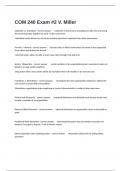
COM 240 Exam #2 V. Miller
Collective vs. Individual - correct answer -Collective is the process of putting recruits who are facing
the same boundary together to work "in the same boat"
-Individual mode allows recruits to accumulate experience separate from other newcomers
Formal v. Informal - correct answer Formal tactics in which newcomers are more or less separated
from others and trained on the job
-Informal tactics allow recruits to learn new roles through trial and error
Serial v. Disjunctive - correct answer -serial members of an organization groom newcomers who are
about to occupy similar positions
-Disjunctive when new comers either do not follow their role models or do not have one
Investiture v. Divestitiure - correct answer -Investiture the new organization embraces/ utilizes the
new comers current skills and qualities
-Divestiture organization strips employee of current characteristics in order to learn new ones
Pivotal (role Elements) - correct answer (required) behaviors an individual must accepts to join and
remain a member of an organization
Relevant (Role Elements) - correct answer (desired) behaviors an organization views as desirable or
good
Peripheral (Role Elements) - correct answer (tolerated) behaviors that are neither necessary nor
desired; if you get to it great, if not it doesn't matter
Obvert Questions (Info Seeking tactics) - correct answer Newcomer solicits info by asking direct
questions
, Observer (Info Seeking Tactics) - correct answer Newcomer solicits info by watching behavior
Surveillance (Info Seeking Tactics) - correct answer Newcomer solicits info by making sense of past
observed behavior
Third Parties (Info Seeking Tactics) - correct answer Newcomer solicits info by asking a secondary
source
Indirect Questions (Info Seeking Tactics) - correct answer Newcomer solicits info by asking non-
interrogative questions
Disguising Conversation (Info Seeking Tactics) - correct answer Newcomer disguising info to make
seem natural
Testing Limits (Info Seeking Tactics) - correct answer Newcomer deviates from organizational rules
and observes reactions
Secondary Adjustments (Forms of Role Making) - correct answer Doubling efforts in one or more
areas while selectively shrinking others
Enacting Peripheral Roles (Forms of Role Making) - correct answer doesnt matter either way
Role Negotiation (Forms of Role Making) - correct answer Interaction with another in order to change
role expectations
Uncertainty mangement - correct answer Sense-making:
-others' interpretations,
-past experiences, predispositions
-schema
Structured Interview Formats (BDI) - correct answer -Focuses on past behavior
Collective vs. Individual - correct answer -Collective is the process of putting recruits who are facing
the same boundary together to work "in the same boat"
-Individual mode allows recruits to accumulate experience separate from other newcomers
Formal v. Informal - correct answer Formal tactics in which newcomers are more or less separated
from others and trained on the job
-Informal tactics allow recruits to learn new roles through trial and error
Serial v. Disjunctive - correct answer -serial members of an organization groom newcomers who are
about to occupy similar positions
-Disjunctive when new comers either do not follow their role models or do not have one
Investiture v. Divestitiure - correct answer -Investiture the new organization embraces/ utilizes the
new comers current skills and qualities
-Divestiture organization strips employee of current characteristics in order to learn new ones
Pivotal (role Elements) - correct answer (required) behaviors an individual must accepts to join and
remain a member of an organization
Relevant (Role Elements) - correct answer (desired) behaviors an organization views as desirable or
good
Peripheral (Role Elements) - correct answer (tolerated) behaviors that are neither necessary nor
desired; if you get to it great, if not it doesn't matter
Obvert Questions (Info Seeking tactics) - correct answer Newcomer solicits info by asking direct
questions
, Observer (Info Seeking Tactics) - correct answer Newcomer solicits info by watching behavior
Surveillance (Info Seeking Tactics) - correct answer Newcomer solicits info by making sense of past
observed behavior
Third Parties (Info Seeking Tactics) - correct answer Newcomer solicits info by asking a secondary
source
Indirect Questions (Info Seeking Tactics) - correct answer Newcomer solicits info by asking non-
interrogative questions
Disguising Conversation (Info Seeking Tactics) - correct answer Newcomer disguising info to make
seem natural
Testing Limits (Info Seeking Tactics) - correct answer Newcomer deviates from organizational rules
and observes reactions
Secondary Adjustments (Forms of Role Making) - correct answer Doubling efforts in one or more
areas while selectively shrinking others
Enacting Peripheral Roles (Forms of Role Making) - correct answer doesnt matter either way
Role Negotiation (Forms of Role Making) - correct answer Interaction with another in order to change
role expectations
Uncertainty mangement - correct answer Sense-making:
-others' interpretations,
-past experiences, predispositions
-schema
Structured Interview Formats (BDI) - correct answer -Focuses on past behavior