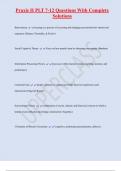
Praxis II PLT 7-12 Questions With Complete
Solutions
Behaviorism learning is a process of accessing and changing associations btw stimuli and
responses (Skinner, Thorndike, & Pavlov)
Social Cognitive Theory Focus on how people learn by observing one another (Bandura)
Information Processing Theory processes within learners' minds; learning, memory, and
performance
Constructivism people construct or create knowledge based on experiences and
interactions (Piaget & Bruner)
Sociocultural Theory combination of social, cultural, and historical contexts in which a
learner exists influence knowledge construction (Vygotsky)
3 Domains of Bloom's Taxonomy Cognitive, performance/psychomotor, affective
,Praxis II PLT 7-12 Questions With Complete
Solutions
Cognitive Domain (low ---> high) knowledge, comprehension, application, analysis,
synthesis, evaluation
Performance/Psychomotor Domain (low --->high) perception, set, guided responses,
mechanism, complex overt responses, adaptation, origination
Affective Domain (low ---> high) receiving phenomena, responding to phenomena,
valuing, organization, internalizing values
Bandura social/observational learning theory; children learn by observing others;
MODELING/learning vicariously
Distributed Cognition Bandura; a person can learn more from a group than s/he can alone
Bruner discovery learning and scaffolding
Dewey learning through experience; individuality, freedom of expression, project-based
learning, problem solving
,Praxis II PLT 7-12 Questions With Complete
Solutions
Erickson (7-12 Only) Adolescence (12-18)--identity v. role confusion, creating a sense of
identity
Gilligan stages of the ethics of care; female-centered
Kohlberg Theory of Moral Reasoning; 9-20 = conventional (good boy/girl, law and order)
Maslow Hierarchy of Needs; lower needs must be met before higher needs can be
satisfied (psychological --> safety --> love/belonging --> esteem --> self-actualization)
Montessori "follow the child"; introduce a concept, process / develop understanding,
"knowing"
Piaget (7-12 Only) Formal operational (11+)--use reason in hypothetical situations, use of
abstract thought
Skinner Operant conditioning; learning is a function of change in observable behavior
, Praxis II PLT 7-12 Questions With Complete
Solutions
Vygotsky zone of proximal development; socialization is key to learning
accomodation responding to a new event or object by changing an existing scheme or
creating a new scheme
assimilation responding to a new event or object that is consistent with an existing scheme
classical conditioning Pavlov; process of behavior modification that causes a person to
respond in a desired manner to what was once a neutral stimulus
conservation knowing that a number or amount stays the same when rearranged or
presented in a different shape
convergent thinking a process of gathering pieces of information to solve a problem
creativity new and original behavior that creates a culturally appropriate product
Solutions
Behaviorism learning is a process of accessing and changing associations btw stimuli and
responses (Skinner, Thorndike, & Pavlov)
Social Cognitive Theory Focus on how people learn by observing one another (Bandura)
Information Processing Theory processes within learners' minds; learning, memory, and
performance
Constructivism people construct or create knowledge based on experiences and
interactions (Piaget & Bruner)
Sociocultural Theory combination of social, cultural, and historical contexts in which a
learner exists influence knowledge construction (Vygotsky)
3 Domains of Bloom's Taxonomy Cognitive, performance/psychomotor, affective
,Praxis II PLT 7-12 Questions With Complete
Solutions
Cognitive Domain (low ---> high) knowledge, comprehension, application, analysis,
synthesis, evaluation
Performance/Psychomotor Domain (low --->high) perception, set, guided responses,
mechanism, complex overt responses, adaptation, origination
Affective Domain (low ---> high) receiving phenomena, responding to phenomena,
valuing, organization, internalizing values
Bandura social/observational learning theory; children learn by observing others;
MODELING/learning vicariously
Distributed Cognition Bandura; a person can learn more from a group than s/he can alone
Bruner discovery learning and scaffolding
Dewey learning through experience; individuality, freedom of expression, project-based
learning, problem solving
,Praxis II PLT 7-12 Questions With Complete
Solutions
Erickson (7-12 Only) Adolescence (12-18)--identity v. role confusion, creating a sense of
identity
Gilligan stages of the ethics of care; female-centered
Kohlberg Theory of Moral Reasoning; 9-20 = conventional (good boy/girl, law and order)
Maslow Hierarchy of Needs; lower needs must be met before higher needs can be
satisfied (psychological --> safety --> love/belonging --> esteem --> self-actualization)
Montessori "follow the child"; introduce a concept, process / develop understanding,
"knowing"
Piaget (7-12 Only) Formal operational (11+)--use reason in hypothetical situations, use of
abstract thought
Skinner Operant conditioning; learning is a function of change in observable behavior
, Praxis II PLT 7-12 Questions With Complete
Solutions
Vygotsky zone of proximal development; socialization is key to learning
accomodation responding to a new event or object by changing an existing scheme or
creating a new scheme
assimilation responding to a new event or object that is consistent with an existing scheme
classical conditioning Pavlov; process of behavior modification that causes a person to
respond in a desired manner to what was once a neutral stimulus
conservation knowing that a number or amount stays the same when rearranged or
presented in a different shape
convergent thinking a process of gathering pieces of information to solve a problem
creativity new and original behavior that creates a culturally appropriate product