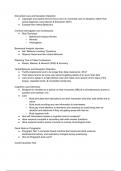
Nonverbal Cues and Deception Detection
● Laypeople and experts tend to focus more on nonverbal cues to deception rather than
actual diagnostic cues (Sporer & Schwandt, 2007)
● Example Non-Verbal Behaviors
Criminal Interrogation and Confessions
● Reid Technique
○ Behavioral Analysis Review
○ Miranda
○ Interrogation
Behavioral Analysis Interview
● Ask “Behavior Invoking” Questions
● Observe Verbal and Non-Verbal Behavior
Detecting True or False Confessions
● Kassin, Meisser, & Norwich (2005) & Accuracy
Verbal Behavior and Deception Detection
● Truthful statements tend to be longer than false statements. Why?
● Truth tellers tend to be more open about forgetting details of an event than liars
● Liars tend to speak in a high-pitched voice and make more speech errors (slips of the
tongue, repeated words, & incomplete sentences)
Cognitive Load Interviews
● Designed to mentally tax a person so that it becomes difficult to simultaneously answer a
question and maintain a lie
● Liars
○ Must formulate their fabrications and then remember what they said earlier and to
whom
○ Must avoid providing any new information to interviewers
○ Must pay more attention to demeanor and reactions to avoid being seen as
deceitful and determine if they are getting away with their lie
○ Must suppress truth
● How will interviewers impose a cognitive load on suspects?
● Have suspects complete a secondary task while answer questions
● Have suspects recall a series of events in reverse chronological order
Quick Note on Polygraphs
● Polygraph Test: A computer-based machine that measures blood pressure,
electrodermal activity, and respiratory changes during questioning.
● How do Polygraph tests work?
Control Question Test
● Laypeople and experts tend to focus more on nonverbal cues to deception rather than
actual diagnostic cues (Sporer & Schwandt, 2007)
● Example Non-Verbal Behaviors
Criminal Interrogation and Confessions
● Reid Technique
○ Behavioral Analysis Review
○ Miranda
○ Interrogation
Behavioral Analysis Interview
● Ask “Behavior Invoking” Questions
● Observe Verbal and Non-Verbal Behavior
Detecting True or False Confessions
● Kassin, Meisser, & Norwich (2005) & Accuracy
Verbal Behavior and Deception Detection
● Truthful statements tend to be longer than false statements. Why?
● Truth tellers tend to be more open about forgetting details of an event than liars
● Liars tend to speak in a high-pitched voice and make more speech errors (slips of the
tongue, repeated words, & incomplete sentences)
Cognitive Load Interviews
● Designed to mentally tax a person so that it becomes difficult to simultaneously answer a
question and maintain a lie
● Liars
○ Must formulate their fabrications and then remember what they said earlier and to
whom
○ Must avoid providing any new information to interviewers
○ Must pay more attention to demeanor and reactions to avoid being seen as
deceitful and determine if they are getting away with their lie
○ Must suppress truth
● How will interviewers impose a cognitive load on suspects?
● Have suspects complete a secondary task while answer questions
● Have suspects recall a series of events in reverse chronological order
Quick Note on Polygraphs
● Polygraph Test: A computer-based machine that measures blood pressure,
electrodermal activity, and respiratory changes during questioning.
● How do Polygraph tests work?
Control Question Test