BI532 Skills for Bioscientists II
Mini Project I
Immunochemistry
Immunochemistry II
Computational Analysis of Biological Sequences
Synapses: Sites of Cell-Cell Communications
Anatomy and Organisation of the Nervous System
, Mini Project I
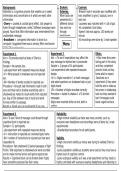
Histidine tagged protein purification
- Uses affinity chromatography to capture recombinant proteins that have been
engineered to possess many histidine tags.
- Immobilised metal affinity chromatography is commonly used as histidine
interacts most strongly to the metal ions.
- Histidine tags can be removed by a protease if it interferes with the function of
the protein or if the protein needs to be in its native state.
o Recombinant proteases can be made.
- Imidazole used to elute recombinant proteins.
Lactose analogue
- Isopropyl b-D-thiogalactopyranoside is a biology reagent that resembles
lactose and so binds to the lac operon repressor, allowing the transcription of
recombinant genes.
Lysozymes
- Glycoside hydrolase that cleaves 1,4-linkages (b) between NAG and NAM of
peptidoglycan cell walls. Compromises its integrity and leads to lysis.
- Doesn’t denature the protein of interest.
Tritan X-10
- Mild detergent used to solubilise proteins.
- Absorbs at 280 nm, so can interfere with protein quantitation.
MgCl2
- Precipitation of DNA by interacting with charges, making it less soluble.
Immunochemistry
- Antigen = antibody generation
Structure of an antibody
- Heavy chain = constant region
o C region = class (IgG, IgA).
- Light chain = variable region
o V region = specificity
- Upon further exposure to an antigen, antibodies increase their affinity each
time. Clonal selection allows for the selection of the most specific antibody to
bind to the foreign body.
Antibody titre
- A test that detects the presence of antibodies and measures the amount in a
sample of blood. The amount and diversity of antibodies signals the strength of
the person’s immune response.
- To produce an antibody serum.
- Animal injected with protein over a number of weeks.
- An adjuvant accelerates and prolongs the animal’s immune response.
Mini Project I
Immunochemistry
Immunochemistry II
Computational Analysis of Biological Sequences
Synapses: Sites of Cell-Cell Communications
Anatomy and Organisation of the Nervous System
, Mini Project I
Histidine tagged protein purification
- Uses affinity chromatography to capture recombinant proteins that have been
engineered to possess many histidine tags.
- Immobilised metal affinity chromatography is commonly used as histidine
interacts most strongly to the metal ions.
- Histidine tags can be removed by a protease if it interferes with the function of
the protein or if the protein needs to be in its native state.
o Recombinant proteases can be made.
- Imidazole used to elute recombinant proteins.
Lactose analogue
- Isopropyl b-D-thiogalactopyranoside is a biology reagent that resembles
lactose and so binds to the lac operon repressor, allowing the transcription of
recombinant genes.
Lysozymes
- Glycoside hydrolase that cleaves 1,4-linkages (b) between NAG and NAM of
peptidoglycan cell walls. Compromises its integrity and leads to lysis.
- Doesn’t denature the protein of interest.
Tritan X-10
- Mild detergent used to solubilise proteins.
- Absorbs at 280 nm, so can interfere with protein quantitation.
MgCl2
- Precipitation of DNA by interacting with charges, making it less soluble.
Immunochemistry
- Antigen = antibody generation
Structure of an antibody
- Heavy chain = constant region
o C region = class (IgG, IgA).
- Light chain = variable region
o V region = specificity
- Upon further exposure to an antigen, antibodies increase their affinity each
time. Clonal selection allows for the selection of the most specific antibody to
bind to the foreign body.
Antibody titre
- A test that detects the presence of antibodies and measures the amount in a
sample of blood. The amount and diversity of antibodies signals the strength of
the person’s immune response.
- To produce an antibody serum.
- Animal injected with protein over a number of weeks.
- An adjuvant accelerates and prolongs the animal’s immune response.