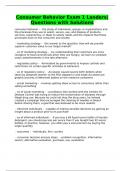
Consumer Behavior Exam 1 Landers|
Questions with Solutions
consumer behavior - -the study of individuals, groups, or organizations and
the processes they use to select, secure, use, and dispose of products,
services, experiences, or ideas to satisfy needs and the impacts that these
processes have on the consumer and society
- marketing strategy - -the answer to the question: How will we provide
superior customer value to our target market?
- ex of marketing strategy - -by understanding that customers are more
receptive to food commercials when they are hungry, we learn to schedule
snack advertisements in the late afternoon
- regulatory policy - -formulated by governments to impose controls and
restrictions on certain specific activities or behaviors
- ex of regulatory policy - -Accutane caused severe birth defects when
taken by pregnant women so the FDA stepped in and made Accutane put
graphic pictures of deformed babies on the medicine containers
- social marketing - -involves getting ideas across to consumers rather than
selling something
- ex of social marketing - -a professor who worked with the Centers for
Disease Control was trying to reduce the transmission of diseases through
illegal drug use. Because he could not stop the drug users, he instead
created a campaign that encouraged the cleaning of needles in bleach
before sharing them, a goal that was believed to be more realistic
- Informed Individuals - -capable of making sensible decisions by gaining an
insight about a product prior to its purchase
- ex of informed individuals - -if you buy a 64 liquid ounce bottle of laundry
detergent, you should pay less per ounce than if you bought two 32 ounce
bottles. In practice, however, you often pay a size premium by buying the
larger quantity
- outcomes - -individuals, firm, society
- consumer decision process steps - -problem recognition, information
search, alternative evaluation, purchase, use, evaluation
, - marketing strategy steps - -product, price, distribution, promotion, service
- market segmentation steps - -identify product-related need sets, group
customers with similar need sets, describe each group, select attractive
segments to target
- Market Analysis Components - -consumers, company, competitors,
conditions
- market segmentation - -a portion of a larger market whose needs differ
from the larger market
- consumer decisions process - -intervenes between the marketing strategy,
as implemented in the marketing mix, and the outcomes
- firm outcomes - -product position (image of the product in the consumer's
mind), sales and profit, customer satisfaction
- individual outcomes - -need satisfaction, injurious consumption
(consumption decisions that have negative consequences for long-run well-
being)
- society outcomes - -economic outcomes, physical environment outcomes,
social welfare
- outcomes of creating satisfied customers - -our total product +
competitors' total products = consumer decisions process--> superior value
expected--> sales--> perceived value delivered--> customer satisfaction
- external influences on consumer behavior - -culture, demographics and
social stratification, ethnic religious and regional subcultures, families and
households, groups
- Internal influences on consumer behavior - -perception, learning, memory,
motives, personality, emotions, attitudes
- self concept - -the totality of an individual's thoughts and feelings about
oneself
- lifestyle - -how one lives, including the products one buys, how one uses
them, what one thinks about them, and how one feels about them
- consumer decisions - -result from perceived problems and opportunities
- cultural values - -widely held beliefs that affirm what is desirable
Questions with Solutions
consumer behavior - -the study of individuals, groups, or organizations and
the processes they use to select, secure, use, and dispose of products,
services, experiences, or ideas to satisfy needs and the impacts that these
processes have on the consumer and society
- marketing strategy - -the answer to the question: How will we provide
superior customer value to our target market?
- ex of marketing strategy - -by understanding that customers are more
receptive to food commercials when they are hungry, we learn to schedule
snack advertisements in the late afternoon
- regulatory policy - -formulated by governments to impose controls and
restrictions on certain specific activities or behaviors
- ex of regulatory policy - -Accutane caused severe birth defects when
taken by pregnant women so the FDA stepped in and made Accutane put
graphic pictures of deformed babies on the medicine containers
- social marketing - -involves getting ideas across to consumers rather than
selling something
- ex of social marketing - -a professor who worked with the Centers for
Disease Control was trying to reduce the transmission of diseases through
illegal drug use. Because he could not stop the drug users, he instead
created a campaign that encouraged the cleaning of needles in bleach
before sharing them, a goal that was believed to be more realistic
- Informed Individuals - -capable of making sensible decisions by gaining an
insight about a product prior to its purchase
- ex of informed individuals - -if you buy a 64 liquid ounce bottle of laundry
detergent, you should pay less per ounce than if you bought two 32 ounce
bottles. In practice, however, you often pay a size premium by buying the
larger quantity
- outcomes - -individuals, firm, society
- consumer decision process steps - -problem recognition, information
search, alternative evaluation, purchase, use, evaluation
, - marketing strategy steps - -product, price, distribution, promotion, service
- market segmentation steps - -identify product-related need sets, group
customers with similar need sets, describe each group, select attractive
segments to target
- Market Analysis Components - -consumers, company, competitors,
conditions
- market segmentation - -a portion of a larger market whose needs differ
from the larger market
- consumer decisions process - -intervenes between the marketing strategy,
as implemented in the marketing mix, and the outcomes
- firm outcomes - -product position (image of the product in the consumer's
mind), sales and profit, customer satisfaction
- individual outcomes - -need satisfaction, injurious consumption
(consumption decisions that have negative consequences for long-run well-
being)
- society outcomes - -economic outcomes, physical environment outcomes,
social welfare
- outcomes of creating satisfied customers - -our total product +
competitors' total products = consumer decisions process--> superior value
expected--> sales--> perceived value delivered--> customer satisfaction
- external influences on consumer behavior - -culture, demographics and
social stratification, ethnic religious and regional subcultures, families and
households, groups
- Internal influences on consumer behavior - -perception, learning, memory,
motives, personality, emotions, attitudes
- self concept - -the totality of an individual's thoughts and feelings about
oneself
- lifestyle - -how one lives, including the products one buys, how one uses
them, what one thinks about them, and how one feels about them
- consumer decisions - -result from perceived problems and opportunities
- cultural values - -widely held beliefs that affirm what is desirable