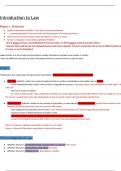
Introduction to Law
Roper v. Simmons
● Eighth amendment prohibits "cruel and unusual punishments"
● "…evolving standards of decency that mark the progress of a maturing society."
● Held: cannot execute someone who committed a crime as a minor
● Reason: analogous to executing cognitively disabled
-Was it always wrong & unconstitutional to execute minors or did it become wrong to execute minors?
-Supreme Court said the law has changed because times have changed. It wasn't wrong then, but we live in different times an
it is now, so we're changing it.
-Law consists of a set of rules and procedures usually intended to regulate some aspect of society.
-Laws are different from place to place, including country to country and even state to state.
Origins:
-Historically, two major types of legal systems developed- civil law systems and common law systems.
● Civil Law Systems- refers to a system based primarily on written constitutions and written laws or codes.
- a ruler/legislative body creates a set of rules or regulations to govern- who gave these rulers the power to make laws?, th
said God
- the role of courts is limited
- Ex: Code of Hammurabi- code of 282 laws inscribed on a stone pillar placed in the public hall for all to see; origin of "an ey
for an eye"; punishments were also dependent on rank in society- lower rank gets harsher punishments
● Common Law Systems- based on the concept of precedent, or stare decisis-"it stands decided"- people know what the law i
because of what it always has been, but customs still evolve
- laws originate from decisions of the court- court officials deciding laws are voted in/appointed by the people
- requires courts to follow decisions of earlier courts
- the written codes of the Constitution are subject to interpretation by the courts
- comes out of England because that's where we came from and adopted the same style
Plessi v. Ferguson- allowing segregation as long as it was equal
Brown v. Board of Education- separation is inherently unequal
Three Categories of Law:
● Whether the law is constitutional law, statutory law, or case law- the source
● Whether the law is substantive or procedural- the type
● Whether the law is criminal or civil- the parties in conflict
Roper v. Simmons
● Eighth amendment prohibits "cruel and unusual punishments"
● "…evolving standards of decency that mark the progress of a maturing society."
● Held: cannot execute someone who committed a crime as a minor
● Reason: analogous to executing cognitively disabled
-Was it always wrong & unconstitutional to execute minors or did it become wrong to execute minors?
-Supreme Court said the law has changed because times have changed. It wasn't wrong then, but we live in different times an
it is now, so we're changing it.
-Law consists of a set of rules and procedures usually intended to regulate some aspect of society.
-Laws are different from place to place, including country to country and even state to state.
Origins:
-Historically, two major types of legal systems developed- civil law systems and common law systems.
● Civil Law Systems- refers to a system based primarily on written constitutions and written laws or codes.
- a ruler/legislative body creates a set of rules or regulations to govern- who gave these rulers the power to make laws?, th
said God
- the role of courts is limited
- Ex: Code of Hammurabi- code of 282 laws inscribed on a stone pillar placed in the public hall for all to see; origin of "an ey
for an eye"; punishments were also dependent on rank in society- lower rank gets harsher punishments
● Common Law Systems- based on the concept of precedent, or stare decisis-"it stands decided"- people know what the law i
because of what it always has been, but customs still evolve
- laws originate from decisions of the court- court officials deciding laws are voted in/appointed by the people
- requires courts to follow decisions of earlier courts
- the written codes of the Constitution are subject to interpretation by the courts
- comes out of England because that's where we came from and adopted the same style
Plessi v. Ferguson- allowing segregation as long as it was equal
Brown v. Board of Education- separation is inherently unequal
Three Categories of Law:
● Whether the law is constitutional law, statutory law, or case law- the source
● Whether the law is substantive or procedural- the type
● Whether the law is criminal or civil- the parties in conflict