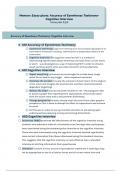
● A01 Accuracy of Eyewitness Testimony
Eyewitness Testimony: Legal term referring to an account given by people of an
event they’ve witnessed. Including : identification of perpetrators, details of the
crime scene
Cognitive Interview: The cognitive interview (CI) is a method of
interviewing eyewitnesses about what they can recall from a crime scene
or eventIt was developed as a way of improving EWT in order to enhance
recall and thus lead to more accurate conviction of the perpetrator
● A01 Cognitive Interview
Report everything- witnesses are encouraged to include every single
detail.Trivial details may trigger other important memories
Reinstate the context- visually the witness’s should return to the original
crime scene and imagine the environment and their emotions(context
dependent forgetting)
Reverse the order- events should be recalled in non -chronological order
to prevent people from reporting their expectations of the event rather
than the actual event and it also prevents dishonesty.
Change perspective- witness should recall the event from other people’s
perspective.This is done to disrupt the effect of expectations and schema
on recall
ECI-focuses on when to use eye contact and when to not,asking open
ended questions,reducing anxiety,minimising distractions
● A03 Cognitive Interview
Geiselman (1985) examined the effectiveness of the cognitive interview using
students who watched a video of a simulated crime.Two days later, participants
were interviewed using the standard police interview or the cognitive interview.
Those who were interviewed using the cognitive interview recalled significantly
more correct information than those interviewed using the standard interview.
This suggests that the cognitive interview is more effective than a standard
interview at eliciting information from eyewitnesses
limitation- amount of time and training needed to implement it technique may
not be appropriate to use for all police forces and all crimes where time and
Eyewitness Testimony: Legal term referring to an account given by people of an
event they’ve witnessed. Including : identification of perpetrators, details of the
crime scene
Cognitive Interview: The cognitive interview (CI) is a method of
interviewing eyewitnesses about what they can recall from a crime scene
or eventIt was developed as a way of improving EWT in order to enhance
recall and thus lead to more accurate conviction of the perpetrator
● A01 Cognitive Interview
Report everything- witnesses are encouraged to include every single
detail.Trivial details may trigger other important memories
Reinstate the context- visually the witness’s should return to the original
crime scene and imagine the environment and their emotions(context
dependent forgetting)
Reverse the order- events should be recalled in non -chronological order
to prevent people from reporting their expectations of the event rather
than the actual event and it also prevents dishonesty.
Change perspective- witness should recall the event from other people’s
perspective.This is done to disrupt the effect of expectations and schema
on recall
ECI-focuses on when to use eye contact and when to not,asking open
ended questions,reducing anxiety,minimising distractions
● A03 Cognitive Interview
Geiselman (1985) examined the effectiveness of the cognitive interview using
students who watched a video of a simulated crime.Two days later, participants
were interviewed using the standard police interview or the cognitive interview.
Those who were interviewed using the cognitive interview recalled significantly
more correct information than those interviewed using the standard interview.
This suggests that the cognitive interview is more effective than a standard
interview at eliciting information from eyewitnesses
limitation- amount of time and training needed to implement it technique may
not be appropriate to use for all police forces and all crimes where time and