Block Assignment 5
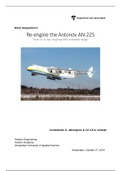
Re-engine the Antonov AN-225
“from six to four engines with extended range ”
Group: FT_AV2E-04
Consultants: D. Jatiningrum & J.P.J.E.A. Verbeek
Aviation Engineering
Aviation Academy
Amsterdam University of Applied Science
Amsterdam, October 27, 2019
,Cover picture by Sergiy Antonyuk, at Gostomel airport (2018)
2
, Reducing six engines to four
Name Student number
Cherish Gunputsing 500799360
Luwe Brouwer 500802400
Mutlu Atmaca 500802933
Yoon Fong Chong 500806473
Liam Kroes 500705425
Gijs Manders 500806172
For the degree of Bachelor of Applied Sciences at the University of Applied Science
Amsterdam
In the
University of Applied Sciences Amsterdam
Aviation Studies
© Group: FT_AV2E-04,2019
University of Applied Sciences Amsterdam
October 2019
All rights reserved. No part of this publication may be reproduced, stored in a retrieval system, or
transmitted, in any form or by any means, electronic, mechanical, photocopying, recording, or
otherwise, without the prior permission in writing from the proprietor.
3
,Table of content
Summary .................................................................................................................... 6
List of Symbols ........................................................................................................... 7
List of Abbreviations ................................................................................................... 8
1 Introduction ............................................................................................................ 10
2 Performance tables................................................................................................ 11
ISA Table .............................................................................................................. 11
2.1 Maximum Range Cruise .................................................................................. 13
2.1.2 Speed........................................................................................................ 13
2.1.3 Maximum Total Air Temperature ............................................................... 14
2.1.4 %N1 .......................................................................................................... 15
2.1.5 Calculate the Fuel Flow per Engine ...................................................... 15
2.2 Holding – Max Endurance ............................................................................... 16
2.2.1 Calculations............................................................................................... 16
2.3 Descent ........................................................................................................... 17
2.3.1 Calculation of the minimum glide angle ..................................................... 17
2.3.2 Calculation of the True Airspeed ............................................................... 17
2.3.4 Time .......................................................................................................... 18
2.3.5 Distance .................................................................................................... 18
2.3.6 Fuel ........................................................................................................... 19
2.4 Second Segment Climb ................................................................................... 20
2.4.1 About the second segment climb .............................................................. 20
2.4.2 Determine the lift coefficient and drag coefficient ...................................... 20
2.4.3 Required climb angle ................................................................................ 20
2.4.4 Maximum take-off thrust with n-1 .............................................................. 21
2.4.5 Determining the maximum weight ............................................................. 21
2.5 En-route climb .................................................................................................... 23
2.5.1 Lift and drag coefficients for max climb ................................................. 23
2.5.2 Maximum available thrust between two altitudes .................................. 23
2.5.3 Maximum climb angle ........................................................................... 23
2.5.4 Calculating the true airspeed ................................................................ 24
2.5.5 Calculating the vertical speed ............................................................... 24
2.5.6 Determining the time flown.................................................................... 25
2.5.7 Calculating the fuel used ....................................................................... 25
2.5.8 Determining the distance flown ............................................................. 26
4
, 2.5.9 Validation .............................................................................................. 26
2.6 Conclusion of the FPPM table’s ...................................................................... 32
3 The new turbofan ................................................................................................... 32
3.1 How can the new engine fit the criteria? .......................................................... 32
3.1.1 The Bypass ............................................................................................... 33
3.1.2 The core .................................................................................................... 36
3.2 Comparison of possible engines ..................................................................... 42
3.3 Possible modifications ..................................................................................... 43
4 Final recommendation and conclusion .................................................................. 44
4.1 Conclusions ..................................................................................................... 44
4.2 Advice.............................................................................................................. 45
Bibliography .............................................................................................................. 46
Appendix................................................................................................................... 48
Appendix A International Standard Atmosphere Table ............................................ 1
Appendix B Maximum Range Cruise Table ............................................................. 2
Appendix C En-Route Climb Table.......................................................................... 3
Appendix D Second Segment Climb From Sea Level ............................................. 4
Appendix E Second Segment Climb From 8000 ft. ................................................. 5
Appendix F Descent Table ...................................................................................... 6
Appendix G Holding Table ...................................................................................... 7
Appendix H Gas turbine Calculations Cruise........................................................... 8
Appendix I Gas Turbine Calculations Cruise Modifications ..................................... 9
5
,Summary
The objective was to decrease the engines from six to four engines and to increase
the range from 2160 Nm to 3200 Nm with a payload of 200 metric tons with 8% fuel
capacity left. First, FPPM’s for every flight phase except for take-off and landing were
made to determine the performance needed, then engine comparisons could be
made to fit the necessary flight performance. Lastly, modifications need to be
implemented in order to achieve the efficiency needed to increase the range to 3200
Nm.
The main question of this project is: ‘Which engine is most suitable to re-engine the
Antonov AN-225 Mriya, into a four-engine configuration with a minimum engine thrust
of 345 kN at sea level so that it is possible to fly at least 3200 Nm with a payload of
200 tons? Which modifications to that engine, if any, are needed to meet the
requirements?’
To answer this, FPPM’s of the second segment climb, en-route climb, cruise, descent
and holding were made. The outcome of these tables tells us what parameters are
needed for the selection of the new engine. The only parameters in the FPPM’s that
are necessary for engine selection are the thrust and Ct values. Because they are the
only values that are linked to the engine, whereas fuel flow is not, but is a product of
the two.
The GE-90-85B is the most suitable engine for the updated aircrafts’ performance. It
has more thrust than the 345 kN required. The only downside is the Ct value, which
is 0.0001689 N/N*s, will be changed during modifications. As well as its weight, but
this is beyond the scope of our report.
After this, engine calculations were made to see what modifications are needed. The
Ct value of 0.0001689 N/N*s, which is too high, must be changed to 0.0001419
N/N*s in order to reach the target range of 3200 nautical miles with 200 metric tons of
payload. Based on these calculations the following is advised to change:
- The BPR from 8.1 to 10.3
- The fan efficiency from 0.93 to 0.98
- The compressor efficiency from 0.91 to 0.97
- Turbine efficiency from 0.93 to 0.98
- The fuel nozzle efficiency from 0.95 to 0.98
- The exhaust efficiency from 0.95 to 0.97
6
, List of Symbols
Symbol Description Unit
a Speed of sound [m/s]
cD Drag coefficient [-]
cD0 Parasitic drag coefficient [-]
cL Lift coefficient [-]
c vertical speed [m/s]
CT Specific fuel consumption in [N/(N*s)]
D Drag [N]
e Oswald factor [-]
e Euler’s Number 2.71828…
g Earth-surface gravitational acceleration in [9.81 m/s2]
h Altitude [m]
L Lift [N]
p0 Pressure on sea level in [Pa]
ph Pressure at altitude h in [Pa]
Rs Specific gas constant [J/kg/K]
T Thrust [N]
T Temperature [K]
S Wing surface [m2]
𝜌0 Density on sea level in [kg/m3]
𝜌h Density at altitude h in [kg/m3]
Π Pi 3.14159…
𝛾 Heat capacity ratio of air or gas [-]
𝛾min Minimum glide angle [ft/min]
7
Re-engine the Antonov AN-225
“from six to four engines with extended range ”
Group: FT_AV2E-04
Consultants: D. Jatiningrum & J.P.J.E.A. Verbeek
Aviation Engineering
Aviation Academy
Amsterdam University of Applied Science
Amsterdam, October 27, 2019
,Cover picture by Sergiy Antonyuk, at Gostomel airport (2018)
2
, Reducing six engines to four
Name Student number
Cherish Gunputsing 500799360
Luwe Brouwer 500802400
Mutlu Atmaca 500802933
Yoon Fong Chong 500806473
Liam Kroes 500705425
Gijs Manders 500806172
For the degree of Bachelor of Applied Sciences at the University of Applied Science
Amsterdam
In the
University of Applied Sciences Amsterdam
Aviation Studies
© Group: FT_AV2E-04,2019
University of Applied Sciences Amsterdam
October 2019
All rights reserved. No part of this publication may be reproduced, stored in a retrieval system, or
transmitted, in any form or by any means, electronic, mechanical, photocopying, recording, or
otherwise, without the prior permission in writing from the proprietor.
3
,Table of content
Summary .................................................................................................................... 6
List of Symbols ........................................................................................................... 7
List of Abbreviations ................................................................................................... 8
1 Introduction ............................................................................................................ 10
2 Performance tables................................................................................................ 11
ISA Table .............................................................................................................. 11
2.1 Maximum Range Cruise .................................................................................. 13
2.1.2 Speed........................................................................................................ 13
2.1.3 Maximum Total Air Temperature ............................................................... 14
2.1.4 %N1 .......................................................................................................... 15
2.1.5 Calculate the Fuel Flow per Engine ...................................................... 15
2.2 Holding – Max Endurance ............................................................................... 16
2.2.1 Calculations............................................................................................... 16
2.3 Descent ........................................................................................................... 17
2.3.1 Calculation of the minimum glide angle ..................................................... 17
2.3.2 Calculation of the True Airspeed ............................................................... 17
2.3.4 Time .......................................................................................................... 18
2.3.5 Distance .................................................................................................... 18
2.3.6 Fuel ........................................................................................................... 19
2.4 Second Segment Climb ................................................................................... 20
2.4.1 About the second segment climb .............................................................. 20
2.4.2 Determine the lift coefficient and drag coefficient ...................................... 20
2.4.3 Required climb angle ................................................................................ 20
2.4.4 Maximum take-off thrust with n-1 .............................................................. 21
2.4.5 Determining the maximum weight ............................................................. 21
2.5 En-route climb .................................................................................................... 23
2.5.1 Lift and drag coefficients for max climb ................................................. 23
2.5.2 Maximum available thrust between two altitudes .................................. 23
2.5.3 Maximum climb angle ........................................................................... 23
2.5.4 Calculating the true airspeed ................................................................ 24
2.5.5 Calculating the vertical speed ............................................................... 24
2.5.6 Determining the time flown.................................................................... 25
2.5.7 Calculating the fuel used ....................................................................... 25
2.5.8 Determining the distance flown ............................................................. 26
4
, 2.5.9 Validation .............................................................................................. 26
2.6 Conclusion of the FPPM table’s ...................................................................... 32
3 The new turbofan ................................................................................................... 32
3.1 How can the new engine fit the criteria? .......................................................... 32
3.1.1 The Bypass ............................................................................................... 33
3.1.2 The core .................................................................................................... 36
3.2 Comparison of possible engines ..................................................................... 42
3.3 Possible modifications ..................................................................................... 43
4 Final recommendation and conclusion .................................................................. 44
4.1 Conclusions ..................................................................................................... 44
4.2 Advice.............................................................................................................. 45
Bibliography .............................................................................................................. 46
Appendix................................................................................................................... 48
Appendix A International Standard Atmosphere Table ............................................ 1
Appendix B Maximum Range Cruise Table ............................................................. 2
Appendix C En-Route Climb Table.......................................................................... 3
Appendix D Second Segment Climb From Sea Level ............................................. 4
Appendix E Second Segment Climb From 8000 ft. ................................................. 5
Appendix F Descent Table ...................................................................................... 6
Appendix G Holding Table ...................................................................................... 7
Appendix H Gas turbine Calculations Cruise........................................................... 8
Appendix I Gas Turbine Calculations Cruise Modifications ..................................... 9
5
,Summary
The objective was to decrease the engines from six to four engines and to increase
the range from 2160 Nm to 3200 Nm with a payload of 200 metric tons with 8% fuel
capacity left. First, FPPM’s for every flight phase except for take-off and landing were
made to determine the performance needed, then engine comparisons could be
made to fit the necessary flight performance. Lastly, modifications need to be
implemented in order to achieve the efficiency needed to increase the range to 3200
Nm.
The main question of this project is: ‘Which engine is most suitable to re-engine the
Antonov AN-225 Mriya, into a four-engine configuration with a minimum engine thrust
of 345 kN at sea level so that it is possible to fly at least 3200 Nm with a payload of
200 tons? Which modifications to that engine, if any, are needed to meet the
requirements?’
To answer this, FPPM’s of the second segment climb, en-route climb, cruise, descent
and holding were made. The outcome of these tables tells us what parameters are
needed for the selection of the new engine. The only parameters in the FPPM’s that
are necessary for engine selection are the thrust and Ct values. Because they are the
only values that are linked to the engine, whereas fuel flow is not, but is a product of
the two.
The GE-90-85B is the most suitable engine for the updated aircrafts’ performance. It
has more thrust than the 345 kN required. The only downside is the Ct value, which
is 0.0001689 N/N*s, will be changed during modifications. As well as its weight, but
this is beyond the scope of our report.
After this, engine calculations were made to see what modifications are needed. The
Ct value of 0.0001689 N/N*s, which is too high, must be changed to 0.0001419
N/N*s in order to reach the target range of 3200 nautical miles with 200 metric tons of
payload. Based on these calculations the following is advised to change:
- The BPR from 8.1 to 10.3
- The fan efficiency from 0.93 to 0.98
- The compressor efficiency from 0.91 to 0.97
- Turbine efficiency from 0.93 to 0.98
- The fuel nozzle efficiency from 0.95 to 0.98
- The exhaust efficiency from 0.95 to 0.97
6
, List of Symbols
Symbol Description Unit
a Speed of sound [m/s]
cD Drag coefficient [-]
cD0 Parasitic drag coefficient [-]
cL Lift coefficient [-]
c vertical speed [m/s]
CT Specific fuel consumption in [N/(N*s)]
D Drag [N]
e Oswald factor [-]
e Euler’s Number 2.71828…
g Earth-surface gravitational acceleration in [9.81 m/s2]
h Altitude [m]
L Lift [N]
p0 Pressure on sea level in [Pa]
ph Pressure at altitude h in [Pa]
Rs Specific gas constant [J/kg/K]
T Thrust [N]
T Temperature [K]
S Wing surface [m2]
𝜌0 Density on sea level in [kg/m3]
𝜌h Density at altitude h in [kg/m3]
Π Pi 3.14159…
𝛾 Heat capacity ratio of air or gas [-]
𝛾min Minimum glide angle [ft/min]
7