

1/7/25, 2:36 PM Advanced Pharmacology for Care of the Family-NR566-2025 update Complete questions and verified answers/100% accurate …
Advanced Pharmacology for Care of the
Family-NR566-2025 update Complete questions
and verified answers/100% accurate
answers|already graded A+
Practice questions for this set
Learn
Studied 7 terms
Nice work, you're crushing it
Continue studying in Learn
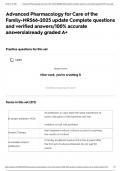
Terms in this set (371)
All antibiotics in class share the same mechanism of
action: disruption of the bacterial cell wall.
β-lactam antibiotic MOA
Inhibition of cell wall synthesis
start treatment without cultures or prior to receiving
Empiric Therapy
the results of a culture
Critically ill patients receive (Fill in the Answer) after
immediate empiric
the first set of cultures obtained; do not wait for
antibiotics
results.
https://quizlet.com/990339381/advanced-pharmacology-for-care-of-the-family-nr566-2025-update-complete-questions-and-verified-answers100-… 1/11
, 1/7/25, 2:36 PM Advanced Pharmacology for Care of the Family-NR566-2025 update Complete questions and verified answers/100% accurate …
Directly kill bacteria: Agents include
aminoglycosides, beta-lactams, fluoroquinolones,
metronidazole, most antimycobacterial agents,
streptogramins, and vancomycin.
Bactericidal antibiotics
preferred for immunocompromised patients such as
those with diabetes, HIV, or cancer and for those
who have overwhelming infections
inhibit bacterial proliferation while the host's immune
Bacteriostatic agents system does the killing. Agents include clindamycin,
macrolides, sulfonamides, and tetracyclines
Penicillins, Cephalosporins, Carbapenems,
β-lactam Antibiotics
Monobactams
Weaken bacterial cell wall by two actions:
Penicillins MOA (1) inhibition of transpeptidases
(2) disinhibition (activation) of autolysins.
Transpeptidases, Autolysins, and other bacterial
PBPs (Penicillin Binding enzymes are collectively named as because
Proteins) antibiotic class must bind to them to produce
antibacterial effects.
two layers: the cytoplasmic membrane and a
gram-positive bacteria relatively thick cell wall; penicillins are generally
very active against these organisms.
three layers: the cytoplasmic membrane, a relatively
thin cell wall, and an additional outer membrane;
gram-negative bacteria
only certain penicillins (e.g., ampicillin) are able to
cross and reach penicillin binding proteins (PBPs)
https://quizlet.com/990339381/advanced-pharmacology-for-care-of-the-family-nr566-2025-update-complete-questions-and-verified-answers100-… 2/11
Advanced Pharmacology for Care of the
Family-NR566-2025 update Complete questions
and verified answers/100% accurate
answers|already graded A+
Practice questions for this set
Learn
Studied 7 terms
Nice work, you're crushing it
Continue studying in Learn
Terms in this set (371)
All antibiotics in class share the same mechanism of
action: disruption of the bacterial cell wall.
β-lactam antibiotic MOA
Inhibition of cell wall synthesis
start treatment without cultures or prior to receiving
Empiric Therapy
the results of a culture
Critically ill patients receive (Fill in the Answer) after
immediate empiric
the first set of cultures obtained; do not wait for
antibiotics
results.
https://quizlet.com/990339381/advanced-pharmacology-for-care-of-the-family-nr566-2025-update-complete-questions-and-verified-answers100-… 1/11
, 1/7/25, 2:36 PM Advanced Pharmacology for Care of the Family-NR566-2025 update Complete questions and verified answers/100% accurate …
Directly kill bacteria: Agents include
aminoglycosides, beta-lactams, fluoroquinolones,
metronidazole, most antimycobacterial agents,
streptogramins, and vancomycin.
Bactericidal antibiotics
preferred for immunocompromised patients such as
those with diabetes, HIV, or cancer and for those
who have overwhelming infections
inhibit bacterial proliferation while the host's immune
Bacteriostatic agents system does the killing. Agents include clindamycin,
macrolides, sulfonamides, and tetracyclines
Penicillins, Cephalosporins, Carbapenems,
β-lactam Antibiotics
Monobactams
Weaken bacterial cell wall by two actions:
Penicillins MOA (1) inhibition of transpeptidases
(2) disinhibition (activation) of autolysins.
Transpeptidases, Autolysins, and other bacterial
PBPs (Penicillin Binding enzymes are collectively named as because
Proteins) antibiotic class must bind to them to produce
antibacterial effects.
two layers: the cytoplasmic membrane and a
gram-positive bacteria relatively thick cell wall; penicillins are generally
very active against these organisms.
three layers: the cytoplasmic membrane, a relatively
thin cell wall, and an additional outer membrane;
gram-negative bacteria
only certain penicillins (e.g., ampicillin) are able to
cross and reach penicillin binding proteins (PBPs)
https://quizlet.com/990339381/advanced-pharmacology-for-care-of-the-family-nr566-2025-update-complete-questions-and-verified-answers100-… 2/11

