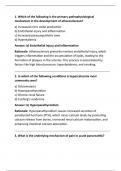
1. Which of the following is the primary pathophysiological
mechanism in the development of atherosclerosis?
a) Increased nitric oxide production
b) Endothelial injury and inflammation
c) Increased parasympathetic tone
d) Hyperkalemia
Answer: b) Endothelial injury and inflammation
Rationale: Atherosclerosis primarily involves endothelial injury, which
triggers inflammation and the accumulation of lipids, leading to the
formation of plaques in the arteries. This process is exacerbated by
factors like high blood pressure, hyperlipidemia, and smoking.
2. In which of the following conditions is hypercalcemia most
commonly seen?
a) Osteomalacia
b) Hyperparathyroidism
c) Chronic renal failure
d) Cushing's syndrome
Answer: b) Hyperparathyroidism
Rationale: Hyperparathyroidism causes increased secretion of
parathyroid hormone (PTH), which raises calcium levels by promoting
calcium release from bones, increased renal calcium reabsorption, and
enhancing intestinal calcium absorption.
3. What is the underlying mechanism of pain in acute pancreatitis?
,a) Direct pancreatic tissue necrosis
b) Increased intra-abdominal pressure
c) Bile duct obstruction
d) Acidosis-induced pain receptors stimulation
Answer: a) Direct pancreatic tissue necrosis
Rationale: In acute pancreatitis, the primary mechanism of pain is the
direct injury to the pancreatic tissue and the release of inflammatory
mediators, leading to pain. Additionally, the release of enzymes into the
surrounding tissue contributes to local inflammation and edema, which
increases the pain response.
4. Which of the following best describes the pathophysiological
changes in asthma?
a) Increased airway smooth muscle relaxation
b) Decreased airway resistance
c) Airway inflammation and bronchoconstriction
d) Impaired surfactant production
Answer: c) Airway inflammation and bronchoconstriction
Rationale: Asthma is characterized by chronic airway inflammation,
which causes bronchoconstriction and mucus hypersecretion, leading to
airway obstruction and respiratory symptoms. This inflammation is
often triggered by allergens or irritants.
5. Which of the following lab findings is most consistent with diabetic
ketoacidosis (DKA)?
a) Hyperglycemia with decreased urine ketones
b) Hyponatremia with low blood glucose
, c) Metabolic acidosis with elevated blood glucose and ketones
d) Hyperkalemia with normal blood glucose
Answer: c) Metabolic acidosis with elevated blood glucose and
ketones
Rationale: Diabetic ketoacidosis (DKA) is characterized by
hyperglycemia, metabolic acidosis, and elevated ketone bodies. This
occurs due to insulin deficiency, leading to fat breakdown and ketone
production, which results in acidosis.
6. In congestive heart failure (CHF), which of the following
compensatory mechanisms is most responsible for worsening fluid
retention?
a) Increased sympathetic nervous system activity
b) Decreased angiotensin II levels
c) Reduced aldosterone secretion
d) Increased natriuretic peptide production
Answer: a) Increased sympathetic nervous system activity
Rationale: In CHF, the body activates the sympathetic nervous system to
increase heart rate and contractility. However, prolonged activation of
this system leads to vasoconstriction, increased afterload, and
stimulation of the renin-angiotensin-aldosterone system (RAAS), which
exacerbates fluid retention and worsens heart failure.
7. Which of the following is a characteristic feature of cirrhosis?
a) Loss of bile production
b) Fibrosis and scarring of liver tissue
mechanism in the development of atherosclerosis?
a) Increased nitric oxide production
b) Endothelial injury and inflammation
c) Increased parasympathetic tone
d) Hyperkalemia
Answer: b) Endothelial injury and inflammation
Rationale: Atherosclerosis primarily involves endothelial injury, which
triggers inflammation and the accumulation of lipids, leading to the
formation of plaques in the arteries. This process is exacerbated by
factors like high blood pressure, hyperlipidemia, and smoking.
2. In which of the following conditions is hypercalcemia most
commonly seen?
a) Osteomalacia
b) Hyperparathyroidism
c) Chronic renal failure
d) Cushing's syndrome
Answer: b) Hyperparathyroidism
Rationale: Hyperparathyroidism causes increased secretion of
parathyroid hormone (PTH), which raises calcium levels by promoting
calcium release from bones, increased renal calcium reabsorption, and
enhancing intestinal calcium absorption.
3. What is the underlying mechanism of pain in acute pancreatitis?
,a) Direct pancreatic tissue necrosis
b) Increased intra-abdominal pressure
c) Bile duct obstruction
d) Acidosis-induced pain receptors stimulation
Answer: a) Direct pancreatic tissue necrosis
Rationale: In acute pancreatitis, the primary mechanism of pain is the
direct injury to the pancreatic tissue and the release of inflammatory
mediators, leading to pain. Additionally, the release of enzymes into the
surrounding tissue contributes to local inflammation and edema, which
increases the pain response.
4. Which of the following best describes the pathophysiological
changes in asthma?
a) Increased airway smooth muscle relaxation
b) Decreased airway resistance
c) Airway inflammation and bronchoconstriction
d) Impaired surfactant production
Answer: c) Airway inflammation and bronchoconstriction
Rationale: Asthma is characterized by chronic airway inflammation,
which causes bronchoconstriction and mucus hypersecretion, leading to
airway obstruction and respiratory symptoms. This inflammation is
often triggered by allergens or irritants.
5. Which of the following lab findings is most consistent with diabetic
ketoacidosis (DKA)?
a) Hyperglycemia with decreased urine ketones
b) Hyponatremia with low blood glucose
, c) Metabolic acidosis with elevated blood glucose and ketones
d) Hyperkalemia with normal blood glucose
Answer: c) Metabolic acidosis with elevated blood glucose and
ketones
Rationale: Diabetic ketoacidosis (DKA) is characterized by
hyperglycemia, metabolic acidosis, and elevated ketone bodies. This
occurs due to insulin deficiency, leading to fat breakdown and ketone
production, which results in acidosis.
6. In congestive heart failure (CHF), which of the following
compensatory mechanisms is most responsible for worsening fluid
retention?
a) Increased sympathetic nervous system activity
b) Decreased angiotensin II levels
c) Reduced aldosterone secretion
d) Increased natriuretic peptide production
Answer: a) Increased sympathetic nervous system activity
Rationale: In CHF, the body activates the sympathetic nervous system to
increase heart rate and contractility. However, prolonged activation of
this system leads to vasoconstriction, increased afterload, and
stimulation of the renin-angiotensin-aldosterone system (RAAS), which
exacerbates fluid retention and worsens heart failure.
7. Which of the following is a characteristic feature of cirrhosis?
a) Loss of bile production
b) Fibrosis and scarring of liver tissue