1
The Riemann Integral
Let 𝑓 be a bounded real valued function on [𝑎, 𝑏] (𝑎, 𝑏 finite). Let
𝑃 = {𝑥0 , 𝑥1 , … , 𝑥𝑛 } be a partition of [𝑎, 𝑏]:
𝑎 = 𝑥0 < 𝑥1 < 𝑥2 < ⋯ < 𝑥𝑛 = 𝑏.
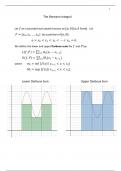
We define the lower and upper Darboux sums for 𝑓 and 𝑃 by:
𝐿(𝑓, 𝑃) = ∑𝑛𝑖=1 𝑚𝑖 (𝑥𝑖 − 𝑥𝑖−1 )
𝑈(𝑓, 𝑃) = ∑𝑛𝑖=1 𝑀𝑖 (𝑥𝑖 − 𝑥𝑖−1 )
where 𝑚𝑖 = inf {𝑓 (𝑥 )| 𝑥𝑖−1 < 𝑥 < 𝑥𝑖 }
𝑀𝑖 = sup {𝑓(𝑥)| 𝑥𝑖−1 < 𝑥 < 𝑥𝑖 }.
Lower Darboux Sum Upper Darboux Sum
, 2
We define the lower and upper Riemann sums of 𝒇 over [𝑎, 𝑏] as:
𝑏
∫_𝑎 𝑓 = sup{𝐿(𝑓, 𝑃)| 𝑃 𝑎 𝑝𝑎𝑟𝑡𝑖𝑡𝑖𝑜𝑛 𝑜𝑓 [𝑎, 𝑏]}
𝑏̅
∫𝑎 𝑓 = inf{𝑈(𝑓, 𝑃)| 𝑃 𝑎 𝑝𝑎𝑟𝑡𝑖𝑡𝑖𝑜𝑛 𝑜𝑓 [𝑎, 𝑏]}.
Since 𝑓 is bounded and [𝑎, 𝑏] has finite length, 𝐿(𝑓, 𝑃) ≤ 𝑈(𝑓, 𝑃) and
𝑏 𝑏̅
∫_𝑎 𝑓 ≤ ∫𝑎 𝑓 .
𝑏 𝑏̅
If ∫_𝑎 𝑓 = ∫𝑎 𝑓 we say that 𝑓 is Riemann integrable over [𝒂, 𝒃].
Proposition: If 𝑃′ is a refinement of 𝑃 (i.e. 𝑃′ contains all of the points of 𝑃 plus
others) then 𝐿(𝑓, 𝑃′ ) ≥ 𝐿(𝑓, 𝑃) and 𝑈(𝑓, 𝑃′ ) ≤ 𝑈(𝑓, 𝑃).
Proof. Choose any subinterval 𝑥𝑖−1 ≤ 𝑥 ≤ 𝑥𝑖 and add a point 𝑡.
𝑎 𝑥𝑖−1 𝑡 𝑥𝑖 𝑏
Let 𝑚𝑖′ = inf 𝑓(𝑥) and 𝑚𝑖′′ = inf 𝑓(𝑥).
𝑥𝑖−1 ≤𝑥≤𝑡 𝑡≤𝑥≤𝑥𝑖
Then 𝑚𝑖 ′ ≥ 𝑚𝑖 and 𝑚𝑖 ′′ ≥ 𝑚𝑖 .
The Riemann Integral
Let 𝑓 be a bounded real valued function on [𝑎, 𝑏] (𝑎, 𝑏 finite). Let
𝑃 = {𝑥0 , 𝑥1 , … , 𝑥𝑛 } be a partition of [𝑎, 𝑏]:
𝑎 = 𝑥0 < 𝑥1 < 𝑥2 < ⋯ < 𝑥𝑛 = 𝑏.
We define the lower and upper Darboux sums for 𝑓 and 𝑃 by:
𝐿(𝑓, 𝑃) = ∑𝑛𝑖=1 𝑚𝑖 (𝑥𝑖 − 𝑥𝑖−1 )
𝑈(𝑓, 𝑃) = ∑𝑛𝑖=1 𝑀𝑖 (𝑥𝑖 − 𝑥𝑖−1 )
where 𝑚𝑖 = inf {𝑓 (𝑥 )| 𝑥𝑖−1 < 𝑥 < 𝑥𝑖 }
𝑀𝑖 = sup {𝑓(𝑥)| 𝑥𝑖−1 < 𝑥 < 𝑥𝑖 }.
Lower Darboux Sum Upper Darboux Sum
, 2
We define the lower and upper Riemann sums of 𝒇 over [𝑎, 𝑏] as:
𝑏
∫_𝑎 𝑓 = sup{𝐿(𝑓, 𝑃)| 𝑃 𝑎 𝑝𝑎𝑟𝑡𝑖𝑡𝑖𝑜𝑛 𝑜𝑓 [𝑎, 𝑏]}
𝑏̅
∫𝑎 𝑓 = inf{𝑈(𝑓, 𝑃)| 𝑃 𝑎 𝑝𝑎𝑟𝑡𝑖𝑡𝑖𝑜𝑛 𝑜𝑓 [𝑎, 𝑏]}.
Since 𝑓 is bounded and [𝑎, 𝑏] has finite length, 𝐿(𝑓, 𝑃) ≤ 𝑈(𝑓, 𝑃) and
𝑏 𝑏̅
∫_𝑎 𝑓 ≤ ∫𝑎 𝑓 .
𝑏 𝑏̅
If ∫_𝑎 𝑓 = ∫𝑎 𝑓 we say that 𝑓 is Riemann integrable over [𝒂, 𝒃].
Proposition: If 𝑃′ is a refinement of 𝑃 (i.e. 𝑃′ contains all of the points of 𝑃 plus
others) then 𝐿(𝑓, 𝑃′ ) ≥ 𝐿(𝑓, 𝑃) and 𝑈(𝑓, 𝑃′ ) ≤ 𝑈(𝑓, 𝑃).
Proof. Choose any subinterval 𝑥𝑖−1 ≤ 𝑥 ≤ 𝑥𝑖 and add a point 𝑡.
𝑎 𝑥𝑖−1 𝑡 𝑥𝑖 𝑏
Let 𝑚𝑖′ = inf 𝑓(𝑥) and 𝑚𝑖′′ = inf 𝑓(𝑥).
𝑥𝑖−1 ≤𝑥≤𝑡 𝑡≤𝑥≤𝑥𝑖
Then 𝑚𝑖 ′ ≥ 𝑚𝑖 and 𝑚𝑖 ′′ ≥ 𝑚𝑖 .