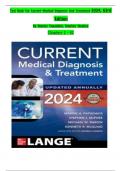
Test Bank For Current Medical Diagnosis And Treatment
x IIll x IIll x IIll x IIll x IIll x IIll x IIll x IIll 2024, 63rd
x IIll
x IIll Edition
By Maxine Papadakis, Stephen Mcphee
x IIll x IIll x IIll x IIll
Chapters 1 - 42 x
IIll x
IIll x IIll
, Chapter x1. x Disease x Prevention x & xHealth xPromotion
Il IIll IIll IIll Il Il
1. x Which x of x the x following x behaviors x indicates x the x highest x potential x for x spreading
IIll IIll IIll IIll IIll IIll IIll IIll IIll IIll IIll
x infections x among x clients? x The x nurse:
IIll IIll IIll IIll IIll
1) disinfects x dirty xhands x with xantibacterial xsoap. IIll Il IIll Il Il
2) allows xalcohol-based x rub x to xdry xfor x 10 x seconds.
IIll IIll IIll Il Il IIll IIll
3) washes x hands x only xafter x leaving xeach xroom. IIll IIll Il IIll Il Il
4) uses xcold x water x for xmedical x asepsis.
Il IIll IIll Ill IIll
2. xWhat x is x the x most x frequent x cause x of x the x spread x of x infection x among x institutionalized
IIll IIll IIll IIll IIll IIll IIll IIll IIll IIll IIll IIll IIll
patients?
1) Airborne xmicrobes x from x other xpatients Il IIll IIll Il
2) Contact xwith xcontaminated x equipment Il Il IIll
3) Hands x of xhealthcare x workers IIll Il IIll
4) Exposure xfrom x family xmembers Il IIll Il
3. x Which x of x the x following x nursing x activities x is x of x highest x priority x for x maintaining
IIll IIll IIll IIll IIll IIll IIll IIll IIll IIll IIll IIll
x
IIll medical x asepsis? IIll
1) Washing xhands Il
2) Donning xgloves Il
3) Applying xsterile xdrapes Il Il
4) Wearing x a x gown IIll IIll
4. xA xpatient x infected x with xa x virus x but xwho xdoes x not x have xany x outward x sign x of xthe
Il Il IIll IIll Il IIll IIll Il Il IIll IIll Il IIll IIll IIll Il
disease x is x considered x a:
x
Il IIll IIll IIll
1) pathogen.
2) fomite.
3) vector.
4) carrier.
5. x A x patient x is x admitted x to x the x hospital x with x tuberculosis. x Which x precautions x must
IIll IIll IIll IIll IIll IIll IIll IIll IIll IIll IIll IIll
x the x nurse x institute x when x caring x for x this x patient?
IIll IIll IIll IIll IIll IIll IIll IIll
1) Droplet xtransmission Il
2) Airborne xtransmission Il
3) Direct xcontact Il
4) Indirect xcontact Il
, 6. xA xpatient x becomes x infected x with x oral x candidiasis x (thrush) xwhile x receiving
Il Il IIll IIll IIll IIll IIll IIll Il IIll
x
IIllintravenous x antibiotics x to x treat x a x systemic x infection. x Which x type x of x infection x has
IIll IIll IIll IIll IIll IIll IIll IIll IIll IIll IIll
xIIllthe x patient x developed?
IIll IIll
1) Endogenous xnosocomial Il
2) Exogenous xnosocomial Il
3) Latent
4) Primary
7.The xnurse xassists xa xsurgeon xwith xcentral xvenous x catheter x insertion. xWhich
IIl Il Il Il Il Il Il IIll IIll Il
x
IIllaction x is x necessary x to x help x maintain x sterile x technique?
IIll IIll IIll IIll IIll IIll IIll
1) Closing xthe xpatients x door x to x limit xroom x traffic x while x preparing x the xsterile x field Il Il IIll IIll IIll Il IIll IIll IIll IIll Il IIll
2) Using xclean xprocedure x gloves x to xhandle x sterile xequipment Il Il IIll IIll Il IIll Il
3) Placing xthe x nonsterile xsyringes x containing xflush xsolution x on x the xsterile x field Il IIll Il IIll Il Il IIll IIll Il IIll
4) Remaining x6 x inches x away x from xthe xsterile x field x during xthe x procedure Il IIll IIll IIll IIll Il IIll IIll Il IIll
x I xI 8.A x patient x admitted x to x the x hospital x with x pneumonia x has x been
l l I I l l IIll IIll IIll IIll IIll IIll IIll IIll IIll
x receiving x antibiotics x for x 2 x days. x His x condition x has x stabilized, x and x his x temperature
IIll IIll IIll IIll IIll IIll IIll IIll IIll IIll IIll IIll
x has x returned x to x normal. x Which x stage x of x infection x is x the x patient x most x likely
IIll IIll IIll IIll IIll IIll IIll IIll IIll IIll IIll IIll IIll
x experiencing?
IIll
1) Incubation
2) Prodromal
3) Decline
4) Convalescence
5) 8.
9. x A x patient x develops x localized x heat x and x erythema x over x an x area x on x the x lower
IIll IIll IIll IIll IIll IIll IIll IIll IIll IIll IIll IIll IIll
x leg. x These x findings x are x indicative x of x which x secondary x defense x against x infection?
IIll IIll IIll IIll IIll IIll IIll IIll IIll IIll IIll
1) Phagocytosis
2) Complement x cascade IIll
3) Inflammation
4) Immunity
10. x The x patient x suddenly x develops x hives, x shortness x of x breath, x and x wheezing x after
IIll IIll IIll IIll IIll IIll IIll IIll IIll IIll IIll
xreceiving x an x antibiotic. x Which x antibody x is x primarily x responsible x for x this x patients
IIll IIll IIll IIll IIll IIll IIll IIll IIll IIll IIll
x response?
IIll
1) IgA
2) IgE
3) IgG
4) IgM
11. x What x type x of x immunity x is xprovided x by x intravenous x (IV)
IIll IIll IIll IIll IIll IIll IIll IIll IIll
, x
IIlladministration x of x immunoglobulin x G?
IIll IIll IIll
1) Cell-mediated
2) Passive
3) Humoral
4) Active
x IIll x IIll x IIll x IIll x IIll x IIll x IIll x IIll 2024, 63rd
x IIll
x IIll Edition
By Maxine Papadakis, Stephen Mcphee
x IIll x IIll x IIll x IIll
Chapters 1 - 42 x
IIll x
IIll x IIll
, Chapter x1. x Disease x Prevention x & xHealth xPromotion
Il IIll IIll IIll Il Il
1. x Which x of x the x following x behaviors x indicates x the x highest x potential x for x spreading
IIll IIll IIll IIll IIll IIll IIll IIll IIll IIll IIll
x infections x among x clients? x The x nurse:
IIll IIll IIll IIll IIll
1) disinfects x dirty xhands x with xantibacterial xsoap. IIll Il IIll Il Il
2) allows xalcohol-based x rub x to xdry xfor x 10 x seconds.
IIll IIll IIll Il Il IIll IIll
3) washes x hands x only xafter x leaving xeach xroom. IIll IIll Il IIll Il Il
4) uses xcold x water x for xmedical x asepsis.
Il IIll IIll Ill IIll
2. xWhat x is x the x most x frequent x cause x of x the x spread x of x infection x among x institutionalized
IIll IIll IIll IIll IIll IIll IIll IIll IIll IIll IIll IIll IIll
patients?
1) Airborne xmicrobes x from x other xpatients Il IIll IIll Il
2) Contact xwith xcontaminated x equipment Il Il IIll
3) Hands x of xhealthcare x workers IIll Il IIll
4) Exposure xfrom x family xmembers Il IIll Il
3. x Which x of x the x following x nursing x activities x is x of x highest x priority x for x maintaining
IIll IIll IIll IIll IIll IIll IIll IIll IIll IIll IIll IIll
x
IIll medical x asepsis? IIll
1) Washing xhands Il
2) Donning xgloves Il
3) Applying xsterile xdrapes Il Il
4) Wearing x a x gown IIll IIll
4. xA xpatient x infected x with xa x virus x but xwho xdoes x not x have xany x outward x sign x of xthe
Il Il IIll IIll Il IIll IIll Il Il IIll IIll Il IIll IIll IIll Il
disease x is x considered x a:
x
Il IIll IIll IIll
1) pathogen.
2) fomite.
3) vector.
4) carrier.
5. x A x patient x is x admitted x to x the x hospital x with x tuberculosis. x Which x precautions x must
IIll IIll IIll IIll IIll IIll IIll IIll IIll IIll IIll IIll
x the x nurse x institute x when x caring x for x this x patient?
IIll IIll IIll IIll IIll IIll IIll IIll
1) Droplet xtransmission Il
2) Airborne xtransmission Il
3) Direct xcontact Il
4) Indirect xcontact Il
, 6. xA xpatient x becomes x infected x with x oral x candidiasis x (thrush) xwhile x receiving
Il Il IIll IIll IIll IIll IIll IIll Il IIll
x
IIllintravenous x antibiotics x to x treat x a x systemic x infection. x Which x type x of x infection x has
IIll IIll IIll IIll IIll IIll IIll IIll IIll IIll IIll
xIIllthe x patient x developed?
IIll IIll
1) Endogenous xnosocomial Il
2) Exogenous xnosocomial Il
3) Latent
4) Primary
7.The xnurse xassists xa xsurgeon xwith xcentral xvenous x catheter x insertion. xWhich
IIl Il Il Il Il Il Il IIll IIll Il
x
IIllaction x is x necessary x to x help x maintain x sterile x technique?
IIll IIll IIll IIll IIll IIll IIll
1) Closing xthe xpatients x door x to x limit xroom x traffic x while x preparing x the xsterile x field Il Il IIll IIll IIll Il IIll IIll IIll IIll Il IIll
2) Using xclean xprocedure x gloves x to xhandle x sterile xequipment Il Il IIll IIll Il IIll Il
3) Placing xthe x nonsterile xsyringes x containing xflush xsolution x on x the xsterile x field Il IIll Il IIll Il Il IIll IIll Il IIll
4) Remaining x6 x inches x away x from xthe xsterile x field x during xthe x procedure Il IIll IIll IIll IIll Il IIll IIll Il IIll
x I xI 8.A x patient x admitted x to x the x hospital x with x pneumonia x has x been
l l I I l l IIll IIll IIll IIll IIll IIll IIll IIll IIll
x receiving x antibiotics x for x 2 x days. x His x condition x has x stabilized, x and x his x temperature
IIll IIll IIll IIll IIll IIll IIll IIll IIll IIll IIll IIll
x has x returned x to x normal. x Which x stage x of x infection x is x the x patient x most x likely
IIll IIll IIll IIll IIll IIll IIll IIll IIll IIll IIll IIll IIll
x experiencing?
IIll
1) Incubation
2) Prodromal
3) Decline
4) Convalescence
5) 8.
9. x A x patient x develops x localized x heat x and x erythema x over x an x area x on x the x lower
IIll IIll IIll IIll IIll IIll IIll IIll IIll IIll IIll IIll IIll
x leg. x These x findings x are x indicative x of x which x secondary x defense x against x infection?
IIll IIll IIll IIll IIll IIll IIll IIll IIll IIll IIll
1) Phagocytosis
2) Complement x cascade IIll
3) Inflammation
4) Immunity
10. x The x patient x suddenly x develops x hives, x shortness x of x breath, x and x wheezing x after
IIll IIll IIll IIll IIll IIll IIll IIll IIll IIll IIll
xreceiving x an x antibiotic. x Which x antibody x is x primarily x responsible x for x this x patients
IIll IIll IIll IIll IIll IIll IIll IIll IIll IIll IIll
x response?
IIll
1) IgA
2) IgE
3) IgG
4) IgM
11. x What x type x of x immunity x is xprovided x by x intravenous x (IV)
IIll IIll IIll IIll IIll IIll IIll IIll IIll
, x
IIlladministration x of x immunoglobulin x G?
IIll IIll IIll
1) Cell-mediated
2) Passive
3) Humoral
4) Active