1
Continuity and Compactness
Def. A mapping 𝑓: 𝐸 ⊆ 𝑋 → ℝ𝑘 is said to be bounded if there exists a real
number 𝑀 such that ‖𝑓(𝑥)‖ ≤ 𝑀 for all 𝑥𝜖𝐸.
Ex. 𝑓(𝑥, 𝑦) = 𝑥 2 + 𝑦 2 is bounded for 𝐸 = {(𝑥, 𝑦)| |𝑥| < 10, |𝑦| ≤ 5}
since |𝑓(𝑥, 𝑦)| ≤ 100 + 25 = 125 = 𝑀;
But it is not bounded on 𝐸 = ℝ2 .
2 +𝑦 2 )
Ex. 𝑓(𝑥, 𝑦) = 𝑒 −(𝑥 is bounded for 𝐸 = ℝ2 since
2 +𝑦 2 )
|𝑓(𝑥, 𝑦)| = |𝑒 −(𝑥 | ≤ 1 = 𝑀.
Theorem: Suppose 𝑓: 𝑋 → 𝑌 is a continuous mapping of a compact metric space
𝑋 into a metric space 𝑌 then 𝑓(𝑋) is compact.
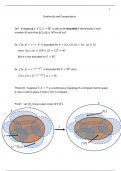
Proof: Let {𝑉𝛼 } be an open cover of 𝑓(𝑋). 𝑌
𝑍 {𝑉𝛼 }
𝑓
𝑋
𝑓(𝑋)
−1
{𝑓 (𝑉𝛼 )}
, 2
Since 𝑓 is continuous, 𝑓 −1 (𝑉𝛼 ), is an open set in 𝑋 (why?) and
𝑋 ⊆ ⋃𝛼 𝑓 −1 (𝑉𝛼 ).
Thus {𝑓 −1 (𝑉𝛼 )} is an open cover of 𝑋.
Since 𝑋 is compact there exists a finite subcover: 𝑋 ⊆ ⋃𝑛 −1
𝑖=1 𝑓 (𝑊𝑖 ), where
{𝑊𝑖 } ⊆ {𝑉𝛼 }.
Since 𝑓(𝑓 −1 (𝐸 )) ⊆ 𝐸 ; for 𝐸 ⊆ 𝑌,
(For example, if 𝑓 (𝑥 ) = 𝑥 2 and 𝐸 = (−1,1); then 𝑓 −1 (−1,1) = (−1,1)
and 𝑓(𝑓 −1 (−1,1)) = [0,1) ⊆ (−1,1) . )
𝑓(𝑋) ⊆ ⋃𝑛𝑖=1 𝑓(𝑓 −1 (𝑊𝑖 )) ⊆ ⋃𝑛𝑖=1 𝑊𝑖 .
So {𝑊𝑖 } is a finite subcover of 𝑓(𝑋), and 𝑓(𝑋) is compact.
Theorem: Suppose 𝑓 is a continuous function on a compact metric space 𝑋 into
ℝ, and 𝑀 = 𝑠𝑢𝑝𝑝𝜖𝑋 𝑓(𝑝) and 𝑚 = 𝑖𝑛𝑓𝑝𝜖𝑋 𝑓(𝑝) , then there exist points 𝑝, 𝑞𝜖𝑋
such that 𝑓(𝑝) = 𝑀 and 𝑓(𝑞) = 𝑚.
Proof: Since 𝑓 is continuous and 𝑋 is compact, 𝑓(𝑋) is a compact subset of ℝ.
By the Heine-Borel theorem we know that any compact subset of ℝ (or ℝ𝑛 ) is
closed and bounded.
Hence 𝑓(𝑋) contains 𝑀 = 𝑠𝑢𝑝𝑝𝜖𝑋 𝑓(𝑝) and 𝑚 = 𝑖𝑛𝑓𝑝𝜖𝑋 𝑓(𝑝).
For suppose 𝑀 = 𝑠𝑢𝑝𝑝𝜖𝑋 𝑓(𝑝) and 𝑀 ∉ 𝑓(𝑋).
Continuity and Compactness
Def. A mapping 𝑓: 𝐸 ⊆ 𝑋 → ℝ𝑘 is said to be bounded if there exists a real
number 𝑀 such that ‖𝑓(𝑥)‖ ≤ 𝑀 for all 𝑥𝜖𝐸.
Ex. 𝑓(𝑥, 𝑦) = 𝑥 2 + 𝑦 2 is bounded for 𝐸 = {(𝑥, 𝑦)| |𝑥| < 10, |𝑦| ≤ 5}
since |𝑓(𝑥, 𝑦)| ≤ 100 + 25 = 125 = 𝑀;
But it is not bounded on 𝐸 = ℝ2 .
2 +𝑦 2 )
Ex. 𝑓(𝑥, 𝑦) = 𝑒 −(𝑥 is bounded for 𝐸 = ℝ2 since
2 +𝑦 2 )
|𝑓(𝑥, 𝑦)| = |𝑒 −(𝑥 | ≤ 1 = 𝑀.
Theorem: Suppose 𝑓: 𝑋 → 𝑌 is a continuous mapping of a compact metric space
𝑋 into a metric space 𝑌 then 𝑓(𝑋) is compact.
Proof: Let {𝑉𝛼 } be an open cover of 𝑓(𝑋). 𝑌
𝑍 {𝑉𝛼 }
𝑓
𝑋
𝑓(𝑋)
−1
{𝑓 (𝑉𝛼 )}
, 2
Since 𝑓 is continuous, 𝑓 −1 (𝑉𝛼 ), is an open set in 𝑋 (why?) and
𝑋 ⊆ ⋃𝛼 𝑓 −1 (𝑉𝛼 ).
Thus {𝑓 −1 (𝑉𝛼 )} is an open cover of 𝑋.
Since 𝑋 is compact there exists a finite subcover: 𝑋 ⊆ ⋃𝑛 −1
𝑖=1 𝑓 (𝑊𝑖 ), where
{𝑊𝑖 } ⊆ {𝑉𝛼 }.
Since 𝑓(𝑓 −1 (𝐸 )) ⊆ 𝐸 ; for 𝐸 ⊆ 𝑌,
(For example, if 𝑓 (𝑥 ) = 𝑥 2 and 𝐸 = (−1,1); then 𝑓 −1 (−1,1) = (−1,1)
and 𝑓(𝑓 −1 (−1,1)) = [0,1) ⊆ (−1,1) . )
𝑓(𝑋) ⊆ ⋃𝑛𝑖=1 𝑓(𝑓 −1 (𝑊𝑖 )) ⊆ ⋃𝑛𝑖=1 𝑊𝑖 .
So {𝑊𝑖 } is a finite subcover of 𝑓(𝑋), and 𝑓(𝑋) is compact.
Theorem: Suppose 𝑓 is a continuous function on a compact metric space 𝑋 into
ℝ, and 𝑀 = 𝑠𝑢𝑝𝑝𝜖𝑋 𝑓(𝑝) and 𝑚 = 𝑖𝑛𝑓𝑝𝜖𝑋 𝑓(𝑝) , then there exist points 𝑝, 𝑞𝜖𝑋
such that 𝑓(𝑝) = 𝑀 and 𝑓(𝑞) = 𝑚.
Proof: Since 𝑓 is continuous and 𝑋 is compact, 𝑓(𝑋) is a compact subset of ℝ.
By the Heine-Borel theorem we know that any compact subset of ℝ (or ℝ𝑛 ) is
closed and bounded.
Hence 𝑓(𝑋) contains 𝑀 = 𝑠𝑢𝑝𝑝𝜖𝑋 𝑓(𝑝) and 𝑚 = 𝑖𝑛𝑓𝑝𝜖𝑋 𝑓(𝑝).
For suppose 𝑀 = 𝑠𝑢𝑝𝑝𝜖𝑋 𝑓(𝑝) and 𝑀 ∉ 𝑓(𝑋).