1
Velocity and Acceleration Models
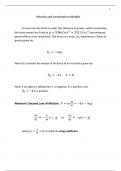
A mass near the Earth is under the influence of gravity, which accelerates
the mass toward the Earth at 𝑔 ≈ 9.8𝑚/𝑠𝑒𝑐 2 ≈ 32𝑓𝑡/𝑠𝑒𝑐 2 (assuming we
ignore effects of air resistance). The force on a mass, 𝑚, experiences a force of
gravity given by:
𝐹𝐺 = −𝑚𝑔.
Now let’s consider the impact of the force of air resistance given by:
𝐹𝑅 = −𝑘𝑣 ; 𝑘 > 0.
Note: If an object is falling then 𝑣 is negative, 𝑘 is positive, and
𝐹𝑅 = −𝑘𝑣 is positive.
𝑑𝑣
Newton’s Second Law of Motion: 𝐹 = 𝑚 = −𝑘𝑣 − 𝑚𝑔
𝑑𝑡
𝑑𝑣 𝑘 𝑑𝑣
= −𝑚𝑣 − 𝑔 or = −𝜌𝑣 − 𝑔
𝑑𝑡 𝑑𝑡
𝑘
where 𝜌 = > 0 is called the drag coefficient.
𝑚
, 2
𝑑𝑣
Ex. Let’s solve the separable equation = −𝜌𝑣 − 𝑔.
𝑑𝑡
1 𝑑𝑣 𝑑𝑣
=1 ⟹ = 𝑑𝑡
−𝜌𝑣−𝑔 𝑑𝑡 −𝜌𝑣−𝑔
𝑑𝑣
∫ −𝜌𝑣−𝑔 = ∫ 𝑑𝑡
1
− ln | − 𝜌𝑣 − 𝑔| + 𝑐1 = 𝑡 + 𝑐2
𝜌
1
− ln | − 𝜌𝑣 − 𝑔| = 𝑡 + 𝑐3
𝜌
ln | − 𝜌𝑣 − 𝑔| = −𝜌𝑡 − 𝑐3 𝜌
−𝜌𝑣 − 𝑔 < 0 so |−𝜌𝑣 − 𝑔| = 𝜌𝑣 + 𝑔 and
ln( 𝜌𝑣 + 𝑔) = −𝜌𝑡 − 𝑐3 𝜌
𝜌𝑣 + 𝑔 = 𝑒 −𝜌𝑡−𝑐3 𝜌 = 𝑒 −𝑐3 𝜌 𝑒 −𝜌𝑡
𝜌𝑣 = 𝑒 −𝑐3 𝜌 𝑒 −𝜌𝑡 − 𝑔
1 𝑔
𝑣(𝑡) = 𝜌 (𝑒 −𝑐3 𝜌 𝑒 −𝜌𝑡 ) − 𝜌 .
Velocity and Acceleration Models
A mass near the Earth is under the influence of gravity, which accelerates
the mass toward the Earth at 𝑔 ≈ 9.8𝑚/𝑠𝑒𝑐 2 ≈ 32𝑓𝑡/𝑠𝑒𝑐 2 (assuming we
ignore effects of air resistance). The force on a mass, 𝑚, experiences a force of
gravity given by:
𝐹𝐺 = −𝑚𝑔.
Now let’s consider the impact of the force of air resistance given by:
𝐹𝑅 = −𝑘𝑣 ; 𝑘 > 0.
Note: If an object is falling then 𝑣 is negative, 𝑘 is positive, and
𝐹𝑅 = −𝑘𝑣 is positive.
𝑑𝑣
Newton’s Second Law of Motion: 𝐹 = 𝑚 = −𝑘𝑣 − 𝑚𝑔
𝑑𝑡
𝑑𝑣 𝑘 𝑑𝑣
= −𝑚𝑣 − 𝑔 or = −𝜌𝑣 − 𝑔
𝑑𝑡 𝑑𝑡
𝑘
where 𝜌 = > 0 is called the drag coefficient.
𝑚
, 2
𝑑𝑣
Ex. Let’s solve the separable equation = −𝜌𝑣 − 𝑔.
𝑑𝑡
1 𝑑𝑣 𝑑𝑣
=1 ⟹ = 𝑑𝑡
−𝜌𝑣−𝑔 𝑑𝑡 −𝜌𝑣−𝑔
𝑑𝑣
∫ −𝜌𝑣−𝑔 = ∫ 𝑑𝑡
1
− ln | − 𝜌𝑣 − 𝑔| + 𝑐1 = 𝑡 + 𝑐2
𝜌
1
− ln | − 𝜌𝑣 − 𝑔| = 𝑡 + 𝑐3
𝜌
ln | − 𝜌𝑣 − 𝑔| = −𝜌𝑡 − 𝑐3 𝜌
−𝜌𝑣 − 𝑔 < 0 so |−𝜌𝑣 − 𝑔| = 𝜌𝑣 + 𝑔 and
ln( 𝜌𝑣 + 𝑔) = −𝜌𝑡 − 𝑐3 𝜌
𝜌𝑣 + 𝑔 = 𝑒 −𝜌𝑡−𝑐3 𝜌 = 𝑒 −𝑐3 𝜌 𝑒 −𝜌𝑡
𝜌𝑣 = 𝑒 −𝑐3 𝜌 𝑒 −𝜌𝑡 − 𝑔
1 𝑔
𝑣(𝑡) = 𝜌 (𝑒 −𝑐3 𝜌 𝑒 −𝜌𝑡 ) − 𝜌 .