From LAIK SARAH, for more: DM Whatsapp +33 (France) 609840925
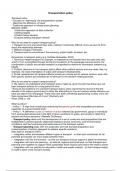
Lecture 1: CHP2 MARKETING STRATEGY AND TACTICS
Marketing defined: market objectives
Marketing is engaging customers and managing profitable customer relationships. Its core activities are to attract new customers
by promising superior value, and to keep and grow customers by delivering satisfaction. It is bringing demand and supply together
in the most suitable (profitable) way.
Marketing strategy: articulates the logic of the value-creation process —> strategy identifies the market in which the company
operates, defines the value exchanges among the key market entities, and outlines the ways in which the offering creates market
value.
• Choice of the market: 5C’
Customers: their needs and their profile —> care abt convenience & speed (delivery), variety & taste
Company (internal): (delivery trucks, software systems supporting delivery scheduling, simple recipes)
Collaborators: suppliers of ingredients (fishmongers, suppliers of packaging materials)
Competitors (meal kits at supermarkets eg Jumbo or AH, home delivery services, home-cooked meal delivery services)
Context: sociocultural (lifestyle, language, religion), technological (new techniques, skills, method), regulatory (taxes, import tariffs, pricing, communication regulations) ,
economic (economic growth, inflation, interest rates) , physical (natural resources, climate, geographic location, health trends)
• Choice of the intended value proposition for this market: 4 aspects of the value-creation process
Identifying target customers: involves grouping customers into segments, selection which segments to target and identifying
actionable strategies to reach the selected target segments
Customer value: why should customers spend their money on our product and not our other product or that of competitors? Involves developing a value proposition
that articulates the benefits and costs of the company’s offering for target customers
Collaborator value: why should retailer allocate shelf space to us, and not our competition or private labels? involves identifying entities that will work with the
company to create market value for target customers and optimizing offering in a way that enables collaborators to reach their goals
Company value: why should we spend money and man-hours of our engineers, management team, salesforce on this product and not another one in the company’s portfolio? involves
optimizing the value exchange in a way that enables the company to reach its goal and create value for its stakeholders
The marketing plan: offering’s marketing can be defined by 5 key activities: setting goal, developing a strategy, designing the tactics,
defining an implementation plan, and identifying a set of control metrics to measure the success of the proposed action
for setting a goal: monetary goals → focus on metrics related to cash (EPS, profit margin, ROI)
strategic goals → all goals that don’t relate to monetary metrics (sales volume, brand awareness, employee retention)
y
Corporate social responsibility (CSR): firm’s consideration and response to issues beyond the narrow economic, technical, and
legal requirements of the firm → implies developing products with social/environmental features, adopting methods to reduces
environmental impacts.
PROS: CONS:
✓ Differentiation from competitors Additional costs
✓ Value creation for consumers Dilution of managerial focus and resource misallocation
✓ Possibility for price premiums
✓ Operation efficiency through cost and waste reduction
✓ Employee attraction/retention
Lecture 2: CHP4 TARGETING AND SEGMENTATION:
3 types of marketing:
Mass marketing → one for all
Segment-based marketing → a unique product is developed for each customer (wheelchairs)
One-to-one marketing
Is One-for-all always a bad idea? Reliable, easily maintained, affordable transportation
Is One-for-each always a good idea? The possible sources of additional costs for the company —> fewer economies of scale in
production, costs of searching for additional suppliers, additional marketing costs (many producer=many campaigns, salesforce training) , harder to
, negotiate with suppliers, fewer opportunities for organizational learning and optimization
TARGETING SEGMENTATION
Def process of identifying customers for whom the grouping customers with similar needs by focusing on
company will optimize its offering. those differences that are relevant for targeting and
ignoring those differences that are irrelevant
Strategic (how to?) Selecting one or more segments to serve by Grouping customers based on the value the company
tailoring the offering to customer needs can create and capture
Tactical Laying out the channels to be used to Grouping customers based on their demographics and
communicate and deliver the offering to behavior
strategically viable
customers
Strategic segmentation principles
To group customers into market segments, must follow 4 key principles:
Relevance: grouping is based on likely response to company’s offering (there is an infinite number of criteria that could be used
to divide customers into segments: but most of these criteria are unrelated to factors that underlie the company’s targeting strategy)
Similarity: customers within the segment have homogenous preferences, so they are likely to interact with the company’s offering
Exclusivity: customers within the segment are different from customers within other segments (heterogeneous)
Comprehensiveness: segments cover the entire market: segments should be comprehensive, meaning that they should include
all potential customers in a given market
Strategic targeting criteria
• Target compatibility = ability of the company to fulfill the needs of its customers better than competition
- Compatibility in terms of what? Access to capital, business infrastructure, collaborator networks, access to scare
resources, know-how, strong brands, established ecosystem, skilled employees
• Target attractiveness = ability of a given segment to create superior value for the company
Individual customer equity (revenue from customer, costs of customer, strategic benefits, expected tenure with company, discount rate)
Total customer equity (revenues and costs per customer, strategic benefits, market size, attrition/growth, discount rate)
- Value in terms of what? Monetary value (income, costs) VS strategic value (social influence, scale value, information value)
Tactical segmentation/targeting
What are the profiles of our sub-segments and how do we reach them? The identification problem
Demographic factors (gender, age, education, income, level of education, occupation, household size)
Behavioral factors: behavior with respect to product category and offering (purchase quantity, price sensitivity, promotion sensitivity=customer response
to incentives, distribution channel=retail format preferred by customer)
Psychographic factors: values, interests, lifestyle (=relatively stable individual characteristics such as personality, moral values, attitudes, interests, and lifestyle)
Segmentation solutions :
• PRIZM: features 67 that capture current demographics, lifestyle and values in Canada —> answers 5 questions abt customers :
who are they? (Age, wealth, diversity, education) what are they like? (Sports, leisure, arts, spending) where do they live, work and shop?
how do they think? (Psychographics, values) how can they be reached? (Media preferences)
• Mentality model: focused on the values and the lifestyle —> groups ppl according to their attitude to life, personal beliefs
and values of work, leisure and politics. Every environment has its own lifestyle and consumption pattern —> 8 different
beliefs and lifestyle (ambition, hierarchical, work & performance, lifestyle, social relationships, socio-demographics)
Lecture 1: CHP2 MARKETING STRATEGY AND TACTICS
Marketing defined: market objectives
Marketing is engaging customers and managing profitable customer relationships. Its core activities are to attract new customers
by promising superior value, and to keep and grow customers by delivering satisfaction. It is bringing demand and supply together
in the most suitable (profitable) way.
Marketing strategy: articulates the logic of the value-creation process —> strategy identifies the market in which the company
operates, defines the value exchanges among the key market entities, and outlines the ways in which the offering creates market
value.
• Choice of the market: 5C’
Customers: their needs and their profile —> care abt convenience & speed (delivery), variety & taste
Company (internal): (delivery trucks, software systems supporting delivery scheduling, simple recipes)
Collaborators: suppliers of ingredients (fishmongers, suppliers of packaging materials)
Competitors (meal kits at supermarkets eg Jumbo or AH, home delivery services, home-cooked meal delivery services)
Context: sociocultural (lifestyle, language, religion), technological (new techniques, skills, method), regulatory (taxes, import tariffs, pricing, communication regulations) ,
economic (economic growth, inflation, interest rates) , physical (natural resources, climate, geographic location, health trends)
• Choice of the intended value proposition for this market: 4 aspects of the value-creation process
Identifying target customers: involves grouping customers into segments, selection which segments to target and identifying
actionable strategies to reach the selected target segments
Customer value: why should customers spend their money on our product and not our other product or that of competitors? Involves developing a value proposition
that articulates the benefits and costs of the company’s offering for target customers
Collaborator value: why should retailer allocate shelf space to us, and not our competition or private labels? involves identifying entities that will work with the
company to create market value for target customers and optimizing offering in a way that enables collaborators to reach their goals
Company value: why should we spend money and man-hours of our engineers, management team, salesforce on this product and not another one in the company’s portfolio? involves
optimizing the value exchange in a way that enables the company to reach its goal and create value for its stakeholders
The marketing plan: offering’s marketing can be defined by 5 key activities: setting goal, developing a strategy, designing the tactics,
defining an implementation plan, and identifying a set of control metrics to measure the success of the proposed action
for setting a goal: monetary goals → focus on metrics related to cash (EPS, profit margin, ROI)
strategic goals → all goals that don’t relate to monetary metrics (sales volume, brand awareness, employee retention)
y
Corporate social responsibility (CSR): firm’s consideration and response to issues beyond the narrow economic, technical, and
legal requirements of the firm → implies developing products with social/environmental features, adopting methods to reduces
environmental impacts.
PROS: CONS:
✓ Differentiation from competitors Additional costs
✓ Value creation for consumers Dilution of managerial focus and resource misallocation
✓ Possibility for price premiums
✓ Operation efficiency through cost and waste reduction
✓ Employee attraction/retention
Lecture 2: CHP4 TARGETING AND SEGMENTATION:
3 types of marketing:
Mass marketing → one for all
Segment-based marketing → a unique product is developed for each customer (wheelchairs)
One-to-one marketing
Is One-for-all always a bad idea? Reliable, easily maintained, affordable transportation
Is One-for-each always a good idea? The possible sources of additional costs for the company —> fewer economies of scale in
production, costs of searching for additional suppliers, additional marketing costs (many producer=many campaigns, salesforce training) , harder to
, negotiate with suppliers, fewer opportunities for organizational learning and optimization
TARGETING SEGMENTATION
Def process of identifying customers for whom the grouping customers with similar needs by focusing on
company will optimize its offering. those differences that are relevant for targeting and
ignoring those differences that are irrelevant
Strategic (how to?) Selecting one or more segments to serve by Grouping customers based on the value the company
tailoring the offering to customer needs can create and capture
Tactical Laying out the channels to be used to Grouping customers based on their demographics and
communicate and deliver the offering to behavior
strategically viable
customers
Strategic segmentation principles
To group customers into market segments, must follow 4 key principles:
Relevance: grouping is based on likely response to company’s offering (there is an infinite number of criteria that could be used
to divide customers into segments: but most of these criteria are unrelated to factors that underlie the company’s targeting strategy)
Similarity: customers within the segment have homogenous preferences, so they are likely to interact with the company’s offering
Exclusivity: customers within the segment are different from customers within other segments (heterogeneous)
Comprehensiveness: segments cover the entire market: segments should be comprehensive, meaning that they should include
all potential customers in a given market
Strategic targeting criteria
• Target compatibility = ability of the company to fulfill the needs of its customers better than competition
- Compatibility in terms of what? Access to capital, business infrastructure, collaborator networks, access to scare
resources, know-how, strong brands, established ecosystem, skilled employees
• Target attractiveness = ability of a given segment to create superior value for the company
Individual customer equity (revenue from customer, costs of customer, strategic benefits, expected tenure with company, discount rate)
Total customer equity (revenues and costs per customer, strategic benefits, market size, attrition/growth, discount rate)
- Value in terms of what? Monetary value (income, costs) VS strategic value (social influence, scale value, information value)
Tactical segmentation/targeting
What are the profiles of our sub-segments and how do we reach them? The identification problem
Demographic factors (gender, age, education, income, level of education, occupation, household size)
Behavioral factors: behavior with respect to product category and offering (purchase quantity, price sensitivity, promotion sensitivity=customer response
to incentives, distribution channel=retail format preferred by customer)
Psychographic factors: values, interests, lifestyle (=relatively stable individual characteristics such as personality, moral values, attitudes, interests, and lifestyle)
Segmentation solutions :
• PRIZM: features 67 that capture current demographics, lifestyle and values in Canada —> answers 5 questions abt customers :
who are they? (Age, wealth, diversity, education) what are they like? (Sports, leisure, arts, spending) where do they live, work and shop?
how do they think? (Psychographics, values) how can they be reached? (Media preferences)
• Mentality model: focused on the values and the lifestyle —> groups ppl according to their attitude to life, personal beliefs
and values of work, leisure and politics. Every environment has its own lifestyle and consumption pattern —> 8 different
beliefs and lifestyle (ambition, hierarchical, work & performance, lifestyle, social relationships, socio-demographics)