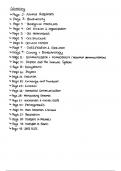
Glossary
↳
Page 2 :
Animal Responses
3:
↳
Page Biodiversity
4
↳
Page Biological
:
Molecules
↳ Cell
Page 4 Division &
organisation
:
Page
↳ 5 :
cell membranes
↳ 5
page cell structure
:
-
6
page :
Cellular control
Page
↳ 7 :
classification & Evolution
9:
Page
↳
Cloning +
Biotechnology
Dage
↳ 12 :
Communication + homeostasis (neuronal communication)
↳
Page 14 :
Disease and the Immune System
↳
Page 16 :
Ecosystems
↳
page 20 :
Enzymes
↳
Dage 21 Evolution :
↳
Page 22 Exchange : and Transport
Page 23
↳ : Excretion
Page 26
↳ :
Hormonal Communication
Page 28
Manipulating Genomes
- :
Page Nucleotides & nucleic acids
-
>
31 :
Page 33 Photosynthesis
- :
.
↳
Page 35 : Plant Responses
a Stimuli
↳
Page 37 Respiration :
↳
Page 38 :
Transport in Animals
Page 40 in plants
↳ :
Transport
↳
Page 43 :
STATS TESTS
, Animal Responses
CNS /Brain + Spinal Chord)
Hypothalamus : Controls Body Temperature
Nervous System
-
Peripheral
-
Somatic NS
Pituitary gland Controls : hormone release
controls conscious
Medulla heart rate
Oblongata controls
breathing +
activities
: crate that SAN fires
DNS 84 Sympathetic
- -
'fight or flight' cerebellum coordinates muscles , balance
: + posture
Autonomic
↳ release noradrenaline
NS
- -
Controls unconscious
activities
Cerebrum :
Allows you to see, near, think + learn
-
Parasympathetic
calms the down
body
↳ release
acetylcholine
The
'fight or
flight' Response
Nerve impulses from sensory neurones arrive at the hypothalamus activating Receptors
hormonal
the system and sympathetic NS
. Baroreceptors : Pressure receptors in the
Pituitary gland is stimulated to release ACTH (a normone) aorta & vena cava stimulated by high/low
·
-
This causes the cortex of the adrenal gland to release steroidal hormones blood pressure
.
(impulse)
↳
sympathetic NS is activated LIGH BP :
Impulse - medulla -
vagus
↑
nerve
-
accelerator
gland)
↳
Triggers the release of adrenaline (from medulla reigon of adrenal secretes acetylcholine
noradrenaline
>
- Binds to receptors on SAN .
EFFECTS Of THIS -
High O2 / Low CO2/ High a
HR inc .
High Low
muscles around bronchioles relax (deeper
breathing Chemoreceptors : Chemical receptors in the
converted to aorta , carotid artery and medulla that monitor
glycogen is
glucose
Blood is diverted from the skin (muscles in arterioles constrict) O2 , CO2a pH levels .
blood
·
+
gut in the
to the heart , lungs& sheletal muscles
.
·
frector pili muscles in skin contract - hairs stand on end . How Adrenaline Increases HR
Adrenaline binds to specific receptors in the heart
,
causing Cardiac muscle to contract more
frequently.
Skeletal Muscle
i
myofibrils Thick
myofilament
-
made from the protein
electrical impulses throughout the
myosin
sarcoplasm
.
bands o
Lightbands
bands)
dark light
Thin myofilament
memorane
~ made from the protein
actin
that store + release Ca2 + for muscle contraction .
-
when contracted ,
the Iband
[myofibrils
gets
Shorter & H zone
gets
Muscle contraction
.
1 An action potential depolarises the Sarcolemma & Sas to Myosin filaments
↑ tubules & the sarcoplasmic reticulum the
, causing
sarcoplasmic reticulum to release calcium ions .
Tropomyosin
↓
.
2 The Calt binds to troponin
changes shape Blocks The
Binding
-> ->
pulls
site .
tropomyosin out of binding site ,
allowing the
myosin head to
find to an actin filament =
actin-myosin cross bridge.
.
3 Cat also activates ATPase which breaks down ATP ,
pulling
I
the actin filament along .
4
. Another ATP binds to the myosin head , which breaks the This
cycle continues
as
long
as Ca2 + are present & bound
bridge so the
myosin detaches , then reattaches to a
to troponin .
binding site further along the actinfilament.
.
5 This is repeated , overall
cycle pulling the actin filament
the sarcomere , 6
. When muscle stimulation stops cal returns via active
along along shortening
,
causing the ,
muscle to contract .
transport to the sarcopasmic reticulum - back to relaxed .
,ATP-Creatine Phosphate system Neuromuscular junctions
ATP is made by phosphorylating ADP
.
They use the neurotransmitter acetylcholine (ACh). The neurotransmitter
The phosphate group is taken from creatine triggers depolarisation in the
postsynaptic cell-which causes it to
(CP)
phosphate is enzyme found
CP is stored in cells contractlif the threshold level is met).
Acetylcholinesterase an
-
Cruns anaerobic , alactic at muscles that break ACh into acetic acid a after
out
quickly ,
down/hydrolyse choline
its use and is stored in clefts .
Skeletal/voluntary
↳ chemicals can block the release of the neurotransmitter,
preventing
muscle : used for speed/strength the muscle from contracting
.
but
fatigues quickly
↓ This can
, many nuclei in each muscle be fatal when it affects muscles involved in breathing -> can't aerobic respire .
fibre .
I some contract &
fatigue Slowly-endurance/bosture) .
Smooth/involuntary muscle controlled unconsciously :
, found in the walls of hollow internal
organs (gut
:
contract to move
food along/blood vessel contract to reduce blood flow) :
Cardiac Muscle : is
myogenic , found in the walls of the heart . Made of muscle fibres connected by intercalated discs
.
(Low Electrical Resistance - nerve impuses passeavily between cells) Branched to allow
. nerve impluses to spread quickly through the muscle.
Biodiversity
Systematic Sampling :
samples taken at fixed intervals along a line transect) with quadrats .
by the investigator. (Have Bias
Sampling
Opportunistic :
Samples are chosen
Stratified Sampling :
Different areas in a habitat are identified
& sampled
separately in proportion to their part of the habitat .
Species Evenness : relative abundance of each species in an area .
// Genetic Diversity : variation of alleles in a species.
Genetic Polymorphism
Polymorphism
Is used to
:
measure
A locus with 2 or more alleles
genetic diversity
.
.
I Proportion of polymorphic
gene loci
=
number of polymorphic gene
total number of loci
loci
What affects Biodiversity :
Human pop. growth [habitat
loss ,
over exploitation urbanisation
, ,
pollution] / monoculture /
Climate change
Keystone Species species that many other species
: in an ecosystem depend .
on
protect species (disrupt food chains + nutrient cycles) ,
maintain genetic resources ,
economic or aesthetic reasons .
In Situ conservation :
Keep species in their natural habitat .
Ex SITU conservation Protects of the population from threatened habitat to
species by removing part a a new
:
a
location . (Last Resort
RIO CONVENTION ON BIOLOGICAL DIVERSITY (CBD) : Aims to develop international strategies on the conservation of biodiversity
and how to animal/plant part of international law to make conserving biodiversity everyone's duty
.
use resources sustainably
.
W
CITES AGREEMENT Designed to increase international cooperation in trade in wild animal and plant specimens
regulating .
:
The member countries made it illegal to kill
endangered species. Limits trade >
-
liscensing a laws ·
Countryside Stewardship Scheme (CSS) :
Conserve wildlife & , improve
biodiversity & extend wildlife habitats by
promoting specific management techniques to landowners .
, Biological Molecules
Carbohydrates (CNO) Energy : source in plants and animals
condensation
.
Is soluble-easily transported .
(Deoxyribose exOH) (Ribose 2xOH) Monosaccharides Polysaccharides (with glycosidic Gands)
,
. "hydrolysis
[Alpha + Alpha >
- Maltose] (Alpha + fructose e sucrose] (alpha/beta +
galactose e Lactose]
H
LipidS (CHO) : (glycerol)-c-on i
+ no-R(fatty acid) e
forms a
triglyceride via an ester bond .
(igycerides Phospholipidsa
,
,
Peptide
Bonds
-
>
- helix
Proteins (CHON(s)) : Amino Acid =
1) _ -con e -
↓ sin-co secondary , spleated sheet hydrogen Tertiary : Ionic, Disulfide ( x
cysteine,on
I I
&
hydrophobic/phillic
pushed
the outside
-
to
I hydrogen bands I heat breaks these,
changing the shapes 3D shape
. Insulin : 2 pp chains >
-
disulfide
J
makes them round
[
protein group attached
globular bands them tog
> Soluble -esareed
in has non
-
a
&
they'resoluble Haemoglobin-
.
Proteins and compact postetic group =
naem
fibrous Proteins Tough rope shaped
:
, ,
insoluble,
strong ,
structural proteins, unreactive .
↳
Collagen : connective /one , suin ,
muscle)/Keratin : hair , nails , e flexible an
feathers horns
, tough/Elastin : connective , skin , blood vessels
.
T
Ca2 Nat NH4t
+
NO3- HCO3 CI- POp3- OH-
Ht
Inorganic chloride Involved in lons
Acts as a involved in Affects
impulses -generating Absorbed from
-
nerve
SAME As Nat-affects &
-
photosynthesis
-
-
6 uffer shift helps
which respiration PH
A
-
rel .
of insulin nerve impulse PH soil by plants same
-
Activates I maintain the pH of Needed for of
to help
-
↳ for muscle
cofactor -
enzymes involved important As synthesis of
enzymes for
-
contraction
blood during gas
-
substances
-
of maintain nucleotides ,
16lood clotting)
-
regulating photosynthesis
in source
NHyt exchange . phospholipids
fluid photosynthesis nitrogen blood
(bone formation) Cofactor for enzyme & Calcium
imbalance PH
amylase . phosphate
Biochemical Tests ↳ Iodine Test for Starch
↳
Benedicts Test for
Sugars .
1 Add iodine dissolved in potassium iodide solution
↳ -
> blue-black
Reducing Sugars starch Fresent of
Turns
↳ NOT PRESENT B StayS Brown-orange
.
1 Add Benedicts reagent + heat in waterbath
Your of precipitate Blue - Green yellow Brick Red
↳
: > -
orange -
-
Binret Test for Proteins
+ ve result = coloured precipitate
↳ 1.Solution needs to be alkaline -> add a few drops of
Non-Reducing Sugars leg .
sucroses
NaOH ,
then add some copper (11) sulfate solution .
. Break them down to
1 monosaccharides by adding dilute
↳
Protein Present = Turns Purple
HCl + heat in water bath -
neutralise with sodium
↳
No Protein =
Stays Blue
hydrogen carbonate.
↳ Emulsion Test for
.
2
Carry out the test for
reducing sugars lipids
1. snake sample with ethanol (1 min) >
Pour into water.
↳
Test Strips for Glucose
e colour
change
↑ Lipids =
milky ↳ No Lipids = clear
Cell Division and organisation
M phase : mitosis and
Cytokinesis
-
CHECKPOINT
made.
Gap phase : cells
grow and new
organelles and proteins are
G 1 CHECKPOINT : checks chemicals needed for replication is there + checks for damage to DNA
Synthesis : cell replicates its DNA
Grante
phase !
Gap Phase 2 : Proteins needed for cell division are made .
G 2 CHECKPOINT : checks for damage to replicated DNA
↳ can be halted &
try to repair damage
↳
Page 2 :
Animal Responses
3:
↳
Page Biodiversity
4
↳
Page Biological
:
Molecules
↳ Cell
Page 4 Division &
organisation
:
Page
↳ 5 :
cell membranes
↳ 5
page cell structure
:
-
6
page :
Cellular control
Page
↳ 7 :
classification & Evolution
9:
Page
↳
Cloning +
Biotechnology
Dage
↳ 12 :
Communication + homeostasis (neuronal communication)
↳
Page 14 :
Disease and the Immune System
↳
Page 16 :
Ecosystems
↳
page 20 :
Enzymes
↳
Dage 21 Evolution :
↳
Page 22 Exchange : and Transport
Page 23
↳ : Excretion
Page 26
↳ :
Hormonal Communication
Page 28
Manipulating Genomes
- :
Page Nucleotides & nucleic acids
-
>
31 :
Page 33 Photosynthesis
- :
.
↳
Page 35 : Plant Responses
a Stimuli
↳
Page 37 Respiration :
↳
Page 38 :
Transport in Animals
Page 40 in plants
↳ :
Transport
↳
Page 43 :
STATS TESTS
, Animal Responses
CNS /Brain + Spinal Chord)
Hypothalamus : Controls Body Temperature
Nervous System
-
Peripheral
-
Somatic NS
Pituitary gland Controls : hormone release
controls conscious
Medulla heart rate
Oblongata controls
breathing +
activities
: crate that SAN fires
DNS 84 Sympathetic
- -
'fight or flight' cerebellum coordinates muscles , balance
: + posture
Autonomic
↳ release noradrenaline
NS
- -
Controls unconscious
activities
Cerebrum :
Allows you to see, near, think + learn
-
Parasympathetic
calms the down
body
↳ release
acetylcholine
The
'fight or
flight' Response
Nerve impulses from sensory neurones arrive at the hypothalamus activating Receptors
hormonal
the system and sympathetic NS
. Baroreceptors : Pressure receptors in the
Pituitary gland is stimulated to release ACTH (a normone) aorta & vena cava stimulated by high/low
·
-
This causes the cortex of the adrenal gland to release steroidal hormones blood pressure
.
(impulse)
↳
sympathetic NS is activated LIGH BP :
Impulse - medulla -
vagus
↑
nerve
-
accelerator
gland)
↳
Triggers the release of adrenaline (from medulla reigon of adrenal secretes acetylcholine
noradrenaline
>
- Binds to receptors on SAN .
EFFECTS Of THIS -
High O2 / Low CO2/ High a
HR inc .
High Low
muscles around bronchioles relax (deeper
breathing Chemoreceptors : Chemical receptors in the
converted to aorta , carotid artery and medulla that monitor
glycogen is
glucose
Blood is diverted from the skin (muscles in arterioles constrict) O2 , CO2a pH levels .
blood
·
+
gut in the
to the heart , lungs& sheletal muscles
.
·
frector pili muscles in skin contract - hairs stand on end . How Adrenaline Increases HR
Adrenaline binds to specific receptors in the heart
,
causing Cardiac muscle to contract more
frequently.
Skeletal Muscle
i
myofibrils Thick
myofilament
-
made from the protein
electrical impulses throughout the
myosin
sarcoplasm
.
bands o
Lightbands
bands)
dark light
Thin myofilament
memorane
~ made from the protein
actin
that store + release Ca2 + for muscle contraction .
-
when contracted ,
the Iband
[myofibrils
gets
Shorter & H zone
gets
Muscle contraction
.
1 An action potential depolarises the Sarcolemma & Sas to Myosin filaments
↑ tubules & the sarcoplasmic reticulum the
, causing
sarcoplasmic reticulum to release calcium ions .
Tropomyosin
↓
.
2 The Calt binds to troponin
changes shape Blocks The
Binding
-> ->
pulls
site .
tropomyosin out of binding site ,
allowing the
myosin head to
find to an actin filament =
actin-myosin cross bridge.
.
3 Cat also activates ATPase which breaks down ATP ,
pulling
I
the actin filament along .
4
. Another ATP binds to the myosin head , which breaks the This
cycle continues
as
long
as Ca2 + are present & bound
bridge so the
myosin detaches , then reattaches to a
to troponin .
binding site further along the actinfilament.
.
5 This is repeated , overall
cycle pulling the actin filament
the sarcomere , 6
. When muscle stimulation stops cal returns via active
along along shortening
,
causing the ,
muscle to contract .
transport to the sarcopasmic reticulum - back to relaxed .
,ATP-Creatine Phosphate system Neuromuscular junctions
ATP is made by phosphorylating ADP
.
They use the neurotransmitter acetylcholine (ACh). The neurotransmitter
The phosphate group is taken from creatine triggers depolarisation in the
postsynaptic cell-which causes it to
(CP)
phosphate is enzyme found
CP is stored in cells contractlif the threshold level is met).
Acetylcholinesterase an
-
Cruns anaerobic , alactic at muscles that break ACh into acetic acid a after
out
quickly ,
down/hydrolyse choline
its use and is stored in clefts .
Skeletal/voluntary
↳ chemicals can block the release of the neurotransmitter,
preventing
muscle : used for speed/strength the muscle from contracting
.
but
fatigues quickly
↓ This can
, many nuclei in each muscle be fatal when it affects muscles involved in breathing -> can't aerobic respire .
fibre .
I some contract &
fatigue Slowly-endurance/bosture) .
Smooth/involuntary muscle controlled unconsciously :
, found in the walls of hollow internal
organs (gut
:
contract to move
food along/blood vessel contract to reduce blood flow) :
Cardiac Muscle : is
myogenic , found in the walls of the heart . Made of muscle fibres connected by intercalated discs
.
(Low Electrical Resistance - nerve impuses passeavily between cells) Branched to allow
. nerve impluses to spread quickly through the muscle.
Biodiversity
Systematic Sampling :
samples taken at fixed intervals along a line transect) with quadrats .
by the investigator. (Have Bias
Sampling
Opportunistic :
Samples are chosen
Stratified Sampling :
Different areas in a habitat are identified
& sampled
separately in proportion to their part of the habitat .
Species Evenness : relative abundance of each species in an area .
// Genetic Diversity : variation of alleles in a species.
Genetic Polymorphism
Polymorphism
Is used to
:
measure
A locus with 2 or more alleles
genetic diversity
.
.
I Proportion of polymorphic
gene loci
=
number of polymorphic gene
total number of loci
loci
What affects Biodiversity :
Human pop. growth [habitat
loss ,
over exploitation urbanisation
, ,
pollution] / monoculture /
Climate change
Keystone Species species that many other species
: in an ecosystem depend .
on
protect species (disrupt food chains + nutrient cycles) ,
maintain genetic resources ,
economic or aesthetic reasons .
In Situ conservation :
Keep species in their natural habitat .
Ex SITU conservation Protects of the population from threatened habitat to
species by removing part a a new
:
a
location . (Last Resort
RIO CONVENTION ON BIOLOGICAL DIVERSITY (CBD) : Aims to develop international strategies on the conservation of biodiversity
and how to animal/plant part of international law to make conserving biodiversity everyone's duty
.
use resources sustainably
.
W
CITES AGREEMENT Designed to increase international cooperation in trade in wild animal and plant specimens
regulating .
:
The member countries made it illegal to kill
endangered species. Limits trade >
-
liscensing a laws ·
Countryside Stewardship Scheme (CSS) :
Conserve wildlife & , improve
biodiversity & extend wildlife habitats by
promoting specific management techniques to landowners .
, Biological Molecules
Carbohydrates (CNO) Energy : source in plants and animals
condensation
.
Is soluble-easily transported .
(Deoxyribose exOH) (Ribose 2xOH) Monosaccharides Polysaccharides (with glycosidic Gands)
,
. "hydrolysis
[Alpha + Alpha >
- Maltose] (Alpha + fructose e sucrose] (alpha/beta +
galactose e Lactose]
H
LipidS (CHO) : (glycerol)-c-on i
+ no-R(fatty acid) e
forms a
triglyceride via an ester bond .
(igycerides Phospholipidsa
,
,
Peptide
Bonds
-
>
- helix
Proteins (CHON(s)) : Amino Acid =
1) _ -con e -
↓ sin-co secondary , spleated sheet hydrogen Tertiary : Ionic, Disulfide ( x
cysteine,on
I I
&
hydrophobic/phillic
pushed
the outside
-
to
I hydrogen bands I heat breaks these,
changing the shapes 3D shape
. Insulin : 2 pp chains >
-
disulfide
J
makes them round
[
protein group attached
globular bands them tog
> Soluble -esareed
in has non
-
a
&
they'resoluble Haemoglobin-
.
Proteins and compact postetic group =
naem
fibrous Proteins Tough rope shaped
:
, ,
insoluble,
strong ,
structural proteins, unreactive .
↳
Collagen : connective /one , suin ,
muscle)/Keratin : hair , nails , e flexible an
feathers horns
, tough/Elastin : connective , skin , blood vessels
.
T
Ca2 Nat NH4t
+
NO3- HCO3 CI- POp3- OH-
Ht
Inorganic chloride Involved in lons
Acts as a involved in Affects
impulses -generating Absorbed from
-
nerve
SAME As Nat-affects &
-
photosynthesis
-
-
6 uffer shift helps
which respiration PH
A
-
rel .
of insulin nerve impulse PH soil by plants same
-
Activates I maintain the pH of Needed for of
to help
-
↳ for muscle
cofactor -
enzymes involved important As synthesis of
enzymes for
-
contraction
blood during gas
-
substances
-
of maintain nucleotides ,
16lood clotting)
-
regulating photosynthesis
in source
NHyt exchange . phospholipids
fluid photosynthesis nitrogen blood
(bone formation) Cofactor for enzyme & Calcium
imbalance PH
amylase . phosphate
Biochemical Tests ↳ Iodine Test for Starch
↳
Benedicts Test for
Sugars .
1 Add iodine dissolved in potassium iodide solution
↳ -
> blue-black
Reducing Sugars starch Fresent of
Turns
↳ NOT PRESENT B StayS Brown-orange
.
1 Add Benedicts reagent + heat in waterbath
Your of precipitate Blue - Green yellow Brick Red
↳
: > -
orange -
-
Binret Test for Proteins
+ ve result = coloured precipitate
↳ 1.Solution needs to be alkaline -> add a few drops of
Non-Reducing Sugars leg .
sucroses
NaOH ,
then add some copper (11) sulfate solution .
. Break them down to
1 monosaccharides by adding dilute
↳
Protein Present = Turns Purple
HCl + heat in water bath -
neutralise with sodium
↳
No Protein =
Stays Blue
hydrogen carbonate.
↳ Emulsion Test for
.
2
Carry out the test for
reducing sugars lipids
1. snake sample with ethanol (1 min) >
Pour into water.
↳
Test Strips for Glucose
e colour
change
↑ Lipids =
milky ↳ No Lipids = clear
Cell Division and organisation
M phase : mitosis and
Cytokinesis
-
CHECKPOINT
made.
Gap phase : cells
grow and new
organelles and proteins are
G 1 CHECKPOINT : checks chemicals needed for replication is there + checks for damage to DNA
Synthesis : cell replicates its DNA
Grante
phase !
Gap Phase 2 : Proteins needed for cell division are made .
G 2 CHECKPOINT : checks for damage to replicated DNA
↳ can be halted &
try to repair damage