1
Improper Integrals
Up to this point we have only discussed integrals of bounded functions on a finite
interval. We will now investigate integrals of functions over unbounded intervals
and integrals of functions with infinite discontinuities.
Infinite Intervals
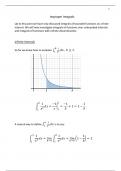
𝑏 1
So far we know how to evaluate ∫1 𝑑𝑥, 𝑏 ≥ 1.
𝑥2
1 𝑏
𝑏
1 −1 𝑏 −1 1
∫ 2 𝑑𝑥 = | = +1=1− .
1 𝑥 𝑥 1 𝑏 𝑏
∞ 1
A natural way to define ∫1 𝑑𝑥 is to say:
𝑥2
∞ 𝑏
1 1 1
∫ 2 𝑑𝑥 = 𝑙𝑖𝑚 ∫ 2 𝑑𝑥 = 𝑙𝑖𝑚 (1 − ) = 1.
1 𝑥 𝑏→∞ 1 𝑥 𝑏→∞ 𝑏
, 2
Definitions of integrals over infinite intervals:
1. If 𝑓 is continuous on [𝑎, ∞), then:
∞ 𝒃
∫ 𝒇(𝒙)𝒅𝒙 = 𝒍𝒊𝒎 ∫ 𝒇(𝒙)𝒅𝒙
𝒂 𝒃→∞ 𝒂
2. If 𝑓 is continuous on (−∞, 𝑏], then:
𝒃 𝒃
∫ 𝒇(𝒙)𝒅𝒙 = 𝒍𝒊𝒎 ∫ 𝒇(𝒙)𝒅𝒙
−∞ 𝒂→−∞ 𝒂
3. If 𝑓 is continuous on (−∞, ∞), then:
∞ 𝒄 ∞
∫ 𝒇(𝒙)𝒅𝒙 = ∫ 𝒇(𝒙)𝒅𝒙 + ∫ 𝒇(𝒙)𝒅𝒙
−∞ −∞ 𝒄
where 𝑐 is any real number.
In the first two cases, if the limit exists, we say the improper integral
converges, otherwise we say that the improper integral diverges. In the third
case, the improper integral on the left diverges if either improper integral on
the right diverges. The improper integral on the left converges only if both
improper integrals on the right converge.
∞ 1
Ex. Decide if the following integral converges or diverges: ∫1 𝑑𝑥.
𝑥2
∞
1 𝑏
1 −1 𝑏 −1
∫ 2 𝑑𝑥 = 𝑙𝑖𝑚 ∫ 2 𝑑𝑥 = 𝑙𝑖𝑚 | = 𝑙𝑖𝑚 ( + 1) = 1
1 𝑥 𝑏→∞ 1 𝑥 𝑏→∞ 𝑥 1 𝑏→∞ 𝑏
∞ 1
So ∫
1 𝑥2
𝑑𝑥 converges.
, 3
∞1
Ex. Evaluate ∫
1 𝑥
𝑑𝑥.
∞ 𝑏
1 1 𝑏
∫ 𝑑𝑥 = 𝑙𝑖𝑚 ∫ 𝑑𝑥 = 𝑙𝑖𝑚 𝑙𝑛𝑥| = 𝑙𝑖𝑚 (𝑙𝑛𝑏 − 𝑙𝑛1)
1 𝑥 𝑏→∞ 1 𝑥 𝑏→∞ 1 𝑏→∞
=∞
So the integral diverges.
0
Ex. Evaluate ∫−∞ 𝑥𝑒 𝑥 𝑑𝑥 .
0 0
∫ 𝑥𝑒 𝑑𝑥 = 𝑙𝑖𝑚 ∫ 𝑥𝑒 𝑥 𝑑𝑥
𝑥
−∞ 𝑎→−∞ 𝑎
Now integrate by parts:
Let 𝑢 = 𝑥 𝑣 = 𝑒𝑥
𝑑𝑢 = 𝑑𝑥 𝑑𝑣 = 𝑒 𝑥 𝑑𝑥
0
= lim ( 𝑥𝑒 𝑥 |0𝑎 − ∫𝑎 𝑒 𝑥 𝑑𝑥 )
𝑎→−∞
= 𝑙𝑖𝑚 (0 − 𝑎𝑒 𝑎 − 𝑒 𝑥 |0𝑎 ) = 𝑙𝑖𝑚 (−𝑎𝑒 𝑎 − (𝑒 0 − 𝑒 𝑎 ))
𝑎→−∞ 𝑎→−∞
= 𝑙𝑖𝑚 (−𝑎𝑒 𝑎 − 1 + 𝑒 𝑎 ) ;
𝑎→−∞
𝑎 −1
𝑙𝑖𝑚 𝑎𝑒 𝑎 = 𝑙𝑖𝑚 = 𝑙𝑖𝑚 (L'Hospital's Rule)
𝑎→−∞ 𝑎→−∞ 𝑒 −𝑎 𝑎→−∞ 𝑒 −𝑎
= 0.
So we have:
0
∫ 𝑥𝑒 𝑥 𝑑𝑥 = 𝑙𝑖𝑚 (−𝑎𝑒 𝑎 − 1 + 𝑒 𝑎 ) = −1.
−∞ 𝑎→−∞
Improper Integrals
Up to this point we have only discussed integrals of bounded functions on a finite
interval. We will now investigate integrals of functions over unbounded intervals
and integrals of functions with infinite discontinuities.
Infinite Intervals
𝑏 1
So far we know how to evaluate ∫1 𝑑𝑥, 𝑏 ≥ 1.
𝑥2
1 𝑏
𝑏
1 −1 𝑏 −1 1
∫ 2 𝑑𝑥 = | = +1=1− .
1 𝑥 𝑥 1 𝑏 𝑏
∞ 1
A natural way to define ∫1 𝑑𝑥 is to say:
𝑥2
∞ 𝑏
1 1 1
∫ 2 𝑑𝑥 = 𝑙𝑖𝑚 ∫ 2 𝑑𝑥 = 𝑙𝑖𝑚 (1 − ) = 1.
1 𝑥 𝑏→∞ 1 𝑥 𝑏→∞ 𝑏
, 2
Definitions of integrals over infinite intervals:
1. If 𝑓 is continuous on [𝑎, ∞), then:
∞ 𝒃
∫ 𝒇(𝒙)𝒅𝒙 = 𝒍𝒊𝒎 ∫ 𝒇(𝒙)𝒅𝒙
𝒂 𝒃→∞ 𝒂
2. If 𝑓 is continuous on (−∞, 𝑏], then:
𝒃 𝒃
∫ 𝒇(𝒙)𝒅𝒙 = 𝒍𝒊𝒎 ∫ 𝒇(𝒙)𝒅𝒙
−∞ 𝒂→−∞ 𝒂
3. If 𝑓 is continuous on (−∞, ∞), then:
∞ 𝒄 ∞
∫ 𝒇(𝒙)𝒅𝒙 = ∫ 𝒇(𝒙)𝒅𝒙 + ∫ 𝒇(𝒙)𝒅𝒙
−∞ −∞ 𝒄
where 𝑐 is any real number.
In the first two cases, if the limit exists, we say the improper integral
converges, otherwise we say that the improper integral diverges. In the third
case, the improper integral on the left diverges if either improper integral on
the right diverges. The improper integral on the left converges only if both
improper integrals on the right converge.
∞ 1
Ex. Decide if the following integral converges or diverges: ∫1 𝑑𝑥.
𝑥2
∞
1 𝑏
1 −1 𝑏 −1
∫ 2 𝑑𝑥 = 𝑙𝑖𝑚 ∫ 2 𝑑𝑥 = 𝑙𝑖𝑚 | = 𝑙𝑖𝑚 ( + 1) = 1
1 𝑥 𝑏→∞ 1 𝑥 𝑏→∞ 𝑥 1 𝑏→∞ 𝑏
∞ 1
So ∫
1 𝑥2
𝑑𝑥 converges.
, 3
∞1
Ex. Evaluate ∫
1 𝑥
𝑑𝑥.
∞ 𝑏
1 1 𝑏
∫ 𝑑𝑥 = 𝑙𝑖𝑚 ∫ 𝑑𝑥 = 𝑙𝑖𝑚 𝑙𝑛𝑥| = 𝑙𝑖𝑚 (𝑙𝑛𝑏 − 𝑙𝑛1)
1 𝑥 𝑏→∞ 1 𝑥 𝑏→∞ 1 𝑏→∞
=∞
So the integral diverges.
0
Ex. Evaluate ∫−∞ 𝑥𝑒 𝑥 𝑑𝑥 .
0 0
∫ 𝑥𝑒 𝑑𝑥 = 𝑙𝑖𝑚 ∫ 𝑥𝑒 𝑥 𝑑𝑥
𝑥
−∞ 𝑎→−∞ 𝑎
Now integrate by parts:
Let 𝑢 = 𝑥 𝑣 = 𝑒𝑥
𝑑𝑢 = 𝑑𝑥 𝑑𝑣 = 𝑒 𝑥 𝑑𝑥
0
= lim ( 𝑥𝑒 𝑥 |0𝑎 − ∫𝑎 𝑒 𝑥 𝑑𝑥 )
𝑎→−∞
= 𝑙𝑖𝑚 (0 − 𝑎𝑒 𝑎 − 𝑒 𝑥 |0𝑎 ) = 𝑙𝑖𝑚 (−𝑎𝑒 𝑎 − (𝑒 0 − 𝑒 𝑎 ))
𝑎→−∞ 𝑎→−∞
= 𝑙𝑖𝑚 (−𝑎𝑒 𝑎 − 1 + 𝑒 𝑎 ) ;
𝑎→−∞
𝑎 −1
𝑙𝑖𝑚 𝑎𝑒 𝑎 = 𝑙𝑖𝑚 = 𝑙𝑖𝑚 (L'Hospital's Rule)
𝑎→−∞ 𝑎→−∞ 𝑒 −𝑎 𝑎→−∞ 𝑒 −𝑎
= 0.
So we have:
0
∫ 𝑥𝑒 𝑥 𝑑𝑥 = 𝑙𝑖𝑚 (−𝑎𝑒 𝑎 − 1 + 𝑒 𝑎 ) = −1.
−∞ 𝑎→−∞