1
Polar Coordinates
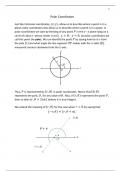
Just like Cartesian coordinates, (𝑥, 𝑦), allow us to describe where a point is in a
plane, polar coordinates also allow us to describe where a point is in a plane. In
polar coordinates we start by thinking of any point 𝑃 in the 𝑥- 𝑦 plane lying on a
circle of radius 𝑟 whose center is at 𝑂, 𝑥 = 0; 𝑦 = 0, (in polar coordinates we
call this point the pole). We can identify the point 𝑃 by saying how far it is from
the pole (𝑟) and what angle the line segment 𝑂𝑃 makes with the 𝑥-axis (𝜃),
measured counter-clockwise from the 𝑥 -axis.
𝑂
Thus, 𝑃 is represented by (𝑟, 𝜃 ) in polar coordinates. Notice that (0, 𝜃 )
represents the pole, 𝑂, for any value of 𝜃. Also, if (𝑟, 𝜃 ) represents the point 𝑃 ,
then so does (𝑟, 𝜃 + 2𝑛𝜋) (where 𝑛 is any integer).
We extend the meaning of (𝑟, 𝜃 ) for the case when 𝑟 < 0 by saying that:
(−𝑟, 𝜃 ) = (𝑟, 𝜃 + 𝜋).
(𝑟, 𝜃)
𝜃+𝜋
(−𝑟, 𝜃)
, 2
3𝜋 3𝜋 5𝜋 𝜋
Ex. Plot the points: 𝐴 (1, ) , 𝐵 (−1, ) , 𝐶 (1, ) , 𝐷 (1, − 2 ).
4 4 2
5𝜋
𝐶 (1, )
2
3𝜋
𝐴 (1, )
4
3𝜋
𝐵 (−1, )
4
𝜋
𝐷 (1, − )
2
.
So what is the relationship between Cartesian coordinates, (𝑥, 𝑦), and polar
coordinates, (𝑟, 𝜃 )?
𝑃(𝑥, 𝑦) 𝑥
cos 𝜃 = ⇒ 𝑥 = 𝑟 cos 𝜃
𝑟
𝑦
sin 𝜃 = ⇒ 𝑦 = 𝑟 sin 𝜃
𝑟 𝑦 𝑟
𝑥 2 + 𝑦 2 = 𝑟 2 cos2 𝜃 + 𝑟 2 sin 𝜃 = 𝑟 2
𝜃 𝑥 𝑦
tan 𝜃 = .
𝑥
Polar Coordinates
Just like Cartesian coordinates, (𝑥, 𝑦), allow us to describe where a point is in a
plane, polar coordinates also allow us to describe where a point is in a plane. In
polar coordinates we start by thinking of any point 𝑃 in the 𝑥- 𝑦 plane lying on a
circle of radius 𝑟 whose center is at 𝑂, 𝑥 = 0; 𝑦 = 0, (in polar coordinates we
call this point the pole). We can identify the point 𝑃 by saying how far it is from
the pole (𝑟) and what angle the line segment 𝑂𝑃 makes with the 𝑥-axis (𝜃),
measured counter-clockwise from the 𝑥 -axis.
𝑂
Thus, 𝑃 is represented by (𝑟, 𝜃 ) in polar coordinates. Notice that (0, 𝜃 )
represents the pole, 𝑂, for any value of 𝜃. Also, if (𝑟, 𝜃 ) represents the point 𝑃 ,
then so does (𝑟, 𝜃 + 2𝑛𝜋) (where 𝑛 is any integer).
We extend the meaning of (𝑟, 𝜃 ) for the case when 𝑟 < 0 by saying that:
(−𝑟, 𝜃 ) = (𝑟, 𝜃 + 𝜋).
(𝑟, 𝜃)
𝜃+𝜋
(−𝑟, 𝜃)
, 2
3𝜋 3𝜋 5𝜋 𝜋
Ex. Plot the points: 𝐴 (1, ) , 𝐵 (−1, ) , 𝐶 (1, ) , 𝐷 (1, − 2 ).
4 4 2
5𝜋
𝐶 (1, )
2
3𝜋
𝐴 (1, )
4
3𝜋
𝐵 (−1, )
4
𝜋
𝐷 (1, − )
2
.
So what is the relationship between Cartesian coordinates, (𝑥, 𝑦), and polar
coordinates, (𝑟, 𝜃 )?
𝑃(𝑥, 𝑦) 𝑥
cos 𝜃 = ⇒ 𝑥 = 𝑟 cos 𝜃
𝑟
𝑦
sin 𝜃 = ⇒ 𝑦 = 𝑟 sin 𝜃
𝑟 𝑦 𝑟
𝑥 2 + 𝑦 2 = 𝑟 2 cos2 𝜃 + 𝑟 2 sin 𝜃 = 𝑟 2
𝜃 𝑥 𝑦
tan 𝜃 = .
𝑥