1
Limits at Infinity
Limits at infinity occur when 𝑥 (or the independent variable) becomes very
large in magnitude. These limits determine the end behavior of a function.
Informal definition: 𝐥𝐢𝐦 𝒇(𝒙) = 𝑳 means as 𝑥 goes toward ∞ the value of
𝒙→∞
𝑓(𝑥) goes toward 𝐿.
Similarly, 𝐥𝐢𝐦 𝒇(𝒙) = 𝑳 means as 𝑥 goes toward −∞ the value of 𝑓(𝑥) goes
𝒙→−∞
toward 𝐿.
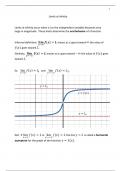
Ex. lim 𝑓 (𝑥 ) = 𝐿1 and lim 𝑓(𝑥 ) = 𝐿2 .
𝑥→∞ 𝑥→−∞
𝑦 = 𝐿1
𝑦 = 𝑓(𝑥)
𝑦 = 𝐿2
Def. If lim 𝑓 (𝑥 ) = 𝐿 or lim 𝑓 (𝑥 ) = 𝐿 the line 𝑦 = 𝐿 is called a horizontal
𝑥→∞ 𝑥→−∞
asymptote for the graph of the function 𝑦 = 𝑓(𝑥).
, 2
1
Ex. For any positive integer 𝑚, 𝑦 = has a horizontal asymptote at 𝑦 = 0
𝑥𝑚
1 1
since as 𝑥 goes to either ∞ or −∞, 𝑚 goes toward 0 (i.e. lim = 0 and
𝑥 𝑥→∞ 𝑥 𝑚
1
lim = 0).
𝑥→−∞ 𝑥 𝑚
1 1
If 𝑚 is any positive real number then lim = 0. lim may or may not
𝑥→∞ 𝑥𝑚 𝑥→−∞ 𝑥 𝑚
1 1 1
exist. For example, lim 1 = lim doesn’t exist since is not defined
𝑥→−∞ 𝑥 2 𝑥→−∞ √𝑥 √𝑥
for 𝑥 < 0.
Ex. Evaluate the following limits:
3
a. lim (4 − )
𝑥→−∞ 𝑥2
𝑐𝑜𝑠𝑥
b. lim ( 3 + )
𝑥→∞ √𝑥
a. By our limits laws:
3 3
lim (4 − 2 ) = lim 4 − lim
𝑥→−∞ 𝑥 𝑥→−∞ 𝑥→−∞ 𝑥 2
1
= lim 4 − (3)( lim ) = 4 − 3(0) = 4.
𝑥→−∞ 𝑥→−∞ 𝑥 2
b. Notice that −1 ≤ 𝑐𝑜𝑠𝑥 ≤ 1 for all real numbers 𝑥 so
−1 𝑐𝑜𝑠𝑥 1
≤ ≤ ; for 𝑥 > 0.
√𝑥 √𝑥 √𝑥
−1 1
By the squeeze theorem since lim = 0 and lim = 0,
𝑥→∞ √𝑥 𝑥→∞ √𝑥
𝑐𝑜𝑠𝑥
⟹ lim = 0.
𝑥→∞ √𝑥
𝑐𝑜𝑠𝑥 𝑐𝑜𝑠𝑥
Thus lim ( 3 + ) = lim 3 + lim = 3 + 0 = 3.
𝑥→∞ √𝑥 𝑥→∞ 𝑥→∞ √𝑥
Limits at Infinity
Limits at infinity occur when 𝑥 (or the independent variable) becomes very
large in magnitude. These limits determine the end behavior of a function.
Informal definition: 𝐥𝐢𝐦 𝒇(𝒙) = 𝑳 means as 𝑥 goes toward ∞ the value of
𝒙→∞
𝑓(𝑥) goes toward 𝐿.
Similarly, 𝐥𝐢𝐦 𝒇(𝒙) = 𝑳 means as 𝑥 goes toward −∞ the value of 𝑓(𝑥) goes
𝒙→−∞
toward 𝐿.
Ex. lim 𝑓 (𝑥 ) = 𝐿1 and lim 𝑓(𝑥 ) = 𝐿2 .
𝑥→∞ 𝑥→−∞
𝑦 = 𝐿1
𝑦 = 𝑓(𝑥)
𝑦 = 𝐿2
Def. If lim 𝑓 (𝑥 ) = 𝐿 or lim 𝑓 (𝑥 ) = 𝐿 the line 𝑦 = 𝐿 is called a horizontal
𝑥→∞ 𝑥→−∞
asymptote for the graph of the function 𝑦 = 𝑓(𝑥).
, 2
1
Ex. For any positive integer 𝑚, 𝑦 = has a horizontal asymptote at 𝑦 = 0
𝑥𝑚
1 1
since as 𝑥 goes to either ∞ or −∞, 𝑚 goes toward 0 (i.e. lim = 0 and
𝑥 𝑥→∞ 𝑥 𝑚
1
lim = 0).
𝑥→−∞ 𝑥 𝑚
1 1
If 𝑚 is any positive real number then lim = 0. lim may or may not
𝑥→∞ 𝑥𝑚 𝑥→−∞ 𝑥 𝑚
1 1 1
exist. For example, lim 1 = lim doesn’t exist since is not defined
𝑥→−∞ 𝑥 2 𝑥→−∞ √𝑥 √𝑥
for 𝑥 < 0.
Ex. Evaluate the following limits:
3
a. lim (4 − )
𝑥→−∞ 𝑥2
𝑐𝑜𝑠𝑥
b. lim ( 3 + )
𝑥→∞ √𝑥
a. By our limits laws:
3 3
lim (4 − 2 ) = lim 4 − lim
𝑥→−∞ 𝑥 𝑥→−∞ 𝑥→−∞ 𝑥 2
1
= lim 4 − (3)( lim ) = 4 − 3(0) = 4.
𝑥→−∞ 𝑥→−∞ 𝑥 2
b. Notice that −1 ≤ 𝑐𝑜𝑠𝑥 ≤ 1 for all real numbers 𝑥 so
−1 𝑐𝑜𝑠𝑥 1
≤ ≤ ; for 𝑥 > 0.
√𝑥 √𝑥 √𝑥
−1 1
By the squeeze theorem since lim = 0 and lim = 0,
𝑥→∞ √𝑥 𝑥→∞ √𝑥
𝑐𝑜𝑠𝑥
⟹ lim = 0.
𝑥→∞ √𝑥
𝑐𝑜𝑠𝑥 𝑐𝑜𝑠𝑥
Thus lim ( 3 + ) = lim 3 + lim = 3 + 0 = 3.
𝑥→∞ √𝑥 𝑥→∞ 𝑥→∞ √𝑥