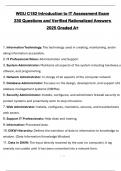
WGU C182 Introduction to IT Assessment Exam
230 Questions and Verified Rationalized Answers
2025 Graded A+
1. Information Technology: The technology used in creating, maintaining, andm
D D D D D D D D D
aking information accessible.
D D
2. IT Professional Roles: Administration and Support
D D D D D
3. System Administrator: Maintains all aspects of the system including hardware,s
D D D D D D D D D D
oftware, and programming.
D D
4. Network Administrator: In charge of all aspects of the computer network
D D D D D D D D D D
5. Database Administrator: Focuses on the design, development, and support ofd
D D D D D D D D D D
atabase management systems (DBMSs).
D D D
6. Security Administrator: Installs, configures, and administers firewall security to
D D D D D D D D D
protect systems and proactively work to stop intrusions.
D D D D D D D
7. Web Administrator: Installs, configures, maintains, secures, and troubleshoots
D D D D D D D D
web severs.
D
8. Support IT Professionals: Help desk and training.
D D D D D D
9. Information: Processed data. D D
10. DIKW Hierarchy: Defines the transition of data to information to knowledge to
D D D D D D D D D D D D
wisdom. (Data Information Knowledge Wisdom)
D D D D
11. Data in DIKW: The input directly received by the user (or computer). It isg
D D D D D D D D D D D D D D
enerally not usable until it has been converted into a relevant form.
D D D D D D D D D D D
1D/D13
,12. Information in DIKW: Having been inferred from data; one or more processesh
D D D D D D D D D D D D
ave been applied to the data to transform it into a more useful form.
D D D D D D D D D D D D D
13. Knowledge in DIKW: Information that has been put to use; information placedi
D D D D D D D D D D D D
nto a context. Refined information such that the user of the knowledge is able to callf
D D D D D D D D D D D D D D D D
orth only relevant portions of information when needed.
D D D D D D D
14. Wisdom in DIKW: Provides a social setting to knowledge; an understanding oft
D D D D D D D D D D D D
he "why". Can only come by having both knowledge and experience.
D D D D D D D D D D
15. Information Systems: A collection of data and information used to support the
D D D D D D D D D D D D
management of an organization. Also refers to the technical components and humanr
D D D D D D D D D D D D
esources that enable the assembly, storage, and processing of data and the deliveryof
D D D D D D D D D D D D D
information. This has existed for a lot longer than computers.
D D D D D D D D D D
16. Characteristics of Quality Data: Relevance - D D D D D
the data being used must applydirectly to the decision being made
D D D D D D D D D D D D
Timely - D
data must be efficient and must be provided in a timely mannerThorough -
D D D D D D D D D D D D D D
the data must be complete
D D D D D
Accurate - D
data should be captured only once, where possible and should becaptured a
D D D D D D D D D D D D D
s close to the point of activity as possible.
D D D D D D D D
2D/D13
, Reliable - D
D data should reflect stable and consistent data collection processes acrosscollectio
D D D D D D D D D D
ns points and over time
D D D D
17. IPOS: The Input-Procession-Output-Storage Cycle
D D D
18. Input: Raw data is entered by the user. D D D D D D D
19. Processing: Raw data is organized or structured for usefulness. D D D D D D D D
20. Output: Information is output so user can see results.
D D D D D D D D
21. Storage: Processed information is stored for permanent record.
D D D D D D D
22. Computer System: A collection of components that work together to meet the
D D D D D D D D D D D D
needs of the user; typically categorized as either hardware, software, networks, oru
D D D D D D D D D D D D
sers.
23. Hardware: Physical components of a computer system which include the sys-
D D D D D D D D D D
tem unit and its components and peripheral devices; tangible aspects of the com-
D D D D D D D D D D D D D
puter.
D
24. Software: Computer programs that tell the computer what to do--
D D D D D D D D D
how to executecommands and process information
D D D D D D
25. Network: A collection of computers and resources connected by various media
D D D D D D D D D D D
so that they can communicate with each other.
D D D D D D D
26. User: Those who use a computer. D D D D D
27. Software Categories: Systems Software and Applications Software
D D D D D D
28. Evolution of Users: First users were the engineers who built and programmedc
D D D D D D D D D D D D
omputers, then employees who had received specialized training were users, andno
D D D D D D D D D D D
w today, anyone and everyone can be a user.
D D D D D D D D
29. Protocol: Rules provided by which networks communicate with each other.
D D D D D D D D D
3D/D13
230 Questions and Verified Rationalized Answers
2025 Graded A+
1. Information Technology: The technology used in creating, maintaining, andm
D D D D D D D D D
aking information accessible.
D D
2. IT Professional Roles: Administration and Support
D D D D D
3. System Administrator: Maintains all aspects of the system including hardware,s
D D D D D D D D D D
oftware, and programming.
D D
4. Network Administrator: In charge of all aspects of the computer network
D D D D D D D D D D
5. Database Administrator: Focuses on the design, development, and support ofd
D D D D D D D D D D
atabase management systems (DBMSs).
D D D
6. Security Administrator: Installs, configures, and administers firewall security to
D D D D D D D D D
protect systems and proactively work to stop intrusions.
D D D D D D D
7. Web Administrator: Installs, configures, maintains, secures, and troubleshoots
D D D D D D D D
web severs.
D
8. Support IT Professionals: Help desk and training.
D D D D D D
9. Information: Processed data. D D
10. DIKW Hierarchy: Defines the transition of data to information to knowledge to
D D D D D D D D D D D D
wisdom. (Data Information Knowledge Wisdom)
D D D D
11. Data in DIKW: The input directly received by the user (or computer). It isg
D D D D D D D D D D D D D D
enerally not usable until it has been converted into a relevant form.
D D D D D D D D D D D
1D/D13
,12. Information in DIKW: Having been inferred from data; one or more processesh
D D D D D D D D D D D D
ave been applied to the data to transform it into a more useful form.
D D D D D D D D D D D D D
13. Knowledge in DIKW: Information that has been put to use; information placedi
D D D D D D D D D D D D
nto a context. Refined information such that the user of the knowledge is able to callf
D D D D D D D D D D D D D D D D
orth only relevant portions of information when needed.
D D D D D D D
14. Wisdom in DIKW: Provides a social setting to knowledge; an understanding oft
D D D D D D D D D D D D
he "why". Can only come by having both knowledge and experience.
D D D D D D D D D D
15. Information Systems: A collection of data and information used to support the
D D D D D D D D D D D D
management of an organization. Also refers to the technical components and humanr
D D D D D D D D D D D D
esources that enable the assembly, storage, and processing of data and the deliveryof
D D D D D D D D D D D D D
information. This has existed for a lot longer than computers.
D D D D D D D D D D
16. Characteristics of Quality Data: Relevance - D D D D D
the data being used must applydirectly to the decision being made
D D D D D D D D D D D D
Timely - D
data must be efficient and must be provided in a timely mannerThorough -
D D D D D D D D D D D D D D
the data must be complete
D D D D D
Accurate - D
data should be captured only once, where possible and should becaptured a
D D D D D D D D D D D D D
s close to the point of activity as possible.
D D D D D D D D
2D/D13
, Reliable - D
D data should reflect stable and consistent data collection processes acrosscollectio
D D D D D D D D D D
ns points and over time
D D D D
17. IPOS: The Input-Procession-Output-Storage Cycle
D D D
18. Input: Raw data is entered by the user. D D D D D D D
19. Processing: Raw data is organized or structured for usefulness. D D D D D D D D
20. Output: Information is output so user can see results.
D D D D D D D D
21. Storage: Processed information is stored for permanent record.
D D D D D D D
22. Computer System: A collection of components that work together to meet the
D D D D D D D D D D D D
needs of the user; typically categorized as either hardware, software, networks, oru
D D D D D D D D D D D D
sers.
23. Hardware: Physical components of a computer system which include the sys-
D D D D D D D D D D
tem unit and its components and peripheral devices; tangible aspects of the com-
D D D D D D D D D D D D D
puter.
D
24. Software: Computer programs that tell the computer what to do--
D D D D D D D D D
how to executecommands and process information
D D D D D D
25. Network: A collection of computers and resources connected by various media
D D D D D D D D D D D
so that they can communicate with each other.
D D D D D D D
26. User: Those who use a computer. D D D D D
27. Software Categories: Systems Software and Applications Software
D D D D D D
28. Evolution of Users: First users were the engineers who built and programmedc
D D D D D D D D D D D D
omputers, then employees who had received specialized training were users, andno
D D D D D D D D D D D
w today, anyone and everyone can be a user.
D D D D D D D D
29. Protocol: Rules provided by which networks communicate with each other.
D D D D D D D D D
3D/D13