

A
Lecture 6
Governance and Strategy
Strategic management in a changing health care system
Learning goals
Students are able to…
• assess the strategic position of a healthcare organization;
• assess the strategic choices of a healthcare organization;
• reflect on how strategies might develop within organizations;
• describe the purpose and relevance of different tools and models for strategic
management;
• critically reflect on the use of these tools for health care practice.
Strategic management
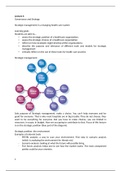
Sole purpose of Strategic management: make a choice. You can’t help everyone and be
good for everyone. That is why most hospitals are in big trouble. They do not choose, they
want to be everything for everyone. But you have to make choices, you are limited in
resources, in scope, in budget. How are you going to contribute to that. Focus of this lecture
is on the strategic position (blue part of the diagram).
Strategic position: the environment
Examples of relevant tools
- PESTEL analysis: a way to scan your environment. First step in scenario analysis
(which is analyzing the environment for threats etc)
- Scenario analysis: looking at what the future will possibly bring.
- Five forces analysis: helps one to see how the market works. The most unexpected
parties could be your enemies.
1
, PESTEL analysis
Economic: Consumerism. Its changing.
Technological: Robotics. Via technology the medical information is coming in the hand of
clients themselves. Doctors might not agree. ‘Intrusion’ on their domain.
Environmental: Very Dutch system. We have three different systems (insurers, providers
and patients).
Legal: new laws that affect health care.
Political: different parties have different interest. How do they discuss and come to a
decision. Go to media with issues.
Social: Patient client. More autonomy.
Second step is the scenario analyses.
- A scenario is a plausible view of how the environment of an organization might
develop in the future.
- Especially relevant when there is a high level of uncertainty
- Key ingredients:
o Different scenario’s build around key drivers of change
o The development of strategies for each scenario
o Monitoring the environment to see how it actually unfolds, and adjust plan
accordingly.
2
Lecture 6
Governance and Strategy
Strategic management in a changing health care system
Learning goals
Students are able to…
• assess the strategic position of a healthcare organization;
• assess the strategic choices of a healthcare organization;
• reflect on how strategies might develop within organizations;
• describe the purpose and relevance of different tools and models for strategic
management;
• critically reflect on the use of these tools for health care practice.
Strategic management
Sole purpose of Strategic management: make a choice. You can’t help everyone and be
good for everyone. That is why most hospitals are in big trouble. They do not choose, they
want to be everything for everyone. But you have to make choices, you are limited in
resources, in scope, in budget. How are you going to contribute to that. Focus of this lecture
is on the strategic position (blue part of the diagram).
Strategic position: the environment
Examples of relevant tools
- PESTEL analysis: a way to scan your environment. First step in scenario analysis
(which is analyzing the environment for threats etc)
- Scenario analysis: looking at what the future will possibly bring.
- Five forces analysis: helps one to see how the market works. The most unexpected
parties could be your enemies.
1
, PESTEL analysis
Economic: Consumerism. Its changing.
Technological: Robotics. Via technology the medical information is coming in the hand of
clients themselves. Doctors might not agree. ‘Intrusion’ on their domain.
Environmental: Very Dutch system. We have three different systems (insurers, providers
and patients).
Legal: new laws that affect health care.
Political: different parties have different interest. How do they discuss and come to a
decision. Go to media with issues.
Social: Patient client. More autonomy.
Second step is the scenario analyses.
- A scenario is a plausible view of how the environment of an organization might
develop in the future.
- Especially relevant when there is a high level of uncertainty
- Key ingredients:
o Different scenario’s build around key drivers of change
o The development of strategies for each scenario
o Monitoring the environment to see how it actually unfolds, and adjust plan
accordingly.
2

