CP I
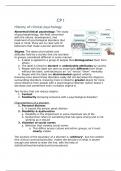
History of clinical psychology
Abnormal/clinical psychology: The study
of psychopathology, the field concerned
with the nature, development, and
treatment of psychological disorders (but
keep in mind, there are no clear sets of
behaviors that make a person abnormal)
Stigma: The destructive beliefs and
attitudes held by a society that are ascribed
to groups considered different in some manner
1. A label is applied to a group of people that distinguishes them from
others
2. The label is linked to deviant or undesirable attributes by society
3. People with the label are seen as essentially different from those
without the label, contributing to an “us” versus “them” mentality
4. People with the label are discriminated against unfairly
Knowing more about these disorders sadly did not decrease the stigma’s
surrounding disorders, knowing more is linked to greater desire for more
social distance from people with a psychological disorder (which doesn’t
decrease and sometimes even increases stigma’s)
Two factors that can reduce stigma:
1. Contact
2. Familiarity (knowing someone with a psychological disorder)
Characteristics of a disorder:
1. Personal distress
a. It causes the person great distress
2. Disability & dysfunction
a. Disability is the impairment in some important are of life
b. Dysfunction refers to something that has gone wrong and is not
working as it should
3. Violation of social norms
a. Behavior that violates social norms
a. This differs across culture and ethnic groups, so it must
clearly violate
The location of the boundary of a disorder is ‘arbitrary’, but not random
(the clinical community/society, makes the decision on what is severe
enough and where to draw the line, with the help of
statistical/mechanical/actuarial procedures)
,DSM-5-TR:
- Classification:
o Categorize based on characteristics of disorders
o Cluster of symptoms: syndrome
- Classification system:
o Diagnostic and Statistical Manual of Mental Disorders (DMS-5-
TR) or ICD-11
o Since DSM-III no etiology
Etiology: The factors that contribute to the onset and
progression of psychological disorders
Exception: PTSD (caused by social/environmental
factors)
- Example of DSM criteria: Manic episode
o Distinct period of abnormally and persistently elevated,
expansive, or irritable mood and abnormally and persistently
increased activity or energy
o Duration: At least a weak (exceptions apply)
o Impaired functioning
o 3 of the following 7 symptoms…
History:
- Early biological explanations
o Most thought disorders were a punishment of the Gods, they
got rid of these through exorcisms
o Hippocrates (460? – 377? BCE), disagreed and was the first
to note that it may be regarded to the brain,
He classified the disorders into three categories: mania,
melancholia, and phrenitis (or brain fever)
He also thought that these were caused by an imbalance
in fluids of the body: blood, black bile, yellow bile, and
phlegm
- Dark ages (around 200 CE)
o Monks cared for people with psychological disorders by
praying over them and touching them with relics
o Beginning of Western medicine, and treatment/investigation of
psychological disorders
- 13 century
th
o People with psychological disorders got hospitalized until they
were ‘sane’
o Lunacy trials (to determine a person’s mental health) were
held
- 15 century
th
o Development of asylums (housing and care for people with
psychological disorders)
But these medical treatments were often crude and
painful
E.g., Benjamin Rush (1745-18213) thought draining
people of blood would cure them
, o Philippe Pinel (1745-1826), is a primary figure in the
movement for more humane treatment in asylums
o The Friends asylum were set up to provide moral (humane)
treatment
But moral treatment was largely abandoned in the latter
part of the 19th century
- Discovering biological origins (1800s)
o Louis Pasteur established the germ theory of disease
Disease is caused by infection of the body by minute
organisms (laid the groundwork for demonstrating the
relation between syphilis and general paresis,
damage to the brain)
o Francis Galton (1822-1911), did twin studies and attributed
many behavioral characteristics to heredity (coming up with
terms as nature/nurture)
But this caused people with psychological disorders to
not have kids or marry because people were afraid,
they would pass on their ‘bad genes’
- 18 century
th
o Many people were observed to be the subject of hysteria
Mesmer (1735-1815), thought hysteria was caused by a
distribution of a universal magnetic fluid in the body and
that fluid could be influenced by another person
(hypnosis)
Charcot (1825-1893), because of one of his students
realized that hysteria could be treated with hypnosis
- 19th century
o Breuer (1842-1925) created a method called the cathartic
method in which he used hypnosis to help people reliving and
emotional trauma and releasing emotional tension of this
trauma
o Sigmund Freud, was influenced by the ideas of Charcot, and
theorized that psychopathology results from unconscious
conflicts in the individual
Mind was divided into three parts: Id (drive), ego
(mediates between drive and reality), and superego
(conscience)
Defense mechanism is a strategy used by the ego to
protect itself form anxiety
One component of psychoanalytic therapy, is
transference (the person’s responses to his or her
analyst that seem to reflect attitudes and ways of
behaving toward important people in the person’s past)
Still influential:
Childhood experiences help shape adult
personality
There are unconscious influences on behavior
The causes and purposes of human behavior are
not always obvious
, o Behaviorism focuses on observable behavior:
Classical conditioning (Pavlov)
Operant conditioning (Thorndike’s law of effect,
satisfying behavior will be repeated)
Modeling, witnessing someone perform certain
activities can increase/decrease diverse kinds of
behavior
- 20th century
o Sakel (1938), claimed that insulin-coma therapy would cure
schizophrenia (which was not the case, it caused mayor health
risks, and death)
o Electroconvulsive therapy (ECT) was originated by Cerletti
and Bini, to induce seizures (but later got used on people with
depression and schizophrenia), and it still used for people with
severe depression
o Prefrontal lobotomy (Egas moniz, 1935) was a procedure to
destroy tacts connecting the prefrontal lobe with other areas
of the brain, showed great success, but that was due to their
brains being damaged (becoming dull, listless, and suffered
losses in emotional and cognitive experiences/capacities)
Epidemiology
Epidemiology: Deals with the study of the incidence, distribution, and
determinants of health-related events or conditions in populations
- Genders differences in distribution
o Women: More prevalent to mood, anxiety disorders
o Men: More prevalent to substance abuse
- Distribution of disorder in population (mood disorders more
common than attention/behavior disorders)
- Comorbidity: The presence of co-occurring medical conditions or
disorders
o High prevalence
History of clinical psychology
Abnormal/clinical psychology: The study
of psychopathology, the field concerned
with the nature, development, and
treatment of psychological disorders (but
keep in mind, there are no clear sets of
behaviors that make a person abnormal)
Stigma: The destructive beliefs and
attitudes held by a society that are ascribed
to groups considered different in some manner
1. A label is applied to a group of people that distinguishes them from
others
2. The label is linked to deviant or undesirable attributes by society
3. People with the label are seen as essentially different from those
without the label, contributing to an “us” versus “them” mentality
4. People with the label are discriminated against unfairly
Knowing more about these disorders sadly did not decrease the stigma’s
surrounding disorders, knowing more is linked to greater desire for more
social distance from people with a psychological disorder (which doesn’t
decrease and sometimes even increases stigma’s)
Two factors that can reduce stigma:
1. Contact
2. Familiarity (knowing someone with a psychological disorder)
Characteristics of a disorder:
1. Personal distress
a. It causes the person great distress
2. Disability & dysfunction
a. Disability is the impairment in some important are of life
b. Dysfunction refers to something that has gone wrong and is not
working as it should
3. Violation of social norms
a. Behavior that violates social norms
a. This differs across culture and ethnic groups, so it must
clearly violate
The location of the boundary of a disorder is ‘arbitrary’, but not random
(the clinical community/society, makes the decision on what is severe
enough and where to draw the line, with the help of
statistical/mechanical/actuarial procedures)
,DSM-5-TR:
- Classification:
o Categorize based on characteristics of disorders
o Cluster of symptoms: syndrome
- Classification system:
o Diagnostic and Statistical Manual of Mental Disorders (DMS-5-
TR) or ICD-11
o Since DSM-III no etiology
Etiology: The factors that contribute to the onset and
progression of psychological disorders
Exception: PTSD (caused by social/environmental
factors)
- Example of DSM criteria: Manic episode
o Distinct period of abnormally and persistently elevated,
expansive, or irritable mood and abnormally and persistently
increased activity or energy
o Duration: At least a weak (exceptions apply)
o Impaired functioning
o 3 of the following 7 symptoms…
History:
- Early biological explanations
o Most thought disorders were a punishment of the Gods, they
got rid of these through exorcisms
o Hippocrates (460? – 377? BCE), disagreed and was the first
to note that it may be regarded to the brain,
He classified the disorders into three categories: mania,
melancholia, and phrenitis (or brain fever)
He also thought that these were caused by an imbalance
in fluids of the body: blood, black bile, yellow bile, and
phlegm
- Dark ages (around 200 CE)
o Monks cared for people with psychological disorders by
praying over them and touching them with relics
o Beginning of Western medicine, and treatment/investigation of
psychological disorders
- 13 century
th
o People with psychological disorders got hospitalized until they
were ‘sane’
o Lunacy trials (to determine a person’s mental health) were
held
- 15 century
th
o Development of asylums (housing and care for people with
psychological disorders)
But these medical treatments were often crude and
painful
E.g., Benjamin Rush (1745-18213) thought draining
people of blood would cure them
, o Philippe Pinel (1745-1826), is a primary figure in the
movement for more humane treatment in asylums
o The Friends asylum were set up to provide moral (humane)
treatment
But moral treatment was largely abandoned in the latter
part of the 19th century
- Discovering biological origins (1800s)
o Louis Pasteur established the germ theory of disease
Disease is caused by infection of the body by minute
organisms (laid the groundwork for demonstrating the
relation between syphilis and general paresis,
damage to the brain)
o Francis Galton (1822-1911), did twin studies and attributed
many behavioral characteristics to heredity (coming up with
terms as nature/nurture)
But this caused people with psychological disorders to
not have kids or marry because people were afraid,
they would pass on their ‘bad genes’
- 18 century
th
o Many people were observed to be the subject of hysteria
Mesmer (1735-1815), thought hysteria was caused by a
distribution of a universal magnetic fluid in the body and
that fluid could be influenced by another person
(hypnosis)
Charcot (1825-1893), because of one of his students
realized that hysteria could be treated with hypnosis
- 19th century
o Breuer (1842-1925) created a method called the cathartic
method in which he used hypnosis to help people reliving and
emotional trauma and releasing emotional tension of this
trauma
o Sigmund Freud, was influenced by the ideas of Charcot, and
theorized that psychopathology results from unconscious
conflicts in the individual
Mind was divided into three parts: Id (drive), ego
(mediates between drive and reality), and superego
(conscience)
Defense mechanism is a strategy used by the ego to
protect itself form anxiety
One component of psychoanalytic therapy, is
transference (the person’s responses to his or her
analyst that seem to reflect attitudes and ways of
behaving toward important people in the person’s past)
Still influential:
Childhood experiences help shape adult
personality
There are unconscious influences on behavior
The causes and purposes of human behavior are
not always obvious
, o Behaviorism focuses on observable behavior:
Classical conditioning (Pavlov)
Operant conditioning (Thorndike’s law of effect,
satisfying behavior will be repeated)
Modeling, witnessing someone perform certain
activities can increase/decrease diverse kinds of
behavior
- 20th century
o Sakel (1938), claimed that insulin-coma therapy would cure
schizophrenia (which was not the case, it caused mayor health
risks, and death)
o Electroconvulsive therapy (ECT) was originated by Cerletti
and Bini, to induce seizures (but later got used on people with
depression and schizophrenia), and it still used for people with
severe depression
o Prefrontal lobotomy (Egas moniz, 1935) was a procedure to
destroy tacts connecting the prefrontal lobe with other areas
of the brain, showed great success, but that was due to their
brains being damaged (becoming dull, listless, and suffered
losses in emotional and cognitive experiences/capacities)
Epidemiology
Epidemiology: Deals with the study of the incidence, distribution, and
determinants of health-related events or conditions in populations
- Genders differences in distribution
o Women: More prevalent to mood, anxiety disorders
o Men: More prevalent to substance abuse
- Distribution of disorder in population (mood disorders more
common than attention/behavior disorders)
- Comorbidity: The presence of co-occurring medical conditions or
disorders
o High prevalence