WOP I
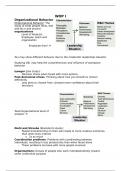
Organizational Behavior
Organizational Behavior: The
study of what people think, feel
and do in and around
organizations
Level of Analysis:
Employee, team and
organization
Employee level
You may show different behavior due to the moderator leadership situation
Studying OB, may help the comprehension and influence of workplace
behavior
Iyengar (Jam study):
- Decision stress when faced with more options
Post-decisional stress: Thinking about how you should’ve chosen
differently
- Less jams to choose from, showed more confidence about their
decisions
Team/organizational level of
analysis
Diehl and Stroebe (Brainstorm study):
- People brainstorming on their own leads to more creative outcomes
than when they interact
o 2x as much
Coordination problems: Problems with coordinating between
individuals, resulting in less productivity then when faced alone
- These problems increase with more people involved
Organizations: Groups of people who work interdependently toward
some (collective) purpose
, - Toward a common goal (is prone for good teamwork)
Interdependently: Need/rely on each other
o Structured communication
o Task coordination
o Collaboration
Collective purpose: Mission statement
Top five skills identified by employers:
1. Problem solving
2. Communication (interwoven with conflict management, leadership
etc.)
3. Teamwork (interwoven with influencing others, managing emotions
etc.)
Emerging workplace landscape:
- Work-life integration:
o Degree that people are effectively engaged in their various
work and nonwork roles and have a low degree of role conflict
across those life domains (prevents work-life conflicts)
Different roles are: Daughter, student, employee etc
o Tactics to manage role boundaries:
Scheduling time blocks
Scheduling when you want to do what
Creating physical role spaces
Assigning specific physical locations to specific
roles
Applying technological bounderies
E.g., shutting off work-related devices during non-
work hours
Communicating role boundary expectations
Letting others know their role-related boundaries
and let them know when those expectations have
been violated
- Remote work:
o Performing the job away from the organization’s physical work
site
Mostly ‘knowledge’ work can be done remotely
Physical and contact work is harder to do remotely
- Diversity and the inclusive workplace:
o Surface-level
Gender, age, color of skin, sexuality etc.
o Deep-level
Personality, psychological etc.
Performance of ‘diverse’ teams:
o Improved, because: Better representation, different
perspectives and information benefit decision making and
creativity
o Risk: Conflict, problems with communication
, Solution: Diversity management
Anchors that represent the principles on which OB knowledge is
developed/redefined:
1. Systematic research anchor
a. Evidence-based management (guided by research evidence)
b. Sometimes not used because of accessibility, contradicts own
beliefs, evidence is general (not specific for situations), not
trendy
2. Practical orientation anchor
a. How well an OB theory finds its way into organizational life
b. E.g., MARS model
3. Multidisciplinary anchor
a. The field should welcome OB theories, from other disciplines
i. But you should not rely to heavily on theories of other
fields
4. Contingency anchor
a. The effect of one variable on another variable often depends
on the characteristics of the situation or people involved
5. Multiple levels of analysis anchor
a. What goes into organizations can be placed into three levels of
analysis:
i. Individual, team and organization (see above)
Organizational effectiveness: How thoroughly and efficiently a
company achieves its business goals
- May not be fulfilled due to:
o Goal level set too low
o Measurement difficulties (public organizations)
o Goals (must) change
- Good effectiveness:
o Good fit with external environment
o Acquired by having good team and individual input
o Effective transformation of
inputs to output through
human capital
Both are
accomplished by
having an open
system
Open system: A
system that has
external interactions
(gets feedback about
what the external
environment wants/needs)
Fit with environment: Input, processes and output
align with recourses, needs and expectations of
external environment
, o Internal: Efficient transformation of inputs
to outputs
o External: Aligned with external environment
Human capital as advantage
Knowledge, skills and abilities for transforming
inputs to outputs and adaptability (employees can
bring this knowledge)
Depends on:
o Acquiring (recognizing) knowledge
o Sharing knowledge
o Using knowledge
o Storing knowledge
o If needed, unlearnling knowledge
The advantages of human capital:
o Better job performance
o Better at adapting to rapidly changing
environments
o Good human capital means the company is
investing in the employees, employees
reciprocate this
o Satisfy needs of key stakeholders (belanghebbende)
Shareholder: An owner of shares in a company
Stakeholder can
influence
organizations or
are influenced by it
Coporate social
responsibility
(CSR) consists of
organizational
activities intended
to benefit society
and the
environment beyong their interest and legal obligation
Positive CSR tend to provide better financiel
performance
MARS model:
=
- Behavior and Results
Organizational Behavior
Organizational Behavior: The
study of what people think, feel
and do in and around
organizations
Level of Analysis:
Employee, team and
organization
Employee level
You may show different behavior due to the moderator leadership situation
Studying OB, may help the comprehension and influence of workplace
behavior
Iyengar (Jam study):
- Decision stress when faced with more options
Post-decisional stress: Thinking about how you should’ve chosen
differently
- Less jams to choose from, showed more confidence about their
decisions
Team/organizational level of
analysis
Diehl and Stroebe (Brainstorm study):
- People brainstorming on their own leads to more creative outcomes
than when they interact
o 2x as much
Coordination problems: Problems with coordinating between
individuals, resulting in less productivity then when faced alone
- These problems increase with more people involved
Organizations: Groups of people who work interdependently toward
some (collective) purpose
, - Toward a common goal (is prone for good teamwork)
Interdependently: Need/rely on each other
o Structured communication
o Task coordination
o Collaboration
Collective purpose: Mission statement
Top five skills identified by employers:
1. Problem solving
2. Communication (interwoven with conflict management, leadership
etc.)
3. Teamwork (interwoven with influencing others, managing emotions
etc.)
Emerging workplace landscape:
- Work-life integration:
o Degree that people are effectively engaged in their various
work and nonwork roles and have a low degree of role conflict
across those life domains (prevents work-life conflicts)
Different roles are: Daughter, student, employee etc
o Tactics to manage role boundaries:
Scheduling time blocks
Scheduling when you want to do what
Creating physical role spaces
Assigning specific physical locations to specific
roles
Applying technological bounderies
E.g., shutting off work-related devices during non-
work hours
Communicating role boundary expectations
Letting others know their role-related boundaries
and let them know when those expectations have
been violated
- Remote work:
o Performing the job away from the organization’s physical work
site
Mostly ‘knowledge’ work can be done remotely
Physical and contact work is harder to do remotely
- Diversity and the inclusive workplace:
o Surface-level
Gender, age, color of skin, sexuality etc.
o Deep-level
Personality, psychological etc.
Performance of ‘diverse’ teams:
o Improved, because: Better representation, different
perspectives and information benefit decision making and
creativity
o Risk: Conflict, problems with communication
, Solution: Diversity management
Anchors that represent the principles on which OB knowledge is
developed/redefined:
1. Systematic research anchor
a. Evidence-based management (guided by research evidence)
b. Sometimes not used because of accessibility, contradicts own
beliefs, evidence is general (not specific for situations), not
trendy
2. Practical orientation anchor
a. How well an OB theory finds its way into organizational life
b. E.g., MARS model
3. Multidisciplinary anchor
a. The field should welcome OB theories, from other disciplines
i. But you should not rely to heavily on theories of other
fields
4. Contingency anchor
a. The effect of one variable on another variable often depends
on the characteristics of the situation or people involved
5. Multiple levels of analysis anchor
a. What goes into organizations can be placed into three levels of
analysis:
i. Individual, team and organization (see above)
Organizational effectiveness: How thoroughly and efficiently a
company achieves its business goals
- May not be fulfilled due to:
o Goal level set too low
o Measurement difficulties (public organizations)
o Goals (must) change
- Good effectiveness:
o Good fit with external environment
o Acquired by having good team and individual input
o Effective transformation of
inputs to output through
human capital
Both are
accomplished by
having an open
system
Open system: A
system that has
external interactions
(gets feedback about
what the external
environment wants/needs)
Fit with environment: Input, processes and output
align with recourses, needs and expectations of
external environment
, o Internal: Efficient transformation of inputs
to outputs
o External: Aligned with external environment
Human capital as advantage
Knowledge, skills and abilities for transforming
inputs to outputs and adaptability (employees can
bring this knowledge)
Depends on:
o Acquiring (recognizing) knowledge
o Sharing knowledge
o Using knowledge
o Storing knowledge
o If needed, unlearnling knowledge
The advantages of human capital:
o Better job performance
o Better at adapting to rapidly changing
environments
o Good human capital means the company is
investing in the employees, employees
reciprocate this
o Satisfy needs of key stakeholders (belanghebbende)
Shareholder: An owner of shares in a company
Stakeholder can
influence
organizations or
are influenced by it
Coporate social
responsibility
(CSR) consists of
organizational
activities intended
to benefit society
and the
environment beyong their interest and legal obligation
Positive CSR tend to provide better financiel
performance
MARS model:
=
- Behavior and Results