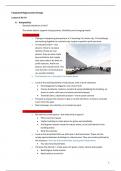
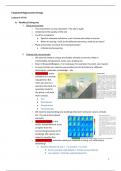
Integrated Regenerative Design
Lesson 6 31/10
A. Adaptability
- General defenition of this?
The whole idea to support living systems, flexibility and changing needs
1. Place Identity
o Change is happening everywhere, it’s ‘branding’ of certain city. The buildings
are working together in a certain way, to give a specific spirit and aura.
o In industrial sites = ‘non
places’, there is no place
identity. These are non
places, they are also made
buy architects, but maybe
they only make it for their on
profit reasons. Avoid non
places, don’t build here!!. The
only function in those places
are usually mobility.
o The Genius Loci = the spirit of a certain place
o Look at the existing identity of old places, with a lot of character.
• Kannikegarden lundgaard, new church hall
• France duinkerke, harbour, lacaton & vassal (dubbling the building, so
there is a twin, with new circularity and techniques)
• Townhall Gent, robbrecht & deam + marie josee van hee
o The past is always the answer, to give a certain direction, to have a concept.
Learn from the past.
o Real message: non-identity, is not what we want
2. Zero space / positive space
o We want to create space > but what kind of space?
• More common space
• Higher building to make place for green and playfields
• Avoid green spaces: keep the nature alone, try to build dense in the
building areas.
• Stop the suburbs
o Look at the brownfield that we still have in the built areas. These are the
empty spaces between buildings in a dense area. They are mostly polluted by
the industry > first use the brownfields, leave green fields alone.
• You also have blackfields.
o Increase the density > make space for green, water, nature and people
• Build higher, build smaller
• New balance to work to
1
, • 50 years ago we looked at highrised buildings > but this got old. Now we
look at mediumhigh buildingnblocks: so there can be commonspaces,
gardens etc. How many layers nog 5-6-7?
• Density in units or density in levels? We need to create the space.
3. Space and change
o Change is not new, everything is constantly changing. Adapt and anticipate to
change
• OFFICE WIT GELE KRUIS, gent > was fromer manchester factory
o Example for the opposite: Zaha hadid Fire station, not usefull at all.
• They couldn’t run to their trucks, the walls were very disillusioning.
• You want to test your own proposal? Skip the program, and check if the
building is also open for other functions? Less fixed elements, would
help.
o Design for change, Skip the program, design the spaces, do scenario thinking.
Bring the buildings to the future
• US miami beach parking, lincoln-road. A parking that is used for
concerts, events, feasts, etc.
• Dom-ino, le corbusier: ‘modernism’ and concrete was coming to the
world. It was a complete new idea to buld a space without a direct
function. They wrote a manual with this.
• Building as a system, with change possible, this idea is not completely
new
• Stewart Brandt: very important man, who thought about layers of
change too.: ‘a building is not something you finish, a building is
something you start’.
• He was able to translate the definition of every building his different
layers
• Buildings can cost significantly more to maintain and use over their
lifetime than they do to build in the first place.
This may be mistakenly seen as an argument for new buildings, with
optimistically low lifecycle costs, but it should instead be seen as an
argument for continuing to use existing buildings. The 6 layers!
2
Lesson 6 31/10
A. Adaptability
- General defenition of this?
The whole idea to support living systems, flexibility and changing needs
1. Place Identity
o Change is happening everywhere, it’s ‘branding’ of certain city. The buildings
are working together in a certain way, to give a specific spirit and aura.
o In industrial sites = ‘non
places’, there is no place
identity. These are non
places, they are also made
buy architects, but maybe
they only make it for their on
profit reasons. Avoid non
places, don’t build here!!. The
only function in those places
are usually mobility.
o The Genius Loci = the spirit of a certain place
o Look at the existing identity of old places, with a lot of character.
• Kannikegarden lundgaard, new church hall
• France duinkerke, harbour, lacaton & vassal (dubbling the building, so
there is a twin, with new circularity and techniques)
• Townhall Gent, robbrecht & deam + marie josee van hee
o The past is always the answer, to give a certain direction, to have a concept.
Learn from the past.
o Real message: non-identity, is not what we want
2. Zero space / positive space
o We want to create space > but what kind of space?
• More common space
• Higher building to make place for green and playfields
• Avoid green spaces: keep the nature alone, try to build dense in the
building areas.
• Stop the suburbs
o Look at the brownfield that we still have in the built areas. These are the
empty spaces between buildings in a dense area. They are mostly polluted by
the industry > first use the brownfields, leave green fields alone.
• You also have blackfields.
o Increase the density > make space for green, water, nature and people
• Build higher, build smaller
• New balance to work to
1
, • 50 years ago we looked at highrised buildings > but this got old. Now we
look at mediumhigh buildingnblocks: so there can be commonspaces,
gardens etc. How many layers nog 5-6-7?
• Density in units or density in levels? We need to create the space.
3. Space and change
o Change is not new, everything is constantly changing. Adapt and anticipate to
change
• OFFICE WIT GELE KRUIS, gent > was fromer manchester factory
o Example for the opposite: Zaha hadid Fire station, not usefull at all.
• They couldn’t run to their trucks, the walls were very disillusioning.
• You want to test your own proposal? Skip the program, and check if the
building is also open for other functions? Less fixed elements, would
help.
o Design for change, Skip the program, design the spaces, do scenario thinking.
Bring the buildings to the future
• US miami beach parking, lincoln-road. A parking that is used for
concerts, events, feasts, etc.
• Dom-ino, le corbusier: ‘modernism’ and concrete was coming to the
world. It was a complete new idea to buld a space without a direct
function. They wrote a manual with this.
• Building as a system, with change possible, this idea is not completely
new
• Stewart Brandt: very important man, who thought about layers of
change too.: ‘a building is not something you finish, a building is
something you start’.
• He was able to translate the definition of every building his different
layers
• Buildings can cost significantly more to maintain and use over their
lifetime than they do to build in the first place.
This may be mistakenly seen as an argument for new buildings, with
optimistically low lifecycle costs, but it should instead be seen as an
argument for continuing to use existing buildings. The 6 layers!
2