Radio – Life Hacks
Context
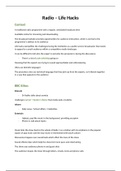
A traditional radio programme with a regular, scheduled broadcast time
Available online for streaming and downloading
The broadcast/website provides opportunities for audience interaction, which is central to the
programme’s address to its audience
Life hacks exemplifies the challenges facing the institution as a public service broadcaster that needs
to appeal to a youth audience within a competitive media landscape
It can be difficult to tell who the expert is and who the presenter is during the discussions
- There’s a lot of code switching going on
Meaning that the experts are trying to sound approachable and unthreatening
(they use demotic language)
The presenters also use technical language that they pick up from the experts, so it blends together
in a way that appeals to the audience
BBC Ethos
Educate
- Dr Radha talks about anxiety
challenges Curran + Seaton’s theory that media lacks creativity
Inform
- Daily news / School affairs / Celebrities
Entertain
- Upbeat, pop-like music in the background, providing escapism
- Phone in, talk about topics
Music links the show back to the whole of Radio 1 as a station with its emphasis on the popular
aspect of pop music and the way music is intertwined with youth culture
Discussions happen over sound beds which affect the tone of the show
Sound effects/clips which help the show feel more pace and entertaining
The show uses audience phone-in and guest slots
The audience shapes the show through letters, emails, texts and phone calls
, Context – Media Industries
Every country has popular music radio stations but nearly all are run as businesses
Advertising revenue is generated easily by a mass audience for popular music.
Why should the BBC have a station which can clearly be supplied by the free-market?
The BBC as a Royal Charter Company:
One way the U.K. often solves a need is by allowing a private company to function as part of the
state
e.g. The East India Company was chartered to colonise India as a business venture and some military
procurements companies become nationalised
The BBC is still a private company but has two important features:
1. It is paid for by the T.V. License (a hypothecated tax). i.e. a tax earmarked for a particular use
There are very few of these in the U.K. Originally it was a radio license but moved to T.V. only in
1971
2. It has a responsibility for public service
Originally a company it became a corporation after the charter so The British Broadcasting Company
became The British Broadcasting Corporation (which is still the name)
Public service broadcasting:
Some countries have a state-backed, governmentally controlled state broadcaster
Many have adopted the U.K. approach as it devised a system and a set of values to govern it
early on in the history of broadcasting so it was easy to emulate it
The U.K. model embodies the following principles:
Universal geographic accessibility
Universal appeal
Attention to minorities
Contribution to national identity and sense of community
Distance from vested interests
Direct funding and universality of payment
Competition in good programming rather than numbers
Guidelines that liberate rather than restrict
Context
A traditional radio programme with a regular, scheduled broadcast time
Available online for streaming and downloading
The broadcast/website provides opportunities for audience interaction, which is central to the
programme’s address to its audience
Life hacks exemplifies the challenges facing the institution as a public service broadcaster that needs
to appeal to a youth audience within a competitive media landscape
It can be difficult to tell who the expert is and who the presenter is during the discussions
- There’s a lot of code switching going on
Meaning that the experts are trying to sound approachable and unthreatening
(they use demotic language)
The presenters also use technical language that they pick up from the experts, so it blends together
in a way that appeals to the audience
BBC Ethos
Educate
- Dr Radha talks about anxiety
challenges Curran + Seaton’s theory that media lacks creativity
Inform
- Daily news / School affairs / Celebrities
Entertain
- Upbeat, pop-like music in the background, providing escapism
- Phone in, talk about topics
Music links the show back to the whole of Radio 1 as a station with its emphasis on the popular
aspect of pop music and the way music is intertwined with youth culture
Discussions happen over sound beds which affect the tone of the show
Sound effects/clips which help the show feel more pace and entertaining
The show uses audience phone-in and guest slots
The audience shapes the show through letters, emails, texts and phone calls
, Context – Media Industries
Every country has popular music radio stations but nearly all are run as businesses
Advertising revenue is generated easily by a mass audience for popular music.
Why should the BBC have a station which can clearly be supplied by the free-market?
The BBC as a Royal Charter Company:
One way the U.K. often solves a need is by allowing a private company to function as part of the
state
e.g. The East India Company was chartered to colonise India as a business venture and some military
procurements companies become nationalised
The BBC is still a private company but has two important features:
1. It is paid for by the T.V. License (a hypothecated tax). i.e. a tax earmarked for a particular use
There are very few of these in the U.K. Originally it was a radio license but moved to T.V. only in
1971
2. It has a responsibility for public service
Originally a company it became a corporation after the charter so The British Broadcasting Company
became The British Broadcasting Corporation (which is still the name)
Public service broadcasting:
Some countries have a state-backed, governmentally controlled state broadcaster
Many have adopted the U.K. approach as it devised a system and a set of values to govern it
early on in the history of broadcasting so it was easy to emulate it
The U.K. model embodies the following principles:
Universal geographic accessibility
Universal appeal
Attention to minorities
Contribution to national identity and sense of community
Distance from vested interests
Direct funding and universality of payment
Competition in good programming rather than numbers
Guidelines that liberate rather than restrict