THEME 1A – CANCER BIOLOGY AND GENETICS
LECTURE 2 – CANCER BIOLOGY: THE HALLMARKS OF CANCER
Characteristics of cancer tissue:
- Chaos / not organised
- Resistance to cell death
- Unlimited proliferation
- Angiogenesis (promotion of formation of blood vessels)
- Metastasis
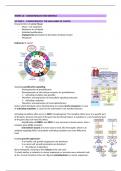
Hallmarks of cancer:
Sustaining proliferative signalling:
- Overexpression of growthfactors
- Overexpression of cell-surface receptors for growthfactors
Activating mutation also possible
- Therefore: overexpression of intracellular signaling molecules
Activating mutation
- Therefore: overexpression of transcriptionfactors
Genes which stimulate cancer development are named proto-oncogenes. In case
of activating mutations, a cause for the acticvation is not needed anymore.
Activating mutations often occur in EGFR. (receptorgene). The mutation often occur in a specific part
of the gene, because only part of the gene has functional impact. A mutation in a non-functional part
of the gene does not have this effect.
Amplification of ERBB2, also HER2, is very common in breast cancer. Also a
receptor gene (HER2 receptor).
Extracellular targets are more easy to treat, like heroseptin, which is an
antibody targeting HER2. Intracellular activating mutations are more difficult to
treat.
Evading growth suppressors:
- In a healthy cell: growth suppressors are dominant
- In a cancer cell: growth promotors are dominant
The balance is disturbed
Start checkpoint: entering of the S-phase of the cell cycle.
To check wether a molecule is a tumor suppressor or an proto-onco molecule, look
at the ‘normal’ function in the cell. (figure) retinoblastoma is a tumor suppressor.
,Growth inhibitors: TGFB receptor, p16 (loss-of-function)
Growth stimulators: cyclin D, CDK4 (gain-of-function)
TP53 = major tumor suppressor
reason: very important protein in the human cell. In every
case of a problem p53 is used.
Senescence = ‘fall asleep’, handbreak of the cell
- Mutated in > 50% of tumors
- Pathways affected in > 90% of the cases
- Loss of p53 loss of cell cycle checkpoints proliferation of cells with DNA damage
- Heriditary mutation: Li Fraumeni syndrome (multiple tumors at young age), dominant
inheritance.
APC complex: destruction of B-catenin no signalling to the nucleus.
In case of WNT stimulation APC complex will not form B-catenin can signal to the
nucleus, stimulating proliferation. APC is a main tumor suppressor in colorectal cancer.
Avoiding immune destruction:
- Less production of MHC-I molecules, to prevent presentation of antigens to immune cells.
Enabling replicative immortality:
- In healthy cells: limited proliferative capacity
- In cancer cells: telomerase activation
Most malignant characteristic: ability to spread to other organs, metastasis
- Loosening of the tumor cells (inactivation of E-cadherin)
- Degradation of ECM (expression of proteolytic enzymes)
- Epithelial tumors: lose epithelial differentiation
Very inefficient process! Millions of cells might be released, only a few are able to metastasize
Ability to induce angiogenesis:
- Growth of tissue leads to increase in nutrients needed
- Selective pressure leads to the ability to promote angiogenesis
Ability to resist cell death:
, - Reduction of pro-apoptic factors (BAX, BAK)
- Increase of anti-apoptotic factors (BCL, MCL)
- Increase of inhibition of apoptosis
Deregulation of cellular energetics:
- The Warburg effect: switch from oxidative fosforylisation to lactation to form building blocks
to form more cells
- This way, more lactate forms, which stimulates angiogenesis.
Enablers: tumor-promoting inflammation
- ..
*osmosis: oncogenes and tumor suppressive genes
LECTURE 3 – CANCER GENETICS
Hallmarks: need to be acquired by a healthy cell to develop into a malignant cell. Mutations are
needed for this. Takes time can take years to develop cancer.
So, cancer is driven by the accumulation of mutations.
Linear vs branched models of cancer evolution
Mutation = permanent alteration in a parental DNA sequence, needed in both strands
- Chromosome mutations
May affect expression of many genes
Loss or gain
Translocation
Multi-locus deletion
Leads to loss of function of the alleles
- Gene mutations
May affect expression of a few genes
Deletions
Insertions
Substitutions
Deletion of a coding sequence that does not affect the reading frame, part of the protein may be
intact, it can be functional or partially functional. Example:
EGFR mutation: structural comformation is changed, leading to activation, but not to loss of function.
In or out-frame mutations:
- Intron; non coding, no effect
- Promotor; may affect transcription efficiency
- Splice site; may affect process of splicing
- Exon; may affect protein composition
, Substitution leads to a frameshift, leading to (partial) loss of function.
Silent mutations: mutations that translate to the same amino acid as before.
Mutation in KRAS prevent the removal of GTP by GAP, leading to continuous activation. The
mutation often occurs in a specific aminoacid.
Mutation in BRAF also causes continuous acitation.
Gene amplification:
- MYC gene neuroblastomas
- HER2 breast, ovarian, gastric etc.
Detection of amplification:
- Complementary sequence that will bind the strand you are looking for
- Staining visible under microscope
In 85% of Burkitt lymphoma cases: chromosomal translocation:
- Proto-oncogene location becomes after a promotor of a very expressive protein
- In case of Burkitt lymphoma: MYC gene after the immunoglobulin promotor increased
expression
MYC: transcriptionfactor which promotes proliferation, onco-gene
Activating mutations typically affect one allele = enough for an acitvating effect
Epigenetic alteration of genes: methylation of DNA, leading to change in histone structure
inactivates the gene by making it more difficult to reach.
Dominant negative mutations: 1 mutation in 1 allele completely destroys the function of the
protein, generally missense mutations
There are mutation patterns in oncogenes, with mutation hotspots.
Driver genes (functional relevance for tumorformation)
- Frequent and functionally relevant mutation
Passenger genes (no functional relevance for cancer fitness)
- Random, functionally irrelevant mutations
LECTURE 2 – CANCER BIOLOGY: THE HALLMARKS OF CANCER
Characteristics of cancer tissue:
- Chaos / not organised
- Resistance to cell death
- Unlimited proliferation
- Angiogenesis (promotion of formation of blood vessels)
- Metastasis
Hallmarks of cancer:
Sustaining proliferative signalling:
- Overexpression of growthfactors
- Overexpression of cell-surface receptors for growthfactors
Activating mutation also possible
- Therefore: overexpression of intracellular signaling molecules
Activating mutation
- Therefore: overexpression of transcriptionfactors
Genes which stimulate cancer development are named proto-oncogenes. In case
of activating mutations, a cause for the acticvation is not needed anymore.
Activating mutations often occur in EGFR. (receptorgene). The mutation often occur in a specific part
of the gene, because only part of the gene has functional impact. A mutation in a non-functional part
of the gene does not have this effect.
Amplification of ERBB2, also HER2, is very common in breast cancer. Also a
receptor gene (HER2 receptor).
Extracellular targets are more easy to treat, like heroseptin, which is an
antibody targeting HER2. Intracellular activating mutations are more difficult to
treat.
Evading growth suppressors:
- In a healthy cell: growth suppressors are dominant
- In a cancer cell: growth promotors are dominant
The balance is disturbed
Start checkpoint: entering of the S-phase of the cell cycle.
To check wether a molecule is a tumor suppressor or an proto-onco molecule, look
at the ‘normal’ function in the cell. (figure) retinoblastoma is a tumor suppressor.
,Growth inhibitors: TGFB receptor, p16 (loss-of-function)
Growth stimulators: cyclin D, CDK4 (gain-of-function)
TP53 = major tumor suppressor
reason: very important protein in the human cell. In every
case of a problem p53 is used.
Senescence = ‘fall asleep’, handbreak of the cell
- Mutated in > 50% of tumors
- Pathways affected in > 90% of the cases
- Loss of p53 loss of cell cycle checkpoints proliferation of cells with DNA damage
- Heriditary mutation: Li Fraumeni syndrome (multiple tumors at young age), dominant
inheritance.
APC complex: destruction of B-catenin no signalling to the nucleus.
In case of WNT stimulation APC complex will not form B-catenin can signal to the
nucleus, stimulating proliferation. APC is a main tumor suppressor in colorectal cancer.
Avoiding immune destruction:
- Less production of MHC-I molecules, to prevent presentation of antigens to immune cells.
Enabling replicative immortality:
- In healthy cells: limited proliferative capacity
- In cancer cells: telomerase activation
Most malignant characteristic: ability to spread to other organs, metastasis
- Loosening of the tumor cells (inactivation of E-cadherin)
- Degradation of ECM (expression of proteolytic enzymes)
- Epithelial tumors: lose epithelial differentiation
Very inefficient process! Millions of cells might be released, only a few are able to metastasize
Ability to induce angiogenesis:
- Growth of tissue leads to increase in nutrients needed
- Selective pressure leads to the ability to promote angiogenesis
Ability to resist cell death:
, - Reduction of pro-apoptic factors (BAX, BAK)
- Increase of anti-apoptotic factors (BCL, MCL)
- Increase of inhibition of apoptosis
Deregulation of cellular energetics:
- The Warburg effect: switch from oxidative fosforylisation to lactation to form building blocks
to form more cells
- This way, more lactate forms, which stimulates angiogenesis.
Enablers: tumor-promoting inflammation
- ..
*osmosis: oncogenes and tumor suppressive genes
LECTURE 3 – CANCER GENETICS
Hallmarks: need to be acquired by a healthy cell to develop into a malignant cell. Mutations are
needed for this. Takes time can take years to develop cancer.
So, cancer is driven by the accumulation of mutations.
Linear vs branched models of cancer evolution
Mutation = permanent alteration in a parental DNA sequence, needed in both strands
- Chromosome mutations
May affect expression of many genes
Loss or gain
Translocation
Multi-locus deletion
Leads to loss of function of the alleles
- Gene mutations
May affect expression of a few genes
Deletions
Insertions
Substitutions
Deletion of a coding sequence that does not affect the reading frame, part of the protein may be
intact, it can be functional or partially functional. Example:
EGFR mutation: structural comformation is changed, leading to activation, but not to loss of function.
In or out-frame mutations:
- Intron; non coding, no effect
- Promotor; may affect transcription efficiency
- Splice site; may affect process of splicing
- Exon; may affect protein composition
, Substitution leads to a frameshift, leading to (partial) loss of function.
Silent mutations: mutations that translate to the same amino acid as before.
Mutation in KRAS prevent the removal of GTP by GAP, leading to continuous activation. The
mutation often occurs in a specific aminoacid.
Mutation in BRAF also causes continuous acitation.
Gene amplification:
- MYC gene neuroblastomas
- HER2 breast, ovarian, gastric etc.
Detection of amplification:
- Complementary sequence that will bind the strand you are looking for
- Staining visible under microscope
In 85% of Burkitt lymphoma cases: chromosomal translocation:
- Proto-oncogene location becomes after a promotor of a very expressive protein
- In case of Burkitt lymphoma: MYC gene after the immunoglobulin promotor increased
expression
MYC: transcriptionfactor which promotes proliferation, onco-gene
Activating mutations typically affect one allele = enough for an acitvating effect
Epigenetic alteration of genes: methylation of DNA, leading to change in histone structure
inactivates the gene by making it more difficult to reach.
Dominant negative mutations: 1 mutation in 1 allele completely destroys the function of the
protein, generally missense mutations
There are mutation patterns in oncogenes, with mutation hotspots.
Driver genes (functional relevance for tumorformation)
- Frequent and functionally relevant mutation
Passenger genes (no functional relevance for cancer fitness)
- Random, functionally irrelevant mutations