

100% de satisfacción garantizada Inmediatamente disponible después del pago Tanto en línea como en PDF No estas atado a nada 4.2 TrustPilot
logo-home
Examen

solutions manual for Abstract algebra a first course second edition by stephen lovett

Puntuación
-
Vendido
-
Páginas
570
Grado
A+
Subido en
05-12-2024
Escrito en
2024/2025

Textbooks in Mathematics Series editors: Al Boggess, Kenneth H. Rosen Elementary Number Theory Gove Effinger, Gary L. Mullen Philosophy of Mathematics Classic and Contemporary Studies Ahmet Cevik An Introduction to Complex Analysis and the Laplace Transform Vladimir Eiderman An Invitation to Abstract Algebra Steven J. Rosenberg Numerical Analysis and Scientific Computation Jeffery J. Leader Introduction to Linear Algebra Computation, Application and Theory Mark J. DeBonis The Elements of Advanced Mathematics, Fifth Edition Steven G. Krantz Differential Equations Theory, Technique, and Practice, Third Edition Steven G. Krantz Real Analysis and Foundations, Fifth Edition Steven G. Krantz Geometry and Its Applications, Third Edition Walter J. Meyer Transition to Advanced Mathematics Danilo R. Diedrichs and Stephen Lovett Modeling Change and Uncertainty Machine Learning and Other Techniques William P. Fox and Robert E. Burks Abstract Algebra A First Course, Second Edition Stephen Lovett CANDHTEXBOOMTH Abstract Algebra A First Course Second Edition Stephen Lovett Wheaton College, USA Second edition published 2022 by CRC Press 6000 Broken Sound Parkway NW, Suite 300, Boca Raton, FL and by CRC Press 4 Park Square, Milton Park, Abingdon, Oxon, OX14 4RN © 2022 Taylor & Francis, LLC First edition published by CRC Press 2016 CRC Press is an imprint of Taylor & Francis Group, LLC Reasonable efforts have been made to publish reliable data and information, but the author and publisher cannot assume responsibility for the validity of all materials or the consequences of their use. The authors and publishers have attempted to trace the copyright holders of all material reproduced in this publication and apologize to copyright holders if permission to publish in this form has not been obtained. If any copyright material has not been acknowledged please write and let us know so we may rectify in any future reprint. Except as permitted under U.S. Copyright Law, no part of this book may be reprinted, reproduced, transmitted, or utilized in any form by any electronic, mechanical, or other means, now known or hereafter invented, including photocopying, microfilming, and recording, or in any information storage or retrieval system, without written permission from the publishers. For permission to photocopy or use material electronically from this work, access or contact the Copyright Clearance Center, Inc. (CCC), 222 Rosewood Drive, Danvers, MA 01923, 978- 750-8400. For works that are not available on CCC please contact Trademark notice: Product or corporate names may be trademarks or registered trademarks and are used only for identification and explanation without intent to infringe. ISBN: 978-1-032-28939-7 (hbk) ISBN: 978-1-032-28941-0 (pbk) ISBN: 978-1-003-29923-3 (ebk) DOI: 10.1201/9781003299233 Typeset in CMR10 by KnowledgeWorks Global Ltd. Publisher’s note: This book has been prepared from camera-ready copy provided by the authors. Access the Support Material at: Library of Congress Cataloging-in-Publication Data Names: Lovett, Stephen (Stephen T.), author. Title: Abstract algebra : a first course / authored by Stephen Lovett, Wheaton College, USA. Description: Second edition. | Boca Raton : Chapman & Hall, CRC Press, 2022. | Series: Textbooks in mathematics | Includes bibliographical references and index. Identifiers: LCCN (print) | LCCN (ebook) | ISBN 9781032289397 (hardback) | ISBN 9781032289410 (paperback) | ISBN 9781003299233 (ebook) Subjects: LCSH: Algebra, Abstract--Textbooks. Classification: LCC QA162 .L68 2022 (print) | LCC QA162 (ebook) | DDC 512/.02--dc23/eng LC record available at LC ebook record available at Contents Preface to Instructors vii Preface to Students xi 1 Groups 1 1.1 Symmetries of a Regular Polygon . . . . . . . . . . . . . . . 2 1.2 Introduction to Groups . . . . . . . . . . . . . . . . . . . . . 11 1.3 Properties of Group Elements . . . . . . . . . . . . . . . . . 21 1.4 Concept of a Classification Theorem . . . . . . . . . . . . . . 28 1.5 Symmetric Groups . . . . . . . . . . . . . . . . . . . . . . . . 35 1.6 Subgroups . . . . . . . . . . . . . . . . . . . . . . . . . . . . 47 1.7 Abstract Subgroups . . . . . . . . . . . . . . . . . . . . . . . 54 1.8 Lattice of Subgroups . . . . . . . . . . . . . . . . . . . . . . 62 1.9 Group Homomorphisms . . . . . . . . . . . . . . . . . . . . . 68 1.10 Group Presentations . . . . . . . . . . . . . . . . . . . . . . . 80 1.11 Groups in Geometry . . . . . . . . . . . . . . . . . . . . . . . 93 1.12 Diffie-Hellman Public Key . . . . . . . . . . . . . . . . . . . 108 1.13 Semigroups and Monoids . . . . . . . . . . . . . . . . . . . . 118 1.14 Projects . . . . . . . . . . . . . . . . . . . . . . . . . . . . . . 128 2 Quotient Groups 131 2.1 Cosets and Lagrange’s Theorem . . . . . . . . . . . . . . . . 132 2.2 Conjugacy and Normal Subgroups . . . . . . . . . . . . . . . 144 2.3 Quotient Groups . . . . . . . . . . . . . . . . . . . . . . . . . 155 2.4 Isomorphism Theorems . . . . . . . . . . . . . . . . . . . . . 166 2.5 Fundamental Theorem of Finitely Generated Abelian Groups 173 2.6 Projects . . . . . . . . . . . . . . . . . . . . . . . . . . . . . . 186 3 Rings 189 3.1 Introduction to Rings . . . . . . . . . . . . . . . . . . . . . . 189 3.2 Rings Generated by Elements . . . . . . . . . . . . . . . . . 201 3.3 Matrix Rings . . . . . . . . . . . . . . . . . . . . . . . . . . . 214 3.4 Ring Homomorphisms . . . . . . . . . . . . . . . . . . . . . . 225 3.5 Ideals . . . . . . . . . . . . . . . . . . . . . . . . . . . . . . . 235 3.6 Operations on Ideals . . . . . . . . . . . . . . . . . . . . . . . 240 3.7 Quotient Rings . . . . . . . . . . . . . . . . . . . . . . . . . . 250 3.8 Maximal Ideals and Prime Ideals . . . . . . . . . . . . . . . . 263 v vi Contents 3.9 Projects . . . . . . . . . . . . . . . . . . . . . . . . . . . . . . 271 4 Divisibility in Integral Domains 275 4.1 Divisibility in Commutative Rings . . . . . . . . . . . . . . . 275 4.2 Rings of Fractions . . . . . . . . . . . . . . . . . . . . . . . . 285 4.3 Euclidean Domains . . . . . . . . . . . . . . . . . . . . . . . 294 4.4 Unique Factorization Domains . . . . . . . . . . . . . . . . . 303 4.5 Factorization of Polynomials . . . . . . . . . . . . . . . . . . 314 4.6 RSA Cryptography . . . . . . . . . . . . . . . . . . . . . . . 327 4.7 Algebraic Integers . . . . . . . . . . . . . . . . . . . . . . . . 335 4.8 Projects . . . . . . . . . . . . . . . . . . . . . . . . . . . . . . 345 5 Field Extensions 347 5.1 Introduction to Field Extensions . . . . . . . . . . . . . . . . 347 5.2 Algebraic and Transcendental Elements . . . . . . . . . . . . 358 5.3 Algebraic Extensions . . . . . . . . . . . . . . . . . . . . . . 364 5.4 Solving Cubic and Quartic Equations . . . . . . . . . . . . . 377 5.5 Constructible Numbers . . . . . . . . . . . . . . . . . . . . . 385 5.6 Cyclotomic Extensions . . . . . . . . . . . . . . . . . . . . . 397 5.7 Splitting Fields and Algebraic Closure . . . . . . . . . . . . . 407 5.8 Finite Fields . . . . . . . . . . . . . . . . . . . . . . . . . . . 418 5.9 Projects . . . . . . . . . . . . . . . . . . . . . . . . . . . . . . 428 6 Topics in Group Theory 431 6.1 Introduction to Group Actions . . . . . . . . . . . . . . . . . 431 6.2 Orbits and Stabilizers . . . . . . . . . . . . . . . . . . . . . . 442 6.3 Transitive Group Actions . . . . . . . . . . . . . . . . . . . . 453 6.4 Groups Acting on Themselves . . . . . . . . . . . . . . . . . 462 6.5 Sylow’s Theorem . . . . . . . . . . . . . . . . . . . . . . . . . 468 6.6 Semidirect Product . . . . . . . . . . . . . . . . . . . . . . . 477 6.7 Classification Theorems . . . . . . . . . . . . . . . . . . . . . 490 6.8 Projects . . . . . . . . . . . . . . . . . . . . . . . . . . . . . . 497 A Appendix 501 A.1 The Algebra of Complex Numbers . . . . . . . . . . . . . . . 501 A.2 Set Theory Review . . . . . . . . . . . . . . . . . . . . . . . 505 A.3 Equivalence Relations . . . . . . . . . . . . . . . . . . . . . . 512 A.4 Partial Orders . . . . . . . . . . . . . . . . . . . . . . . . . . 519 A.5 Basic Properties of Integers . . . . . . . . . . . . . . . . . . . 527 A.6 Modular Arithmetic . . . . . . . . . . . . . . . . . . . . . . . 538 A.7 Lists of Groups . . . . . . . . . . . . . . . . . . . . . . . . . . 545 Bibliography 547 Index 551 Preface to Instructors This textbook intends to serve as a first course in abstract algebra. Students are expected to possess a background in linear algebra and some basic exposure to logic, set theory, and proofs, usually in the form of a course in discrete mathematics or a transition course. The selection of topics serves both of the common trends in such a course: a balanced introduction to groups, rings, and fields; or a course that primarily emphasizes group theory. However, the book offers enough flexibility to craft many other pathways. By design, the writing style remains student-centered, conscientiously motivating definitions and offering many illustrative examples. Various sections, or sometimes just examples or exercises, introduce applications to geometry, number theory, cryptography, and many other areas. Order and Selection of Topics With 48 sections, each written to correspond to a one-hour contact period, this book offers various possible paths through a one-semester introduction to abstract algebra. Though Chapter 1 begins right away with the theory of groups, an instructor may wish to use some of the sections from the Appendix (complex numbers, set theory, elementary number theory) as preliminary content or review. To create a course that offers an approximately balanced introduction to groups, rings, and fields, the instructor could select to use Chapters 1 through 5 and perhaps opt to skip Sections 1.11, 1.12, and 1.13 in the chapter on group theory, which discusses groups in geometry, the Diffie-Hellman public key algorithm, and monoids, respectively. To design a course that emphasizes group theory, the author could complete all of Chapters 1 and 2, select an appropriate number of sections from the next three chapters on rings and fields, and then complete Chapter 6, which offers topics in group theory, including group actions and semi-direct products. Besides the application sections, the instructor may wish to add color to the course by spending a little more time on some subsections marked as optional or by devoting a few days to student projects or various computer algebra systems designed for abstract algebra. vii viii Preface to Instructors Software and Computer Algebra Systems There exist a number of commercial computer algebra systems (CAS) (e.g., Maple, Mathematica, MATLAB) that provide packages that implement certain calculations that are useful in algebra. There also exist several free CAS that are specifically designed for computations in algebra (e.g., SageMath, Magma, and Macaulay2 ). It is impossible in this textbook to offer a tutorial on each one. Though the reader should visit the various CAS help pages, we occasionally end a section by discussing a few commands or libraries of commands that are relevant to that section. This textbook will draw examples from Maple1 and SageMath or more briefly Sage2 . Maple comes with its own user interface that involves either a Worksheet Mode or Document Mode. The company MapleSoft offers excellent online help files and programming guides for every aspect of this CAS. (Though we do not explicitly describe the commands for Mathematica, they are similar in structure to Maple.) To interact with SageMath, the user will employ either the SageMath shell or a Jupyter notebook. Sage is built on Python3 so it natively incorporates syntax from Python and itself can easily be called from a Python script. For example, Python’s Combinatorics module offers commands for calculating the order of a permutation group, i.e., a group defined as a subgroup of the symmetric group Sn, but Sage subsumes this. Unless indicated by CAS, it is generally expected that the computations in the exercises be done by hand and not require the use of a CAS. Projects Another feature of this book is the project ideas, listed at the end of each chapter. The project ideas come in two flavors: investigative or expository. The investigative projects briefly present a topic and pose open-ended questions that invite the student to explore the topic, asking them to try to answer their own questions. Investigative projects may involve computations, utilize some programming, or lead the student to try to prove something original (or original to them). For investigative projects, students should not consult outside sources, or only do so minimally for background. Indeed, it 1Maple is made by MapleSoft, whose website is 2Previously known as SAGE for “System for Algebra and Geometry Experimentation,” the official website for SageMath is 3The website Preface to Instructors ix is possible to find sources on many of the investigative projects, but finding such sources is not the point of an investigative project. Expository projects invite the student to explore a topic with algebraic content or pertain to a particular mathematician’s work through responsible research. The exploration should involve multiple sources and the paper should offer a report in the students’ own words, and offering their own insights as they can. In contrast to investigative projects, expository projects rely on the use of outside (library) sources and cite them appropriately. A possible rubric for grading projects involves the “4Cs of projects”. The projects should be (1) Clear: Use proper prose, follow the structure of a paper, and provide proper references; (2) Correct: Proofs and calculations must be accurate; (3) Complete: Address all the questions or questions one should naturally address associated with the investigation; and (4) Creative: Evidence creative problem-solving or question-asking skills. When they require letters of recommendation, graduate schools and sometimes other employers want to know a student’s potential for research or other type of work (independent or team-oriented). If a student has not landed one of the few coveted REU spots during their undergraduate years, speaking to the student’s participation in class does not answer that rubric well. A faculty person who assigns projects will have some speaking points for rubric on a letter of recommendation for a student. Habits of Notation and Expression This book regularly uses =⇒ for logical implication and ⇐⇒ for logical equivalence. More precisely, if P(x, y, . . .) is a predicate with some variables and Q(x, y, . . .) is another predicate using the same variables, then P(x, y, . . .) =⇒ Q(x, y, . . .) means ∀x∀y . . . P(x, y, . . .) −→ Q(x, y, . . .)  and P(x, y, . . .) ⇐⇒ Q(x, y, . . .) means ∀x∀y . . . P(x, y, . . .) ←→ Q(x, y, . . .)  . As another habit of expression particular to this author, the textbook is careful to always and only use the expression “Assume [hypothesis]” as the beginning of a proof by contradiction. Like so, the reader can know ahead of time that whenever he or she sees this expression, the assumption will eventually lead to a contradictio x Preface to Instructors Solutions Manual A solutions manual for all exercises is available by request. Faculty may obtain one by contacting me directly at or at Furthermore, the author invites faculty using this textbook to email their suggestions for improvement and other project ideas for inclusion in future editions. Acknowledgments First, I must thank the reviewers and my publisher for many helpful suggestions for improvements. The book would not be what it is without their advice. Next, I must thank the mathematics majors at Wheaton College (IL) who served for many years as the test environment for many topics, exercises, and projects. I am indebted to Wheaton College (IL) for the funding provided through the Aldeen Grant that contributed to portions of this textbook. I especially thank the students who offered specific feedback on the draft versions of this book, in particular Kelly McBride, Roland Hesse, and David Garringer. Joel Stapleton, Caleb DeMoss, Daniel Bradley, and Jeffrey Burge deserve special gratitude for working on the solutions manual to the textbook. I also must thank Justin Brown for test running the book and offering valuable feedback. I also thank Africa Nazarene University for hosting my sabbatical, during which I wrote a major portion of this textbook. Preface to Students What is Abstract Algebra? When a student of mathematics studies abstract algebra, he or she inevitably faces questions in the vein of, “What makes the algebra abstract?” or “What is it good for?” or, more teasingly, “I finished algebra in high school; why are you still studying it as a math major?” On the other hand, since undergraduate mathematics curriculum designers nearly always include an algebra requirement, then these questions illustrate an awareness gap by the general public about advanced mathematics. Consequently, we try to answer this question up front: “What is abstract algebra?” Algebra, in its broadest sense, describes a way of thinking about classes of sets equipped with binary operations. In high school algebra, a student explores properties of operations (+, −, ×, and ÷) on real numbers. In contrast, abstract algebra studies properties of operations without specifying what types of numbers or objects we work with. Hence, any theorem established in the abstract context holds not only for real numbers but for every possible algebraic structure that has operations with the stated properties. Linear algebra follows a similar process of abstraction. After an introduction to systems of linear equations, it explores algebraic properties of vectors in R n along with properties and operations of m × n matrices. Then, a linear algebra course generalizes these concepts to abstract (or general) vector spaces. Theorems in abstract linear algebra not only apply to n-tuples of real numbers but imply profound consequences for analysis, differential equations, statistics, and so on. A typical first course in abstract algebra introduces the structures of groups, rings, and fields. There are many other interesting and fruitful algebraic structures but these three have many applications within other branches of mathematics – in number theory, topology, geometry, analysis, and statistics. Outside of pure mathematics, scientists have noted applications of abstract algebra to advanced physics, inorganic chemistry, methods of computation, information security, and various forms of art, including music theory. (See [18], [10], [9], or [12].) xi xii Preface to Students Strategies for Studying From a student’s perspective, one of the biggest challenges to modern algebra is its abstraction. Calculus, linear algebra, and differential equations can be taught from many perspectives, but often most of the exercises simply require the student to carefully follow a certain prescribed algorithm. In contrast, in abstract algebra (and other advanced topics) students do not learn as many specific algorithms and the exercises challenge the student to prove new results using the theorems presented in the text. The student then becomes an active participant in the development of the field. In this textbook, however, for many exercises (though not all) the student will find useful ideas either in a similar example or informative strategies in the proofs of the theorems in the section. Therefore, though the theorems are critical, it is very useful to spend time studying the examples and the proofs of theorems. Furthermore, to get a full experience of the material, we encourage the reader to peruse the exercises in order to see some of the interesting consequences of the theory. Projects This book offers a unique feature in the lists of projects at the end of each section. Graduate schools always, and potential employers sometimes, want to know about a mathematics student’s potential for research. Even if an undergraduate student does not get one of the coveted spots in an official REU (Research Experience for Undergraduates) or write a senior thesis, the expository writing or the exploratory work required by a project offers a vehicle for a faculty person to assess the student’s potential for research. So the author of this textbook does not view projects as just something extra or cute, but rather an opportunity for a student to work on and demonstrate his or her potential for open-ended investigation. 1 Groups As a field in mathematics, group theory did not develop in the order that this book follows. Historians of mathematics generally credit Evariste Galois with first writing down the current definition of a group. Galois introduced groups in his study of symmetries among the roots of polynomials. Galois’ methods turned out to be exceedingly fruitful and led to a whole area called Galois theory, a topic sometimes covered in a second course in abstract algebra. As mathematicians separated the concept of a group from Galois’ application, they realized two things. First, groups occur naturally in many areas of mathematics. Second, group theory presents many challenging problems and

Mostrar más Leer menos
Institución
Abstract Algebra
Grado
Abstract Algebra


Ups! No podemos cargar tu documento ahora. Inténtalo de nuevo o contacta con soporte.

Libro relacionado

Escuela, estudio y materia

Institución
Abstract Algebra
Grado
Abstract Algebra

Información del documento

Subido en
5 de diciembre de 2024
Número de páginas
570
Escrito en
2024/2025
Tipo
Examen
Contiene
Preguntas y respuestas

Temas

Vista previa del contenido

,Abstract Algebra

,Textbooks in Mathematics
Series editors:
Al Boggess, Kenneth H. Rosen

Elementary Number Theory
Gove Effinger, Gary L. Mullen
Philosophy of Mathematics
Classic and Contemporary Studies
Ahmet Cevik
An Introduction to Complex Analysis and the Laplace Transform
Vladimir Eiderman
An Invitation to Abstract Algebra
Steven J. Rosenberg
Numerical Analysis and Scientific Computation
Jeffery J. Leader
Introduction to Linear Algebra
Computation, Application and Theory
Mark J. DeBonis
The Elements of Advanced Mathematics, Fifth Edition
Steven G. Krantz
Differential Equations
Theory, Technique, and Practice, Third Edition
Steven G. Krantz
Real Analysis and Foundations, Fifth Edition
Steven G. Krantz
Geometry and Its Applications, Third Edition
Walter J. Meyer
Transition to Advanced Mathematics
Danilo R. Diedrichs and Stephen Lovett
Modeling Change and Uncertainty
Machine Learning and Other Techniques
William P. Fox and Robert E. Burks
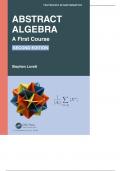
Abstract Algebra
A First Course, Second Edition
Stephen Lovett
https://www.routledge.com/Textbooks-in-Mathematics/book-series/
CANDHTEXBOOMTH

, Abstract Algebra
A First Course
Second Edition


Stephen Lovett
Wheaton College, USA

$27.49
Accede al documento completo:

100% de satisfacción garantizada
Inmediatamente disponible después del pago
Tanto en línea como en PDF
No estas atado a nada

Conoce al vendedor
Seller avatar
TESTBANKSPOOL001

Conoce al vendedor

Seller avatar
TESTBANKSPOOL001 Princeton University
Seguir Necesitas iniciar sesión para seguir a otros usuarios o asignaturas
Vendido
0
Miembro desde
1 año
Número de seguidores
0
Documentos
78
Última venta
-

0.0

0 reseñas

5
0
4
0
3
0
2
0
1
0

Recientemente visto por ti

Por qué los estudiantes eligen Stuvia

Creado por compañeros estudiantes, verificado por reseñas

Calidad en la que puedes confiar: escrito por estudiantes que aprobaron y evaluado por otros que han usado estos resúmenes.

¿No estás satisfecho? Elige otro documento

¡No te preocupes! Puedes elegir directamente otro documento que se ajuste mejor a lo que buscas.

Paga como quieras, empieza a estudiar al instante

Sin suscripción, sin compromisos. Paga como estés acostumbrado con tarjeta de crédito y descarga tu documento PDF inmediatamente.

Student with book image

“Comprado, descargado y aprobado. Así de fácil puede ser.”

Alisha Student

Preguntas frecuentes
