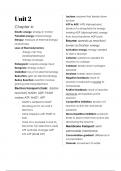
Unit 2
Lactase: enzyme that breaks down
lactose
ATP to ADP: ATP( triphosphate)
Chapter 4: breaks of a phosphate for energy
Kinetic energy: energy in motion making ADP (diphosphate), energy
Potential energy: stored energy from food transforms ADP back
Entropy: measure of thermal energy/ Enzyme: speeds up reaction/
randomness
lowers activation energy
Laws of thermodynamics
Activation energy: energy needed
- Energy can’t be
to start a reaction
created/destroyed
Cofactor: substance needed for
- Entropy increases
reaction to catalyze
Endergonic: requires energy input
Catalase: breaks down hydrogen
Exergonic: energy output
peroxide
Oxidation: loss of an electron/energy
Amylase: breaks down starch
Reduction: gain an electron/energy
Negative feedback: result of
Redox Reaction: reaction involves
reaction is reduced to reverse to
gaining and losing electrons
homeostasis
Electron transport chain: (redox
Positive feedback: result of reaction
reaction) NADH, ADP, FADH reinforces and speeds up the
makes ATP, NAD*, ATP reaction
- NADH is oxidized to NAD* Competitive inhibition: product of
donating an H+ ion and 2 reaction active site and blocks
electrons substrate
- same happens with FADH to Noncompetitive inhibition: products
FAD binds to place other than active site,
- more H+ is pumped in and O2 denaturing the enzyme
becomes H2O (electrons used) Membrane transport: semi
- ATP synthase changes ADP permeable membrane
into ATP (20-28 ATP)
Concentration gradient: difference in
concentration
Osmosis: movement of water
Lactase: enzyme that breaks down
lactose
ATP to ADP: ATP( triphosphate)
Chapter 4: breaks of a phosphate for energy
Kinetic energy: energy in motion making ADP (diphosphate), energy
Potential energy: stored energy from food transforms ADP back
Entropy: measure of thermal energy/ Enzyme: speeds up reaction/
randomness
lowers activation energy
Laws of thermodynamics
Activation energy: energy needed
- Energy can’t be
to start a reaction
created/destroyed
Cofactor: substance needed for
- Entropy increases
reaction to catalyze
Endergonic: requires energy input
Catalase: breaks down hydrogen
Exergonic: energy output
peroxide
Oxidation: loss of an electron/energy
Amylase: breaks down starch
Reduction: gain an electron/energy
Negative feedback: result of
Redox Reaction: reaction involves
reaction is reduced to reverse to
gaining and losing electrons
homeostasis
Electron transport chain: (redox
Positive feedback: result of reaction
reaction) NADH, ADP, FADH reinforces and speeds up the
makes ATP, NAD*, ATP reaction
- NADH is oxidized to NAD* Competitive inhibition: product of
donating an H+ ion and 2 reaction active site and blocks
electrons substrate
- same happens with FADH to Noncompetitive inhibition: products
FAD binds to place other than active site,
- more H+ is pumped in and O2 denaturing the enzyme
becomes H2O (electrons used) Membrane transport: semi
- ATP synthase changes ADP permeable membrane
into ATP (20-28 ATP)
Concentration gradient: difference in
concentration
Osmosis: movement of water