HISTORY FINAL EXAM P2
TOPIC 2: Independent Africa.
TOPIC 6: The end of the Cold War and a new world order: 1989 to the present.
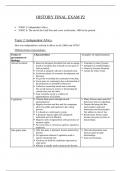
Topic 2: Independent Africa
How was independence realised in Africa in the 1960s and 1970s?
Different forms of government:
Forms of Characteristics Examples of implementation
government or
ideology
African Socialism Based on European Socialism but sold as unique Tanzania by Julius Nyerere.
brand of socialism that is based on true spirit of Senegal by Leopold Senghor.
African beliefs. Ghana by Kwame Nkrumah.
Viewed as uniquely African in localised sense. Guinea by Sekou Toure.
In between phase of economic development and
Marxism.
No private ownership but communal ownership.
Focus more on community than a dictatorship of
the proletariat as intended by Marxism.
Collective ownership meant state ownership.
Nio social classes in society or dictatorship by
certain class over the other.
State would be run by a coalition of
representatives of all tribes.
Capitalism Citizens share power through elected Many African states opted for
representatives. democracy but not capitalism.
Regular elections and free and fair campaigns Despite declaring this this,
allow for public participation in the voting many leaders respected
process. democracy and its principles.
It is based on a multi-party system. Not adhere to rules of law.
It promotes human rights and safeguards Result many African states
individual and civil liberties. became one-party systems or
Majority rules recognised but with protection of dictatorships.
minority rights.
No social class is viewed as superior; equality is
respected.
One-party state Only one party is tolerated. System enforced by After decolonisation most
dictator. African states became
No opposition allowed. Legislation used to dictatorships.
enforce dictatorial rule. Zaire and Tanzania.
Elections are held but candidates represent by
same party.
Military is usually used to prop up the dictator.
,How did the newly independent states in Africa meet political, economic and social
challenges? (1960 to 1980):
Congo Details
Ethnic division and Colonialism had divided people along ethnic and tribal lines.
tribalism Different ethnic groups were scattered over more than one state,
Congo, Rwanda, Burundi. Map of Africa had been redrawn.
Divisions persisted during Cold War when different groups aligned
themselves with opposing political blocs.
Some African leaders, Lumumba wanted to forge a new national
identity and eradicated ethical division.
Mobuto Sese Seko forged national unity though his despotic rule
after Lumumba was killed.
Fairly sophisticated civil These collapsed after independence. The local African population
service and infrastructure. had not been educated or trained to take on administrative and
technical functions. Colonial withdrawal left a technical vacuum.
The strategy to develop peasant agriculture and greater gov
intervention in industrial development to grow employment
opportunities was hampered due to lack of expertise.
Financial grants had been squandered due to poor and inadequate
controls.
Nature of colonialism Dependent mainly on mining in certain areas leaving many regions
industry under-developed and poverty stricken.
Economy of Congo became reliant on exports of cheaper raw
materials and imported more expensive manufactured goods.
Congo remained trapped and leader did not govern efficiently or
innovatively after independence.
Tanzania Details
Lack of technical and Colonial officials withdrew rapidly leaving a vacuum.
administrative capacity Little training was done to educate Africans for their new roles in
government.
Uneven development: Nyerere tried to force the population to move back to the rural areas
rural and urban areas. and to develop communal villages there to eradicate poverty.
His policy of villagisation was rejected and resulted in more
poverty for his people.
Foreign policy of non- Country remained dependent on foreign capitals for its
alignment adopted. development.
Debt hindered development.
It began links with the Eastern bloc, China helped construct the
TANZAM railway line.
, Case study: The Congo/Zaire and Tanganyika/Tanzania.
Political instability and stability:
Congo
Ethnic rivalry, Ideological differences between leaders: Kasavubu and Lumamba.
tension and Congolese elites had different ambitions: federalists vs Unitarians, regionalists
uncertainty. and nationalists.
Secessionist gained supports from Belgium business to break away –
instability and war.
Deaths and anarchy in many areas.
Soviet forces, CIA, a UN force, mercenaries and Belgian and French soldiers
made situation more complex to solve.
Murder of Lumumba and death of UN secretary general Dag Hammarskjold.
Made it worse.
1965 semblance of stability returned with Mobutu Sese Seko seized power.
Gained support of same western nations and ally against Eastern bloc, Est a
one-party dictatorship that lasted for 30 years.
West tolerated Sese Seko despite dictatorship regime and corruption.
Not really stable but dictatorial suppression of all opposition.
Tanzania
Smooth transition to Period of self-government seemed to smooth over initial problems to some
independence. extent.
Ujamaa seemed more appropriate to Tanzanian’s way of life.
Their centralised government brought stability initially. No civil war.
1964: Tanzania and Zanzibar united as a republic, Nyerere as president and
Karume as vice-president.
The two countries only really united under Nwinyi in 1985.
States that emerged after independence:
State Leader
Type of state
Congo Mobutu
Centralised.
Sese Unitary (opposite of democracy)
Seko Military regime/dictatorship.
One-party rule.
The state assumed a guardian role and restored to forceful maintenance
of law and order.
Mobutuism emerged: cult figure that uses state power to prob up his
power.
More interested in building an authoritarian state than a unite nation.
Consolidated, national identity was not achieved.
Tanzania Julius A single-party state.
Nyerere Socialist ideology
Aimed to mobilise all Tanzanians to help build a nation.
He succeeded in overcoming ethnic differences to establish a united
Tanzania.
Elections were held to choose the best individual but only one party,
Tanganyika African National Union (TANU) existed.
Nyerere became president for life.
Economic challenges.
TOPIC 2: Independent Africa.
TOPIC 6: The end of the Cold War and a new world order: 1989 to the present.
Topic 2: Independent Africa
How was independence realised in Africa in the 1960s and 1970s?
Different forms of government:
Forms of Characteristics Examples of implementation
government or
ideology
African Socialism Based on European Socialism but sold as unique Tanzania by Julius Nyerere.
brand of socialism that is based on true spirit of Senegal by Leopold Senghor.
African beliefs. Ghana by Kwame Nkrumah.
Viewed as uniquely African in localised sense. Guinea by Sekou Toure.
In between phase of economic development and
Marxism.
No private ownership but communal ownership.
Focus more on community than a dictatorship of
the proletariat as intended by Marxism.
Collective ownership meant state ownership.
Nio social classes in society or dictatorship by
certain class over the other.
State would be run by a coalition of
representatives of all tribes.
Capitalism Citizens share power through elected Many African states opted for
representatives. democracy but not capitalism.
Regular elections and free and fair campaigns Despite declaring this this,
allow for public participation in the voting many leaders respected
process. democracy and its principles.
It is based on a multi-party system. Not adhere to rules of law.
It promotes human rights and safeguards Result many African states
individual and civil liberties. became one-party systems or
Majority rules recognised but with protection of dictatorships.
minority rights.
No social class is viewed as superior; equality is
respected.
One-party state Only one party is tolerated. System enforced by After decolonisation most
dictator. African states became
No opposition allowed. Legislation used to dictatorships.
enforce dictatorial rule. Zaire and Tanzania.
Elections are held but candidates represent by
same party.
Military is usually used to prop up the dictator.
,How did the newly independent states in Africa meet political, economic and social
challenges? (1960 to 1980):
Congo Details
Ethnic division and Colonialism had divided people along ethnic and tribal lines.
tribalism Different ethnic groups were scattered over more than one state,
Congo, Rwanda, Burundi. Map of Africa had been redrawn.
Divisions persisted during Cold War when different groups aligned
themselves with opposing political blocs.
Some African leaders, Lumumba wanted to forge a new national
identity and eradicated ethical division.
Mobuto Sese Seko forged national unity though his despotic rule
after Lumumba was killed.
Fairly sophisticated civil These collapsed after independence. The local African population
service and infrastructure. had not been educated or trained to take on administrative and
technical functions. Colonial withdrawal left a technical vacuum.
The strategy to develop peasant agriculture and greater gov
intervention in industrial development to grow employment
opportunities was hampered due to lack of expertise.
Financial grants had been squandered due to poor and inadequate
controls.
Nature of colonialism Dependent mainly on mining in certain areas leaving many regions
industry under-developed and poverty stricken.
Economy of Congo became reliant on exports of cheaper raw
materials and imported more expensive manufactured goods.
Congo remained trapped and leader did not govern efficiently or
innovatively after independence.
Tanzania Details
Lack of technical and Colonial officials withdrew rapidly leaving a vacuum.
administrative capacity Little training was done to educate Africans for their new roles in
government.
Uneven development: Nyerere tried to force the population to move back to the rural areas
rural and urban areas. and to develop communal villages there to eradicate poverty.
His policy of villagisation was rejected and resulted in more
poverty for his people.
Foreign policy of non- Country remained dependent on foreign capitals for its
alignment adopted. development.
Debt hindered development.
It began links with the Eastern bloc, China helped construct the
TANZAM railway line.
, Case study: The Congo/Zaire and Tanganyika/Tanzania.
Political instability and stability:
Congo
Ethnic rivalry, Ideological differences between leaders: Kasavubu and Lumamba.
tension and Congolese elites had different ambitions: federalists vs Unitarians, regionalists
uncertainty. and nationalists.
Secessionist gained supports from Belgium business to break away –
instability and war.
Deaths and anarchy in many areas.
Soviet forces, CIA, a UN force, mercenaries and Belgian and French soldiers
made situation more complex to solve.
Murder of Lumumba and death of UN secretary general Dag Hammarskjold.
Made it worse.
1965 semblance of stability returned with Mobutu Sese Seko seized power.
Gained support of same western nations and ally against Eastern bloc, Est a
one-party dictatorship that lasted for 30 years.
West tolerated Sese Seko despite dictatorship regime and corruption.
Not really stable but dictatorial suppression of all opposition.
Tanzania
Smooth transition to Period of self-government seemed to smooth over initial problems to some
independence. extent.
Ujamaa seemed more appropriate to Tanzanian’s way of life.
Their centralised government brought stability initially. No civil war.
1964: Tanzania and Zanzibar united as a republic, Nyerere as president and
Karume as vice-president.
The two countries only really united under Nwinyi in 1985.
States that emerged after independence:
State Leader
Type of state
Congo Mobutu
Centralised.
Sese Unitary (opposite of democracy)
Seko Military regime/dictatorship.
One-party rule.
The state assumed a guardian role and restored to forceful maintenance
of law and order.
Mobutuism emerged: cult figure that uses state power to prob up his
power.
More interested in building an authoritarian state than a unite nation.
Consolidated, national identity was not achieved.
Tanzania Julius A single-party state.
Nyerere Socialist ideology
Aimed to mobilise all Tanzanians to help build a nation.
He succeeded in overcoming ethnic differences to establish a united
Tanzania.
Elections were held to choose the best individual but only one party,
Tanganyika African National Union (TANU) existed.
Nyerere became president for life.
Economic challenges.