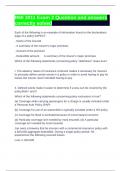
RMI 3011 Exam 2 Question and answers
correctly solved
Each of the following is an example of information found on the declarations
page of a policy EXPECT:
- Name of the insured
- A summary of the insurer's major promises
- Amount of the premium
- Deductible amount A summary of the insurer's major promises
Which of the following statements concerning policy "definitions" is/are true?
I. The aleatory nature of insurance contracts makes it necessary for insurers
to precisely define certain words in a policy in order to avoid having to pay for
losses the insurer never intended having to pay.
II. Defined words make it easier to determine if a loss can be covered by the
policy Both I and II
Which of the following statements concerning policy exclusions is true?
(a) Coverage while carrying passengers for a charge is usually included under
a Personal Auto Policy (PAP)
(b) Coverage for use of an automobile is typically included under a HO policy
(c) Coverage for flood is excluded because of moral hazard concerns
(d) Particular coverage isn't needed by most insureds (d) A particular
coverage isn't needed by most insureds
Joe owns a brewery that he insurers with a commercial insurance policy with
a $20,000 aggregate deductible. During a single policy period, He
experiences the following covered losses.
Loss 1: $10,000
, Loss 2: $6,000
Loss 3: $7,000
How much will Joe's insurer pay Joe for Loss 3?$3,000
Which of the following statements concerning the coinsurance clause of a
property insurance policy is/are true?
I. The coinsurance clause only applies to partial losses, not total losses
II. The fundamental purpose of coinsurance is to achieve rating equity Both I
and II
When each insurance policy applicable to a loss only pays its share of the
loss based on its proportion of the total available insurance coverage, it is an
example of:
(a) Primary and excess insurance
(b) Pro rata liability
(c) contribution by equal shares
(d) all of the above (b) Pro rata liability
Which of the following statements is/are true?
I. Other-insurance provisions apply to the payment of losses when more than
one policy provides coverage for the same loss
II. Other-insurance provisions are an exception to the principle of indemnity
I only
_______ impose certain requirements on an insured before they are able to
receive payment for a covered loss.
(a) Declarations
(b) Insuring agreement
correctly solved
Each of the following is an example of information found on the declarations
page of a policy EXPECT:
- Name of the insured
- A summary of the insurer's major promises
- Amount of the premium
- Deductible amount A summary of the insurer's major promises
Which of the following statements concerning policy "definitions" is/are true?
I. The aleatory nature of insurance contracts makes it necessary for insurers
to precisely define certain words in a policy in order to avoid having to pay for
losses the insurer never intended having to pay.
II. Defined words make it easier to determine if a loss can be covered by the
policy Both I and II
Which of the following statements concerning policy exclusions is true?
(a) Coverage while carrying passengers for a charge is usually included under
a Personal Auto Policy (PAP)
(b) Coverage for use of an automobile is typically included under a HO policy
(c) Coverage for flood is excluded because of moral hazard concerns
(d) Particular coverage isn't needed by most insureds (d) A particular
coverage isn't needed by most insureds
Joe owns a brewery that he insurers with a commercial insurance policy with
a $20,000 aggregate deductible. During a single policy period, He
experiences the following covered losses.
Loss 1: $10,000
, Loss 2: $6,000
Loss 3: $7,000
How much will Joe's insurer pay Joe for Loss 3?$3,000
Which of the following statements concerning the coinsurance clause of a
property insurance policy is/are true?
I. The coinsurance clause only applies to partial losses, not total losses
II. The fundamental purpose of coinsurance is to achieve rating equity Both I
and II
When each insurance policy applicable to a loss only pays its share of the
loss based on its proportion of the total available insurance coverage, it is an
example of:
(a) Primary and excess insurance
(b) Pro rata liability
(c) contribution by equal shares
(d) all of the above (b) Pro rata liability
Which of the following statements is/are true?
I. Other-insurance provisions apply to the payment of losses when more than
one policy provides coverage for the same loss
II. Other-insurance provisions are an exception to the principle of indemnity
I only
_______ impose certain requirements on an insured before they are able to
receive payment for a covered loss.
(a) Declarations
(b) Insuring agreement