Memory
Short and Long Term Memory
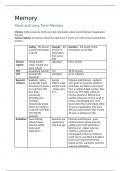
Memory is the process by which we retain information about events that have happened in
the past
Sensory register are memory stores for each of our 5 senses e.g. vision (iconic) and hearing
(echoic)
Coding – the format Capacity – the Duration – the length of time
in which information amount of information can be held
is stored information
that can be
held
Sensory Modal specific - Unlimited Half a second
register echoic (sound) and
iconic (visual)
STM Acoustically (sound) 7±2 18-30 seconds
LTM Semantically Unlimited Up to a lifetime
(meaning)
Research Baddeley - letters George Peterson and Peterson - students
evidence acoustically similar Miller's magic were given a consonant syllable to
(rhyming) are harder number study remember and told to count down
to recall from STM - things come from a random 3 digit number. They
than those in 7s found our STM fades unless we
acoustically mental rehearse it. Bahrick et al. -
dissimilar (non- studied Americans on their recall of
rhyming). names of graduating class. They
Semantically similar found when they were tested within
letters are harder to 15 years of graduation, they were
recall from LTM than 90% accurate however after around
semantically 50 years, it declined to 70%.
dissimilar
Evaluation Used artificial Research was Peterson and Peterson - used
stimuli, lacked conducted a artificial stimuli, lacked external
external validity long time ago validity (real-world application)
(real-world Bahrick et al. - higher external
application) validity as used semantic
(meaningful) memories. However
could not be controlled as he didn't
know how frequently they had
looked at their yearbooks. And only
used one nationality.
, Multi Store Model of Memory
Atkinson & Shiffrin
“Explain the multi store model of memory” (6 marks)
Information is received from the 5 senses (1). It Is stored in the sensory memory until
attention is paid to it (2). If attention isn't paid to it, the information decays (3). When
attention is paid, it transfers the information to the STM. (3) Here, maintenance rehearsal
takes place (4). Elaborative rehearsal then transfers information to the LTM (5). To retrieve
the information, it must pass back through the STM before it is remembered (6).
Evaluation
A strength of the multi-store memory model is support from studies showing that
STM and LTM have different stores. For example, the case of HM and Clive Wearing
showed that one memory store can be affected whilst one can be intact.
MRI scans show which parts of the brain are being used when different tasks are
being carried out. These findings back up the existence of different stores for
different memories.
Short and Long Term Memory
Memory is the process by which we retain information about events that have happened in
the past
Sensory register are memory stores for each of our 5 senses e.g. vision (iconic) and hearing
(echoic)
Coding – the format Capacity – the Duration – the length of time
in which information amount of information can be held
is stored information
that can be
held
Sensory Modal specific - Unlimited Half a second
register echoic (sound) and
iconic (visual)
STM Acoustically (sound) 7±2 18-30 seconds
LTM Semantically Unlimited Up to a lifetime
(meaning)
Research Baddeley - letters George Peterson and Peterson - students
evidence acoustically similar Miller's magic were given a consonant syllable to
(rhyming) are harder number study remember and told to count down
to recall from STM - things come from a random 3 digit number. They
than those in 7s found our STM fades unless we
acoustically mental rehearse it. Bahrick et al. -
dissimilar (non- studied Americans on their recall of
rhyming). names of graduating class. They
Semantically similar found when they were tested within
letters are harder to 15 years of graduation, they were
recall from LTM than 90% accurate however after around
semantically 50 years, it declined to 70%.
dissimilar
Evaluation Used artificial Research was Peterson and Peterson - used
stimuli, lacked conducted a artificial stimuli, lacked external
external validity long time ago validity (real-world application)
(real-world Bahrick et al. - higher external
application) validity as used semantic
(meaningful) memories. However
could not be controlled as he didn't
know how frequently they had
looked at their yearbooks. And only
used one nationality.
, Multi Store Model of Memory
Atkinson & Shiffrin
“Explain the multi store model of memory” (6 marks)
Information is received from the 5 senses (1). It Is stored in the sensory memory until
attention is paid to it (2). If attention isn't paid to it, the information decays (3). When
attention is paid, it transfers the information to the STM. (3) Here, maintenance rehearsal
takes place (4). Elaborative rehearsal then transfers information to the LTM (5). To retrieve
the information, it must pass back through the STM before it is remembered (6).
Evaluation
A strength of the multi-store memory model is support from studies showing that
STM and LTM have different stores. For example, the case of HM and Clive Wearing
showed that one memory store can be affected whilst one can be intact.
MRI scans show which parts of the brain are being used when different tasks are
being carried out. These findings back up the existence of different stores for
different memories.