Introduction to management
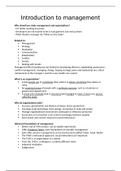
Why should we study management and organisations?
- For better working processes
- Developers are not trained to be in management, but end up there
- What should a manager do? What are the tasks?
Related to:
Management
Strategy
Motivation
Communication
Stakeholders
Conflict
Society
Dealing with trends
Managerial skills (including but not limited to developing alliances, negotiating, governance,
conflict management, managing change, forging strategic plans and leadership) are critical
components of the manager’s tool kit in any health care system
What is an organization?
A tool people use to coordinate their actions to obtain something they desire or
value.
An organized group of people with a particular purpose, such as a business or
government department
A social unit of people that is structured and manged to meet a need or to pursue
collective goals.
Why do organizations exist?
Increase specialization and division of labour (more productive)
Use large-scale technology (cost savings, economies of scale and scope)
Manage organizational environment (anticipate or influence pressures)
Economize on transaction costs (control exchanges between people)
Exert power and control (reward or punish behaviour)
Historical foundations of management
Before end of 19th century: not an explicit topic/study
1886: Frederick Taylor: early foundations of scientific management
Early 20th century: management can be learned and codified Taylor, Fayol, Weber
The 1940’s: behavioral approach, social interactions are important
The 1950’s: an organization is a system
From the 1950’s: contingency, combine different views
Industrial revolution
Enlightment
, The classical approach: Weber and Bureaucracy
Terwijl Taylor gericht is op de productie van bedrijven en Fayol op het management in het
algemeen, was Max Weber (1864-1920) bezig met het bestuderen van overheidsinstellingen
en grote bedrijven vanuit een sociologisch perspectief. Deze ' ideale bureaucratie ' is niet
alleen een beschrijving van een organisatie, maar ook een theoretisch model dat is nuttig is
in de studie van organisaties.
Bureaucracy = efficiency
Management = control
Higher degree of formalization and codification
Four main features:
- Hierarchy of authority
- Specialization and division of labour
- System of rules (standardisation)
- Impersonality
The classical approach: Taylor and scientific management
Frederick Taylor was de eerste die een systematische, coherente aanpak suggereerde om te
bepalen op welke wijze de fabrieken moesten worden georganiseerd . De manager moest
zich richten op de planning, de coördinatie en moest het toezicht hebben op de resultaten
en moest de controle daar ook over hebben.
- Explicit emphasis of the control element of bureaucracy
- Three major assumptions:
1. Management must plan and control the labour process
2. Management must supervise: people don’t want to work
3. Management must determine the best methods
The classical approach: Fayol and administrative management
In Europa was het Henry Fayol (1841-1925) die voor het eerst een samenhangend geheel
van richtsnoeren met betrekking tot de wijze waarop organisaties hun activiteiten als geheel
zou kunnen beheren ontwikkelde. Zijn algemene management theorie was bedoeld als een
educatief model. Voor Fayol was eenheid van bevel het belangrijkste principe. Zijn erfenis
bestaat uit het feit dat er tegenwoordig meer aandacht wordt besteed aan de taken van
managers.
General principles of management:
Why should we study management and organisations?
- For better working processes
- Developers are not trained to be in management, but end up there
- What should a manager do? What are the tasks?
Related to:
Management
Strategy
Motivation
Communication
Stakeholders
Conflict
Society
Dealing with trends
Managerial skills (including but not limited to developing alliances, negotiating, governance,
conflict management, managing change, forging strategic plans and leadership) are critical
components of the manager’s tool kit in any health care system
What is an organization?
A tool people use to coordinate their actions to obtain something they desire or
value.
An organized group of people with a particular purpose, such as a business or
government department
A social unit of people that is structured and manged to meet a need or to pursue
collective goals.
Why do organizations exist?
Increase specialization and division of labour (more productive)
Use large-scale technology (cost savings, economies of scale and scope)
Manage organizational environment (anticipate or influence pressures)
Economize on transaction costs (control exchanges between people)
Exert power and control (reward or punish behaviour)
Historical foundations of management
Before end of 19th century: not an explicit topic/study
1886: Frederick Taylor: early foundations of scientific management
Early 20th century: management can be learned and codified Taylor, Fayol, Weber
The 1940’s: behavioral approach, social interactions are important
The 1950’s: an organization is a system
From the 1950’s: contingency, combine different views
Industrial revolution
Enlightment
, The classical approach: Weber and Bureaucracy
Terwijl Taylor gericht is op de productie van bedrijven en Fayol op het management in het
algemeen, was Max Weber (1864-1920) bezig met het bestuderen van overheidsinstellingen
en grote bedrijven vanuit een sociologisch perspectief. Deze ' ideale bureaucratie ' is niet
alleen een beschrijving van een organisatie, maar ook een theoretisch model dat is nuttig is
in de studie van organisaties.
Bureaucracy = efficiency
Management = control
Higher degree of formalization and codification
Four main features:
- Hierarchy of authority
- Specialization and division of labour
- System of rules (standardisation)
- Impersonality
The classical approach: Taylor and scientific management
Frederick Taylor was de eerste die een systematische, coherente aanpak suggereerde om te
bepalen op welke wijze de fabrieken moesten worden georganiseerd . De manager moest
zich richten op de planning, de coördinatie en moest het toezicht hebben op de resultaten
en moest de controle daar ook over hebben.
- Explicit emphasis of the control element of bureaucracy
- Three major assumptions:
1. Management must plan and control the labour process
2. Management must supervise: people don’t want to work
3. Management must determine the best methods
The classical approach: Fayol and administrative management
In Europa was het Henry Fayol (1841-1925) die voor het eerst een samenhangend geheel
van richtsnoeren met betrekking tot de wijze waarop organisaties hun activiteiten als geheel
zou kunnen beheren ontwikkelde. Zijn algemene management theorie was bedoeld als een
educatief model. Voor Fayol was eenheid van bevel het belangrijkste principe. Zijn erfenis
bestaat uit het feit dat er tegenwoordig meer aandacht wordt besteed aan de taken van
managers.
General principles of management: